Showing posts with label Lovecraft. Show all posts

Sunday, October 27, 2013

Tommy's Take on tremulus playbooks I-III and cemetery expansion


tremulus was finally released recently, and you should totally run out and buy it. However, a number of expansions have also been released...such as three playbook sets and a cemetery expansion. What do those contain and are they worth your dough?

tremulus playbook set I: flexible thinkers

WHAT YOU SHOULD KNOW: This $5 PDF was free to Kickstarter backers above a certain level, and includes 5 new playbooks for your players to use:

The Adventurer - A man of action, whose Moves can give him options like constant Armor, bonus damage to attacks and acting using his Passion instead of his Reason (because he's a man of instinct and not book-smarts).

The Entertainer - An actor, musician, singer, dancer, what have you. The Entertainer may be wealthy and famous, or have a gift for manipulating other people. The one Entertainer we've seen in our games proved incredibly light on his feet, which was a huge boon for him.

The Handyman - A fixer. He may have a workshop that he builds things with, he can jury rig repairs and one Move humorously duplicates the idea of smacking something to make it work.

The Librarian - A thinker who can occasionally use their wits to their advantage in combat.

The Scientist - Generally far more reasonable than most, insulating them from mental distress...though one option makes The Scientist harder to relate to, but allows them to start with Lore points.

WHAT WORKS: A few nice, thematic options that stretch the field. Some of the Playbook tweaks make it even easier to get the end result you want, like a purely "rational" scientist versus one that's becoming a little more unhinged. The Handyman is another one that stands out.

WHAT DOESN'T WORK: On one hand, The Entertainer seems to stand out more than the others (as being out of place here). On the other, it's the only one we've used thus far. If the aesthetics of tremulus didn't do it for you, then the hard to see, old-timey images in this set won't do you any favors, either.

CONCLUSION: The Adventurer, Librarian and Scientist all seem very suited for period Lovecraftian adventurer. $1 per playbook also seems to be a bit better than similar deals for similar games, though I haven't looked too closely. Good pick-up if you want some options just a step away from the standard playbooks.

tremulus playbook set II: on the fringes

WHAT YOU SHOULD KNOW: Same as above - $5 package of playbooks to expand your game, running the fine line of "acceptable society":

The Artist - Passion drives most of what the Artist does, and this can leave them vulnerable to shock, or make them off-putting to others.

The Criminal - Not generally a thug, the Criminal's Lore move allows them to formulate a Backup Plan, and other moves provide options like being sneaky or charming.

The Dreamer - No, this isn't just someone with their head in the clouds...The Dreamer can reach the actual Dreamlands! This can provide valuable insight at times.

The Drifter - A bonafide ramblin' man, who sometimes gets by on Luck as much as anything. Additionally, your Drifter may have witnessed a bit more in his day than most.

The Psychic - Full-blown having visions and communing with the spirit world.

WHAT WORKS: Some very oddball options for tremulus, stretching the boundaries further. We've used Drifter and Psychic both in play, so these are options proving popular over here.

WHAT DOESN'T WORK: The Psychic communing with spirits can get out of hand at times, and I would imagine from the reading that The Dreamer could get that way as well.

CONCLUSION: If you want more weirdness from your PCs in tremulus, this is a good step as especially The Dreamer and The Psychic are particularly oddball. Just watch out for them spending too much time using their Moves (which aren't even Lore moves, but which do have time constraints on them) as they can blow some of your mystery right off.

tremulus playbook set III: madmen

WHAT YOU SHOULD KNOW: Have you noticed a trend developing here? These entries have been a steady walk off the deep end, and the Madmen make the last set look normal.

The Chosen - No, not quite Buffy, or even Ash. The Chosen can be downright bizarre, perhaps touched by darkness in such a way that they now see in the dark or even breathe underwater.

The Escapee - You've lost your mind once, but you know there's crazy stuff out there. You may be hunted by the very things that led to your imprisonment, but you are powered by a desperate will now.

The Inventor - The Scientist and The Handyman pumped up to 11. More Frankenstein than Einstein.

The Sorcerer - You have a handful of magical effects on standby, and are more adept than most at casting rituals.

The Veteran - You experienced the horrors of war, but occasionally you still find glimpses of the man you once were, and unleash him against the darkness.

WHAT WORKS: One of the more unique sets (and the sets are usually pretty impressive). I particularly like the portrayals of The Veteran and The Escapee.

WHAT DOESN'T WORK: Not a lot. I like the balance on The Inventor and Sorcerer more than I do The Dreamer and The Psychic, and the character options are among the most interesting.

CONCLUSION: If I were a player, I think I'd probably play The Veteran first and foremost above all of them, though The Escapee runs a close second. Probably my two favorite options among all the playbooks.

the cemetery (Ebon Eaves Expansion I)

WHAT YOU SHOULD KNOW: This expansion is a little different than the others, running $10 instead of $5. On top of that, it only includes three Playbooks:

The Bereaved - Someone in mourning, needing a shoulder to lean on. Definitely NOT one to play in a one-on-one game, as a few of their moves rely on other people being present...namely, gaining Trust with others and using their Lore moves.

The Grave Digger - You can pick Moves that make him a perfectly nice guy...or you can make him a scuzzy graverobber instead.

The Mortician - Somebody's gotta prepare the bodies. The Mortician comforts folks who have just suffered tragedy, which can come in handy in a horror game.

So if it's $10 and only has three playbooks, what's the deal? The deal is that it adds more info based off of the Town Lore questions at the beginning of the game, effectively blowing up the information combinations by adding a whole other set of mysteries to the town (all kinda cemetery based).

WHAT WORKS: A slew of new options for town generation. Three new playbooks, each of which are interesting and unique in their own way, yet still tied to the cemetery setting.

WHAT DOESN'T WORK: The minor complaint that the cemetery results are tied to the Town Lore, so those results will be bound together regardless (though there are soooo many possible results that this becomes a very minor quibble).

CONCLUSION: Well worth it if you're looking for more than just a one shot game, as a third plot thread should get you rolling nicely. If you're just in it for the playbooks, though, that price tag might be a tad steep.


Monday, September 30, 2013

tremulus Actual Play: The Hatchetman and the Silver Saints


We decided to give tremulus another go, with the new group of Russ, Chrystal, Tommy (who plays in most of my Savage Worlds games) and myself. Unlike the last time we played tremulus, we had extra Playbooks to choose from and more players, so this left us with a motley crew of Russ as an Entertainer named Frank Stone (and a bodyguard named Sheffield), Chrystal as a Psychic named Eliza Dent (and her driver Chauncey) and Tommy as a Drifter named Ramblin' Tom.

I was actually pretty ill prepared going in, so we started the session with Ramblin' Tom walking into town and being passed by Eliza and Chauncey...while a distracted Frank Stone ran off the road and clipped the Drifter, who chose (after rolling a 7-9) to take a little extra damage but force Stone to blow a tire and hit a tree. This led to Frank being a little shaken up and Tom hurting a bit, but Tom gathered his wits and put Frank in a bind, essentially blackmailing Frank into taking care of him, once Tom and Sheffield took care of the car tire.

Eliza and Chauncey checked into their hotel, which was a spacious, two story affair. As Eliza and Chauncey went to their room, Eliza noticed a younger man wearing a silver star pendant watching her. She smiled at him, but he turned his head away. When she and Chauncey got to the room, she decided to relax and commune with the spirits to see what she could see.

Back at the car, while looking for the spare, Ramblin' Tom noticed that the driver of the car (Frank) had some headshots in his trunk...making Tom realize that the driver was an actor or model or something, and this gave Tom a bit more leverage. He also saw a curious silver star pendant in the trunk of the car, which he pocketed. The three men piled back into the car and headed into Ebon Eaves.

Eliza had a vision of dozens and dozens of townsfolk, including the young man that was watching her, forming an angry mob while a demonic face loomed over them.

Frank Stone, Sheffield and Ramblin' Tom headed to the hotel, where Frank discovered there was only one available room...so he used charm and money to get people kicked out of their rooms while he and Sheffield took Tom to get some food (as part of their deal for, y'know, nearly killing him). The service in the diner was much nicer, friendlier and more competent than the hotel. The three men were just starting to maybe get along when a tall, silver-haired man entered the diner, flanked by a short, nervous man and a stern-faced man with a milky white eye. The tall man was referred to as "Reverend", which caught the attention of Stone and Tom. Frank said he didn't like that white eye, so Sheffield got up and grabbed a knife, threatening to put it out, but Frank made him sit back down.

Eliza and Chauncey entered the diner and sat down, and Chauncey never took his eyes off of the Reverend and his entourage. As dinner went on, Frank didn't like the look of Chauncey and sent Sheffield over to Eliza and her driver to make sure there was no issue. This nearly escalated into violence as Chauncey told Sheffield to take two steps away from Eliza. Frank overhead the commotion and told Sheffield to back off, (and Tom was busy eating all of Sheffield's food while this was going on). As Frank gathered up Sheffield and Tom and headed to the door, they were cut off by the Reverend, who recognized Frank. He asked for an autograph for Martin's (the nervous man with the Reverend) son and the two men soon decided that they should have dinner together. Tom mentioned being both broke and injured, and the Reverend offered him medical care at the doctor's and work at the church the next day. Frank began to press The Reverend on the real reason he had come here: Ebon Eaves' legendary Hatchetman. Many years ago, a young man named Billy had gone insane and chopped up five of his friends before a sixth stopped him...and every five years, the murders started up again. As Frank pushed the Reverend on these legends, the Reverend shrugged it off.

Ramblin' Tom headed to the Doctor when he felt an overwhelming sense of being watched...and discovered that *everyone* on the street was watching him.

Frank returned to the hotel and sent Sheffield out to find some drugs, while he began pumping the old lady now working the counter for information about the Hatchetman.

Eliza and Chauncey, paranoid about the town, scoured their room for cameras...until Eliza spotted something on the window. The outside of the window. The word "Witch". Eliza contacted the Spirit World once more, getting a flash of an eyeless, oily skinned creature in an old rock quarry...and a flash from the future of a newspaper headline proclaiming that that anniversary of the Hatchetman had passed without incident.

Ramblin' Tom got his wounds dressed by the friendly Doctor who suddenly, as Tom was leaving, told him to "keep your nose clean or we'll f---ing kill you."

Frank got upset when the old woman told him the Hatchetman wasn't a ghost...but a curse on the town, which drives people insane every five years...and that the next Hatchetman would be coming soon.

Eliza and Chauncey decided to go for a walk, having a chat with the old woman, who seemed nice enough...except she said that the town was constantly poisoned by satanic outsiders, such as witches like Eliza. Frank and Tom decided to turn in to their respective rooms.

Frank was awoken by someone beating on his door and peered through the peep hole to see Sheffield...who drove a hatchet into the door! He smashed his way in and the terrified Frank Stone darted away from him and bolted through into Ramblin' Tom's room, waking him up as the crazed Sheffield burst in! Frank fired his handgun at Sheffield and wounded him, but the enraged bodyguard charged Tom and Frank, only to be taken by surprise by the Drifter, who managed to rip the axe from his hands and knock him into a door, accidentally breaking his neck! Frank immediately proclaimed victory for stopping the Hatchetman. A nervous back and forth ensued about who to call, with Tom pointing out that the Reverend runs this town, and Frank became optimistic that his friendship with the Reverend would help out.

Eliza and Chauncey tried to return to the hotel...only to find it bustling with activity, including four of the Reverend's Silver Saints blocking her entrance, calling her a "Witch". Chauncey threatened violence on the four men, but Eliza opted for a less violent approach and took Chauncey back to Meg's Diner, where she once more contacted the Spirit World.

The Reverend and his sidekicks, Martin and Robert, were relieved to see that Tom and Frank had stopped the Hatchetman without further bloodshed.

Eliza got a flash of an eyeless, oily being biting Sheffield and driving him into a rage...and Sheffield biting someone else and throwing them aside as he grabbed a hatchet from the man's truck and stomped to the hotel...leaving the wounded, enraged man to attack another bystander and so on...and that the creature is now dormant.

Outside the hotel, the Silver Saints guarding it were attacked.

Ramblin' Tom decided to cut out, only to look down the stares at the old woman from the counter, now quite crazed and charging up the stairs. He barely got away from her, but didn't get the door barred in time. Frank tried to block her entry himself...but failed as she nearly bit him, causing him to lunge away from the door.

Eliza began asking the gentleman in the diner about rock quarries, leading to her and Chauncey deciding to head to the quarry to put an end to this monster.

Frank scurried away...leading to woman attacking Martin and ripping a chunk out of him! She tossed him aside and lunged at Tom, who got away from her and never saw Martin lunging up and biting Robert! While Tom and the old woman fought, Frank opened fire...shooting Tom in the shoulder and making him drop his axe! The Reverend began fighting with Robert, and Frank opened fire on on Robert, giving the Reverend an opening to draw a knife from somewhere and drive it into Robert's skull! Frank was pleased...until Martin pounced on him and dragged him to the ground! Tom and the old woman fought, but he flipped her end over end and out the window! Frank shot Martin, stunning him so that the Reverend could move in and slice Martin's head off!

Eliza and Chauncey began to enter the quarry to execute the dormant monster, when bizarre, vaguely crablike fungal creatures ordered her and Chauncey to stop! They were surprised as these beings descended from the skies and said that they created the hunter to quell the Nightgaunts...and that killing it would doom the town. Eliza tried to debate them, pointing out that it was killing people, but the beings said that those were acceptable losses to keep the Nightgaunts under control. She and the creatures argued, until she finally ordered Chauncey to execute the sleeping hunter, which he did with a high powered rifle. The creatures recoiled, stating their belief that she had doomed the area to the swell of the Nightgaunts.

In the aftermath, the Silver Saints did a splendid job of quelling the uprising caused by the madness of the hunter's bite, and when Eliza confronted to the Reverend about his town's zealotry, to her surprise he agreed: He's been well aware of the rising darkness in the town and has been deathly afraid of his inability to quell it.

Notes: I totally did a horrible job of conveying the humor we had going on here, as Russ hammed it up as Frank Stone and I had a blast slipping back and forth between Chauncey and Sheffield. The tremulus system is a bit exhausting, as I'm not used to improvising *that much*. All the improv is why some things were set up and not paid off (like Tom finding a Silver Star in the trunk of Frank's car). That said, I have to give the group credit: This was the first time roleplaying with this configuration, the first time Chrystal had played a non-D&D game and the first time Russ had played a non-fantasy RPG and everyone slipped right in. They played like characters in a horror game, and took my bait as I laid it out there, running with little tidbits here and there to advance the plot, conveniently choosing the same hotel to stay at and diner to eat at, and so on. Ironic, then, that Eliza *never* directly interacted with the other two PCs.

This was also the first time using non-core Playbooks, as all the Playbooks used came from the tremulus Kickstarter stretch goals. The special moves came into play a LOT (especially Frank's ability to gain +2 while trying to Act Under Pressure in defensive situations, Tom's ability to roll Luck to lessen harm and Eliza contacting the Spirit World, which bordered on being awesome and gamebreaking).

A good time was had by all, the new group got off to a promising start, and next week we hit familiar territory for me and Tommy: Deadlands Reloaded!

Sunday, February 17, 2013

Tommy's Take on Achtung! Cthulhu - Zero Point Pt. 2: Heroes of the Sea


Previously, I reviewed Three Kings, the first Achtung! Cthulhu adventure. Now, it is time to take a look at the second adventure (Heroes of the Sea), in the wake of the new Achtung! Cthulhu Kickstarter, which is hoping to turn Achtung! Cthulhu from a series of adventures into a full-fledged setting. As with the last review, this review focuses exclusively on the Savage Worlds version.

WHAT YOU SHOULD KNOW: While the Achtung! Cthulhu adventures are also available in Call of Cthulhu and PDQ, I’m way more familiar with (and interested in) Savage Worlds, and so I’m focusing on that. The PDF is 63 pages at $14.99, and is meant to be ran after Three Kings, though it can also be ran completely standalone. As with Three Kings, you will want a copy of the Savage Worlds rules and Realms of Cthulhu.

As always, I will try to run light on spoilers, but that does get difficult, so be aware.

After the events of Three Kings, an undercover agent has gone missing shortly after uncovering a secret German project. It is up to the PCs to move in and try to figure out what has happened. If you think this is a cut and dried investigation, however, you clearly are not paying attention.

So now it’s 1940, the Allies are retreating from the Germans so they aren’t driven into the sea, and the PCs are having to find a missing intelligence agent in the embattled Dunkirk region. The opening of the adventure is a chaotic affair filled with all kinds of random encounters, including an encounter chart with options like booby traps, troops on sinking ships, dive bombers, criminal activity and more.

There are five “episodes” to the adventure, but the adventure professes that the “how” and “when” of each encounter is up to the PCs. Realistically, I don’t see a TON of variance in how the first couple of chapters play out, but I could be wrong.

The PCs should find the agent pretty early, though she is quite incapacitated. There are a couple of handy crazed notes that can be passed out to the PCs that ominously warn of things to come.

From there it does get a bit free flowing. There is potential for the PCs to travel into another dimension, where they can force an early encounter with the villain of the adventure, as well as catch a sneak peek at what the Nazis are up to. The grand finale is an epic confrontation in a raging storm while Allied Forces are retreating to boats en masse, only to face the end result of the Nazi plan (and fans of the Mythos probably have some idea what is coming). There are three likely outcomes included, one of which is a colossal failure for the PCs, one of which is a straight up victory, and one of which is very, very poetic.

When the smoke clears, there’s enough questions about what the Nazis are into, leading to the formation of a new branch of British intelligence designed to deal with just these things.

Four pregenerated characters are included, though ranks/XP aren’t listed. The Rules appendix adds a new skill that everyone gets at d4 (Dreaming), as well as a number of new Powers, many of which are utilized by the villains. For instance, Mindblast forces the target to roll a Guts check against the spellcasting roll or take 2d6 Mental Anguish AND suffer temporary insanity. Finally, rules are provided for trying to slip through a full on firefight.

Other appendices include new monsters and relevant vehicle stats for the adventure.

Several printable handouts are included, which can be used to give the scenario that extra punch.

An ad for Zero Point: Code of Honour, set in Constantinople, drops hints at the future of the campaign, as well as an ad plugging Weird War II, which has material that could be useful in a campaign like this.

The adventure does include a pair of alternate openings to the adventure, one of which casts the group as academics (archaelogists) whose explorations lead to them stumbling across the Nazi plot, and a second (very interesting) one, which features the PCs as German agents at odds with the SS!

WHAT WORKS: The adventure really is very flexible after the opening chapter or two, something I always appreciate. The gradual reveal of the Lovecraftian elements in the campaign continues and it’s a good thing. The alternate openings are also nice, if you don’t want to go the British Intelligence route and/or you want to skip Three Kings. The production values generally look fantastic. Nice ending, setting up the next adventure.

WHAT DOESN’T WORK: A lot of material is repeated in the book, especially the handouts, which are included at the relevant parts of the adventure as well as one of the appendices. Organization didn’t feel quite as tight in this book as it did in the last adventure, though I couldn’t tell for sure if that was layout or writing.

CONCLUSION: Another very good entry in the Zero Point series, continuing the theme of Nazi occultism in World War II/Mythos influence while still feeling very different from the previous adventure. I also deeply appreciate that while the author has things that they assume will happen, notes are provided to help the GM along if the PCs go “off script” (like if they successfully take on the Big Bad of the adventure in Episode 3, or even if they completely skip Episode 3 altogether). Some organizational issues hamper the overall product, in my view, but the pros definitely outweigh the cons, with some nice new rules, cool powers and a fairly open adventure for your money.

Thursday, January 3, 2013

Tommy's Take on Achtung! Cthulhu - Zero Point Pt. 1: Three Kings


Achtung! Cthulhu is a new setting for multiple systems, including Savage Worlds, Trail of Cthulhu and Call of Cthulhu. This review, and likely all future reviews, will focus entirely on the Savage Worlds versions. Achtung! Cthulhu is a melding of Mythos and World War II, and Three Kings is the first part of the first campaign for the setting, called Zero Point.

WARNING!

SPOILERS WILL FOLLOW!

WHAT YOU SHOULD KNOW: For maximum effect, you will need Realms of Cthulhu by Reality Blurs and a copy of the Savage Worlds rules. The PDF, by Modiphius, is $9.99 for 42 pages (a print compilation is promised when the campaign is complete), kicking off the wartime campaign. The book is very nice, having a layout that evokes an “old book” feel, with notes attached to the pages and handwritten bits in the margins.

The adventure is set in Czechoslovakia in 1939, and the PCs are assumed to be special operatives being dropped into the region to link up with the leaders of the underground resistance movement known as The Three Kings.

The book is split into Episodes, with the first featuring multiple options for getting the PCs into the region. The first option assumes the British Special Ops backstory and has the team parachuting in. A second option has the team slipping into the country as spies, while yet a third option is presented with the PCs being academics at the University of Prague, hearing rumblings of unnatural things occurring at Castle Karlstein.

Episode 2 provides us with a very nice map of the region, and hinges on the PCs making contact with the resistance. The PCs also gain the opportunity to pick up some rumors that hint at the true nature of the adventure here. Two sidebars are provided here, on regarding the efforts of the resistance agent known as Codename ANGEL, and the second covering the horrifying options if a PC is captured: Suicide by cyanide, or torture at the hands of the Nazis.

Episode 3 gives the PCs the chance to meet up not only with the Three Kings, but also Codename ANGEL, where the PCs can join Codename ANGEL’s rescue mission.

Episode 4 is the assault on Castle Karlstein, and it may shock you to discover that it is NOT a standard Nazi operation at work here. Doktor Von Hammerstein is hard at work on an army of supersoldiers, and he’s using the occult to do it. This is played open-ended, with the layout of the castle and its defenses provided, and the approach and attack up to the PCs. And there’s a stunning twist that can make the whole situation worse…and downright nightmarish.

Episode 5 is the (optional) resolution, with the PCs hopefully extracting themselves from the situation. A sidebar also points out the elements from here that are meant to play a larger role in the Zero Point campaign.

Stat blocks are provided for NPCs (two major NPCs are covered in the adventure itself when they first appear), and rules work was credited to Dave Blewer, meaning they should be in capable hands. Four pregenerated PCs are also provided, along with standardized equipment lists.

A second appendix covers rules for Parachuting, guards being on alert, Half-Track vehicles as well as torture and interrogation.

The book ends with some swell handouts you can print and give to your players, plus a blurb for Heroes of the Sea, the second adventure in the series.

WHAT WORKS: The production values look great. The writing on the adventure is loose enough that if the PCs take an alternate approach to something, you aren’t scrambling to figure out how to make it all fit. Some potentially unnerving twists, especially if your PCs aren’t aware it’s a horror adventure.

WHAT DOESN’T WORK: Realms of Cthulhu plus Savage Worlds plus this volume is a steeper than normal buy in. That said, you can get Realms and Three Kings in a bundle for $15, which is a pretty great deal. Having the new rules material printed within the adventures as well as in an appendix seems a tad wasteful.

CONCLUSION: Very promising start to the campaign. I believe this is their first product for Savage Worlds, but they got a Savage Worlds guy that knows his stuff. I would love to run this for a group that’s not aware we’re doing a horror adventure. Being American, I would have also preferred an opening for American Investigators (military or not), but that’s easy enough to remedy. I’m far from a World War II or Mythos enthusiast, but I know what I like, and this is a really nice addition to the Savage Worlds ranks.

Sunday, December 2, 2012

Tommy's Take on tremulus


I’ve had a few blog posts about it, one of which being from my first guest blogger, and I’ve even ran it…though it’s not been officially released to the public. That said, the next review is for tremulus by Reality Blurs.

WHAT YOU SHOULD KNOW: tremulus came into my hands as the result of a very successful Kickstarter. I currently have the PDF (Kickstarter Edition v1.3) and am waiting the eventual physical book, as well as a number of other goodies. tremulus is a self-described storytelling game of Lovecraftian Horror using the Haiku system, which is a hybrid of Apocalypse World, FATE and Fiasco. It is a “player-facing” game, meaning the GM rolls no dice…all rolls are performed by the players. (Edit: The PDF is now available at RPGNow for $15.)

In a nutshell, any roll by a player is 2d6 plus an attribute, with the following guidelines: 10+ is a success, 7-9 is a partial success with a consequence and 6 or less is a failure of some sort.

The core game includes 11 Playbooks (character archetypes, essentially) and only one of these archetypes can be used in a game at a time. For instance, there is only one Detective, one Dilettante, one Journalist, etc. Each player picks a Playbook and customizes it, picking the name, distinguishing features, point arrays to be spread over the Attributes (Reason, Passion, Might, Luck and Affinity), and Special Moves.

See, Moves are the actions the characters can do in the game, and there’s a big list of Basic Moves, with each Playbook getting two Special Moves and each having a Lore Move. Basic Moves include Resort to Violence, Threaten, Poke Around and Act Under Pressure. In the game I ran, the lone PC was a Detective and his two Special Moves were Tough As Nails which gave him +1 armor at all times and Methodical, which let him use Reason for his Poke Around rolls instead of Luck, which turned out to be a huge boon for him. Additionally, he had a Lore move, called Playing a Hunch, which costs a Lore point and gives the Detective +1 on rolls involving a given NPC. Each of the Playbooks have their own unique flavor and options. The Basic Moves all have tips on when to use them, as well as ideas to help you interpret the dice rolls.

As is common in games inspired by Apocalypse World, the PCs are encouraged to work out their connection with each other beforehand, in this case tying into a Trust Mechanic, ranked on a scale of +3 to -3, and if it ever crosses either extreme, you learn a deep, dark secret about that PC!

As noted, this is a game of Lovecraftian Horror, though that doesn’t necessarily mean Cthulhu and the Elder Gods, just cosmic and unknowable horror (which the book makes a point of explaining up front). This also explains why there are two “damage” tracks: Harm and Sanity. Insanity and Lovecraft tends to go hand in hand. You can adjust the lethality of the game by allowing PCs to take Debilities for Health, Sanity or both (or neither, by default), taking penalties instead of facing death or insanity.

The Keeper’s Section is pretty extensive, preaching a “fiction first” approach (it IS a storytelling game) and the three approaches to starting a game (running with a playset, like the included Ebon Eaves, running with a framework like the Primrose Path Kickstarter framework, and just winging it). The game I ran was using the Ebon Eaves playset, and was really quite a fun exercise.

One of the twists in the GM paradigm is that GMs are largely assumed to use THEIR moves when they are spending points of Hold that they have acquired from PC failure. Keepers have Moves and Hard Moves, the difference being that PCs can interrupt Moves and they are reacting to the outcomes of Moves if you are using a Hard Move. For example, a Move would entail a creature leaping out of a closet, then asking the PC how they react. A Hard Move has the creature leaping out and hurting the PC, THEN asking him how they react.

Everything that opposes the PCs is classified under Hazards, grouped as Elders (people in position of power), Townies (larger groups in the setting), Landscape (Prisons, Mazes, Breeding Pits), Weird (pretty much anything that is ultimately strange and alien) and Doom (any bad practical circumstance). Each Hazard type has a set of Moves and a Subtype of their own to help you figure out how to use them.

The Keeper’s section then walks you through putting all of this together in order to make your framework for the game, by putting Hazards together, tying them together with a Lynchpin and adding a Texture (like Revenge, Transformation or Forbidden Love) to make a Thread…and then tying multiple threads together. This gives you five elements: The Tragic End (what happens if the baddies win), The Unknown (unresolved questions), Lurking Evil (the stuff in the PCs’ way), Darkness Grows (how the bad guys’ plans progress) and Theme (the aforementioned Texture).

Bad guys/NPCs are slightly more streamlined with PCs, and a selection of creepy monsters are included, like Ghouls (which I used in my one shot) and Shoggoths, as well as a handful of regular animals. Not a big selection by any stretch, but the focus will generally be on investigation anyway.

Rituals are also included, and are powered by Lore. Anyone can try to cast them, but you take damage if you don’t have enough Lore. For that reason, I strongly recommend not telling the PCs how much Lore a ritual takes until they use it (unless they do some crazy research first). These include enchanting weapons, summoning or dismissing entities and contacting Outer Gods.

A lot of other good advice is scattered around, including a bit on pacing.

The Ebon Eaves playset is included to get you started, and is quite interesting: You start off by asking the players two groups of seven questions, to which they must answer yes to three each. Their answers dictate the starting descriptions and plot hooks of the town, with each entry having a paragraph for you to read to them, and a paragraph for you to keep to yourself about the secrets of the town. These questions also help to set elements like the Hazards. By Sean Preston’s count, including turning the elements into Frameworks and adding Textures, the Ebon Eaves set alone provides 17.500 combinations. That’s impressive.

WHAT WORKS: A ton of great advice is present throughout the book. An improv happy group will have a field day with this, and there’s already a lot of great support coming from the Kickstarter stretch goals, including expansions to Ebon Eaves and a lot more Playbooks, as well as new Playsets. The system works well for horror, with its harsh and unforgiving damage systems, and the Playbooks being designed with all the PC Moves already on them makes the game much easier to pick up and go for newbies (speaking from experience here). Playset creation is similarly inspiring, using the players’ answers to help dictate the plot threads (and probably in ways they will never expect). One of the best “Player Facing” systems I’ve seen thus far.

WHAT DOESN’T WORK: Some of the terminology (Forwards, Holds, etc) can take a bit of getting used to. I always prefer a bigger monster selection. Some of the advice can be repetitive, and the organization feels like it could be cleaner.

CONCLUSION: We played one session of this with me not having a chance to fully read the book and all prep done at the game table and had a good time. My player for that solo session actively wants to play again (and he’s a hardcore Savage Worlds nut), but with more people so we can use the Trust mechanic in play. I also told him about some of the Playbooks coming to me as a Kickstarter backer and how many of them seem more his speed and he was pumped.

tremulus doesn’t exactly reinvent the wheel, though it does a really nice job of supporting investigative horror, providing a TON of structure to this as opposed to everyone standing around and swapping the story baton or something. It’s a pretty traditional horror/investigation RPG with some narrative quirks, and you can decide for yourself if that’s a good or bad thing. For us, it was a lot of fun…fun that we will surely revisit in the future.

Sunday, October 28, 2012

tremulus Actual Play Report

Last night, we decided to give tremulus a go in a solo game as we work through various breaks before we finally resume Necessary Evil.

My lone player selected the Detective playbook (which I rather expected) and gave him the name "Harry Copperfield Dresden" (so he wasn't looking for points for originality).

We went through the Ebon Eaves creation, generating a town that had seen its heyday come and go, after wealthy eccentric McKenzie Baker, leader of the Silver Circlet and owner of the Windsor Place, had passed away. Harry was actually in Ebon Eaves at the behest of Lorraine Raslo's second cousin, Judith Crandall. See, Raslo murdered her family, saying it was "God's Will" until her brother-in-law Jack returned to Ebon Eaves. Jack, a big-time explorer who had been thought dead, was riding this fame and controversy all the way to the Mayor's office. Judith couldn't believe her cousin was capable of this, and sent Harry to investigate.

Ebon Eaves, PA
1927

As Harry rolled into town, he took a visit to the police station where he met Clint, a young, overworked officer manning the station by himself. Harry slipped him a quick bribe to get into the Raslo case files where he stumbled across the journal of Raslo's husband Stanley. Harry tried to slip it in his pocket, but when he "accidentally" dropped the case file, the journal fell behind Clint's desk. Harry came away from that visit with two things: The journal contained rantings about "snake men" and the police chief was an alcoholic.

Harry set out for the old Windsor Place, operating on a hunch, and while snooping around outside the house he stumbled on some dirty, yet fancy, eye glasses. Trying them on, he decided that the glasses belonged to someone who was incredibly nearsighted and pocketed them. Harry tried to enter Windsor Place and found the way barred, so he scaled the side of the house to the third story balcony...where an attractive, older woman in a flattering red dress was standing at the large double doors drinking tea. Harry tried to bluff his way through his trespassing, claiming that he heard cries for help, and when she pointed out that the road was two miles downhill from the house, he claimed his car had stalled. She instructed Boris and Dmitri  a big, lumpy Russian and a handsome younger one, to eject Harry...and they nearly threw him off the balcony. She ultimately relented and had them take Harry out the front door...though on the way out, he saw a portrait of an older gentleman surrounded by a dozen people...including the blond woman and the two Russians...and the older gentleman was wearing the glasses Harry had found outside. As Harry was being thrown outside, he heard an eerie moan from somewhere inside the mansion.

Harry's next stop was the Ebon Eaves Home for the Mentally Distressed, where he was told it was past visiting hours.

Harry went to the bar, where he found the chief knocking back drinks and he told the chief that he saw Clint taking bribes. His smooth talking combined with the chief's drunkenness lead to him and the chief heading back to the police station and sending Clint home, giving Harry his chance at getting the journal back. Inside, he ran the insane rantings of Stanley Raslo, who claimed that his entire family was snake men.

Harry got himself a room in a boarding house, and wound up oversleeping the next day.

He rushed back to the Asylum where he was told that Lorraine had been having "incidents". He asked to speak to her doctor, Dr. Gould, but was told he was in a meeting. Making arrangements to speak with Dr. Gould later, he went out to his car, where he was clubbed in the head from behind. When he awoke in the car, he was missing the journal and had a note on his chest telling him to leave Raslo alone.

Deciding to head a diner for some food and hoping to rustle up a lead, he found out a bit more about the woman in Windsor Place, and spied something lurking around his car. Heading outside to investigate, he was shocked to see - momentarily - the pale form of McKenzie Baker...missing his glasses. Heading back into the diner to pump the waitress for information, she directed him to the local paper and Jackie Laurence, intrepid reporter.

Harry found Jackie working late and the two began to talk. Jackie questioned why Harry was snooping around the Windsor Place if he was sent here to investigate Raslo, and then he dropped a bombshell on Harry: Lorraine Raslo's cousin had committed suicide since the last time Harry had spoken with her. Jackie dismissed both families (Stanley's and Lorraine's) as being crazy, but was intrigued with the activity at Windsor Place. He also noted that Lorraine's doctor, Dr. Gould, was part of Baker's inner circle. The two men set off for Windsor Place.

They searched around the house and found a shed...and Harry removed floorboards to find a tunnel underneath. The two men ventured in and followed the tunnel back to the house...where they found a large metal, unlocked door. As they started in, Harry heard the Russians coming and tried to threaten them with his gun, but only wound up trading bullets with Boris instead. Dmitri moved in to kill Harry, but he ripped Dmitri's hand around and shot Dmitri in the throat with his own gun.

Harry and Jackie, both armed now, entered the underground chamber, which was disturbingly cold, and began looking around. Harry came face to face with Baker once more...who was staring at him with glassy eyes. Harry offered Baker his eyeglasses and felt the chill of the grave as Baker touched him. Tabitha McFlaherty, the woman Harry had met earlier, walked into the chamber and explained that Baker had died but that she was trying desperately to restore him...she just hadn't gotten it right and he came back "wrong". Harry countered that the dead shouldn't come back at all, and she dismissed that as "rules for the little people". She explained that Ebon Eaves NEEDED Baker now, more than ever, due to Jack Raslo's moves to take over the town. Harry asked her why she didn't just run a candidate against him, and she pointed out that Raslo's serpentine tentacles were everywhere...including the newspaper.

Harry turned to see Jackie Laurence with his gun in Harry's face. Harry and Jackie both fired and Harry went down. As he recovered, he saw a blood trail heading out the tunnel and Tabitha and Baker closing the door to the house. Harry tried to break down the door and ultimately shot his way in...and managed to make it through the house and in front of an escaping hearse. He ordered the driver to stop, but he swerved around and Harry shot the tire out, causing it to crash into the large, wrought-iron gate. Harry moved in on the hearse, only to have Baker bust out of the back, attacking him. Harry was bitten by Baker multiple times, but managed to blow Baker's face off.

Tabitha, wounded from the crash, climbed out of the hearse and cursed Harry for his actions and all the damage he had caused, causing Harry to retort "that's what little people do". Dying, from his injuries and the arcane infection running in his veins, Harry asked Tabitha to save him like she did Baker, but she said she didn't know how...that's why they were trying to get the Raslo family secrets from Lorraine. She said she would put Harry out of his misery, though, and use the mystical artifacts collected by the Silver Circlet to fight Jack Raslo that way. As she moved in to finish Harry off, he snapped off a shot between her eyes.

Harry, in desperation, crawled back up the hill and into Windsor Place, where he searched desperately for something. Bleeding all over the place, his blood began to seep into runes in the fireplace, causing it to spring to life. The flames parted and hands reached for him as he passed out from the blood loss.

THOUGHTS: This definitely could have gone smoother, but we had constant interruptions from my kid, I was having Adobe issues with the PDF (on my end, not Reality Blurs' end) and I was distracted by a couple of additional outside factors at points in the game, aaaaaand I hadn't made enough time to really read the book as thoroughly as I wanted to before play. I was also scrambling to pull the plot threads together, though a LOT of things that came up were entirely improv based off of the PC's die rolls (like finding the glasses, being unable to see Lorraine). Raslo partisans were all over the town and I was noting how much Harry said to whom, and if the story had gone in a different direction the implication was going to be that Raslo's reach had gotten to the cousin.

We were fine with the player facing rolls, though the lack of "initiative" and "combat rounds" was a bit of a struggle, and trying to fit everything into the Basic Moves was difficult (though I recovered and began making up relevant moves on the fly). Lore is kind of a big thing in the game and all of Harry's Lore came from rolling 12s while making Moves.

There was also a bit more comedy, intentional and unintentional, than tremulus probably expects by default. I wasn't setting out to kill the PC, but a) we knew this was probably a one shot and b) the tremulus rules are fairly unflinching when it comes to combat. It can get really ugly, very quickly...which, I mean, is fine for a horror game.

In the end, we both had fun (especially as we entered the final act, I think) and we'll bust this out again, or at least another Apocalypse World-hack (like Dungeonworld or Monster of the Week). I also think that the bonus playbooks that'll be coming would really have helped my player out, as Detective was one of the very few within his comfort zone.

Ideally, I'd love to try this with multiple people next time, so we can see the Trust mechanic in play, as well as the Help/Hinder move.

Great set-up, great ending, some Keeper (GM) failure in the middle...but really no worse than most first time experiences with a game.

Friday, September 7, 2012

tremulus and Truth and Lies

To follow up on the Exploding Aces Kickstarter I blogged about the other day, I have two more to mention:

WU XING: TRUTH & LIES

Obviously, I'm a big fan of Wu Xing. I've mentioned this a lot. I feel bad that I didn't mention this Kickstarter before, because, Wu Xing.

Anywho, this book covers the Will of Iron and Hidden Strands of Fate clans, two major Wu Xing clans (the former acting as a force for justice while the latter manipulates everything they can from behind the scenes). I have yet to be disappointed with a Wu Xing purchase (or any purchase from Third Eye Games, and I own everything except Mermaid Adventures...I even own t-shirts for each game line), and I have backed this at the $25 level in order to score a print and PDF copy.

It only has 13 hours to go and they are trying to score $400 more, at which point a Wu Xing combat tracker app will be released to backers for free, as well as a new clan.

tremulus

I left this uncapitalized because the word is supposed to be uncapitalized, and I didn't want a lower case "i" and a capitalized rest of the word.

Anyway, this Kickstarter is for a storytelling game by Reality Blurs, based off of the Apocalypse World engine with a Lovecraftian twist. I'm torn between the PDF and print levels, but the anticipation is killing me enough that I've acquired Monsterhearts (which uses the same engine) for review.

Read a playtest right here on the blog.

With 24 days left to go, it has been funded many times over and just keeps unlocking stretch goal after stretch goal.

Saturday, August 4, 2012

Guest Post: tremulus Playtest Report

I met Jimmie Bise Jr. on RPG.net almost ten years ago, and I'm not 100% sure he even remembers it. We swapped some RPG books via mail (all I remember sending him was Forgotten Realms 3e, I have no idea what I got in return). Over the last couple of years, we've had lots of back and forth exchanges on Twitter. Like myself, Jimmie is a blogger and podcaster but his blog is primarily of a political bent, so when he had something RPG related to post, rather than disrupt his normal routine or start a new blog, the idea occurred to us that he should post it here.

I'm glad to share this playtest of tremulus by Reality Blurs with you, and hopefully Jimmie can come back in the future. That said, let me turn the floor over to Jimmie.

***********
A couple of weeks ago, I answered an open call on Twitter from the head honcho of Reality Blurs, Sean Preston. I knew of him and his company from their excellent supplements to Savage Worlds: Realms of Cthulhu and the Ennie-nominated Agents of Oblivion. He was looking for a couple of people to playtest his new non-SW game of Lovecraftian Horror called tremulus and I volunteered to be one of the guinea pigs. I was apprehensive because I really didn't know Sean and he didn't know me and I had never been part of a playtest group even though I've been a gamer for most of my life.

I needn't have been worried. Sean is a fantastic guy and the playtest was a world of fun. The other three players in the session -- Jake, Eric, and Michael -- were good guys and I had a blast.

Wait…did I just say three other players? I did and that's worth a quick note. Sean had originally intended to run two players in a relatively quick session, but he decided more or less at the last minute to ask a couple more and give tremulous a more rigorous run. It could have gone badly, but it didn't. In fact, I'm prepared to say that tremulus could become the game of the year. Yes, I realize how crazy that reads given that I've only played the game for three hours and I've yet to see the full Keeper section of the rules but I'll stand by it and here's why.

I sat down in a Skype session with three other people I had never before met to play a game I had never before seen and had some of the most gaming fun I've had in a long time. We played for three hours in a mansion the Keeper didn't even know would exist until we created our characters. Character creation took us about 30 minutes, which included several questions about the rules. Our mansion-exploration wasn't mere noodling around either. There are two solid mysteries we have yet to solve (one of which I'm pretty sure we tossed into Sean's lap as we played). That is a sign of a game that's not only simple enough to pick up and play at a moment's notice but also powerful enough to provide a rich experience that will keep everyone engaged until it's time to call it a night. And it hit all the "scary" buttons you'd expect in a game that seeks to recreate the atmospheric (and ultimately doom-laden) horror of a Lovecraft story. We crept around in a dark cellar, found secret entrances, mucked about with Things Man Was Not Meant to Know (or at least one Thing), dealt with scarce resources, had a couple freakout moments, and finished the session with many more questions about out situation than when we began.

But let me back up for a minute and tell you a bit about the "adventure" in which we played. We spent almost the entire session in and around a mansion located on the outskirts of a mostly-forgotten  California town. Neither the town nor the mansion existed before we sat down to play; that is, Preston wasn't working from a module nor did he create any part of the town before we started the session. We players created the setting and generated the plot points based on the choices we made during character and town creation and in play.

Yeah. Cool.

Character creation is a breeze. The game provides Playbooks, two-page dossiers built around an archetype, from which the players choose. The Playbooks provide solid niche-protection -- I played The Journalist and there were no other Journalists in the game -- and give each player a nice little set of strengths and weaknesses. From each playbook, the player picks a set of Affinity (think Attributes here) numbers, chooses  identifying features (clothing style, general "look") that will help distinguish them, and two Moves (think Feats here) from a list of several. Each Playbook also has a special Move that is unique to that archetype and is triggered by spending Lore, which can be earned both at character creation and also through play. The Playbooks are short enough, at least in the current version of the game, that a Keeper could print them out separately and give them to the players to use in lieu of formal character sheets.  They are simple enough that a player could keep all the notes they need on a fairly small sheet of paper, as I did. See? Here is my character sheet, which also included brief bits about the other players, next to my computer mouse so you can see just how little information each player could need. 

Once the players have their Playbooks, it's time to create the town. The Keeper asks the group seven pre-generated "yes" or "no" questions, to which the players may answer "yes" to only three. This happens twice -- once to determine the relatively mundane aspects of the town (think Aspects from FATE) and once more to determine the supernatural aspects. Those choices, "local color" and "town lore", determine certain characteristics about the town from which the Keeper can begin to build the Framework (think, well, of a framework!) that will move the plot forward. In fact, each set of three "yes" answers corresponds to a code the Keeper will look up in the Keeper's section that will give the initial Framework for the scenario. Now, I bet you're thinking, "Wait. Sean Preston wrote out a Framework for every combination of "yes" answers?" He absolutely did and though all the Frameworks weren't available in the set of rules he gave us, he did give us a little sample we could use to see how the Frameworks work and how they contain the other plot elements inside them. I won't get too bogged down here, but plot construction is extremely modular. A Framework is built from smaller plot elements, all of which contain some obstacle the players must overcome. it seems complex, but in play it works very smoothly, at least it did from where I sat as a player.

There is one more element of the game, the one I found most interesting, I want to mention. Normally, it's part of character creation, but I want to tease it out of that a bit because it has an interesting effect on game play. Each of the players can have a direct relationship with the other players, thanks to a clever little mechanic called Trust. The players have a certain amount of Trust "points", determined at the outset, they allocate among the other players. The more points you bestow on a player, the more you trust them. The default level of Trust is zero, meaning that your acquaintance is casual and you neither like nor hate them. Positive Trust numbers can go as high as +3, which means that you trust that person with your very life. Now, other games have relationship mechanics, usually to help determine reactions in cases where the players haven't built up an in-game history. This game gives Trust a very important role. Trust determines how good you are at helping other players do things, as your roll is modified by the number of Trust points you invested in the other character. That means that the more you are trusted, the more help your "friend" will be to you.

That gives the relationships between the players a solidity that tends not to exist in other role-playing games, where relationships are usually color for a story or an interesting plot point. In tremulus, Trust can mean the difference between your character opening that lock before the slavering monster eats your face off and, well, being a faceless corpse.

As for the tremulus'  mechanics, you don't have a lot of rules to remember. The game is built from vital bits of several games you may already know -- Apocalypse World, FATE, and Fiasco --  and a few more very neat bits you may not have seen before. Don't fret, though, game play is simple and fast. You resolve your actions, called Moves, with the familiar 2d6 Die Roll +  the relevant Affinity against a set target number. The real twist is what happens after the roll. There is no such thing as a simple success or a simple failure in tremulus. Every dice roll leads to a choice, for good or ill, and the players control their choices. For instance, if you want to look around to find a lamp, you make a roll. If you succeed, you may find the lamp or you may find something even more useful. If you fail, you may simply fail or the Keeper can give you a partial success (like, say, a single candle) and bank your failure to use against you and your fellow intrepid adventurers later. Good Keepers will keep a few failures in his pocket, since he can use them to build plot complications and force hard but interesting choices on the players later on in the game. More choices lead to more fun, or at least they did during our playtest. Even damage involves a choice. In one instance in our game, a character failed a roll and fell down the stairs. His choices were to take physical damage, have an important item damaged slightly, or have a minor item damaged badly. In another, my character was searching for a secret door in the cellar. Not only did my Journalist find a secret door, Sean allowed me to describe what kind of door it was (a "dummy" cask of wine, like you might remember from that Scooby Doo episode with Sweet Cousin Maldehyde. I've always wanted to find one of those in a game and, to that point, never had). The ever-present element of choice -- that the Keeper does not simply press consequences on the players -- makes tremulus a far more interesting and enjoyable game without the correspondingly complicated rules you might expect would exist.

This leads me to the last thing I'll say about the rules. Sean impressed on us a couple major design principles of tremulus that infuse the entire game. The first is that the Keeper's job is to be honest and generous with the players. The second is that questions (and you have many chances to ask questions of the Keeper) are powerful. When players ask the Keeper questions about what is going on in the game, the Keeper must give them honest and useful answers. I admit, this weirded me out the first couple times it happened. Honesty and forthrightness from the guy running the game? What deviltry is this! I'm pretty sure Sean had to reassure us several times that this is simply how tremulus rolls. Once we fully understood that, we put ourselves in situations where we could ask more questions and trust what he gave us to move the plot forward.

In conclusion, tremulus really does have the potential to be a blockbuster game. We should see some sign of a final product in the very near future, perhaps as early as the end of this month (but please, don't hold him to that!) with a final publication date to follow as quickly as he is able. I am looking forward to this one and I think you should keep your eyes open for it as well.

Sunday, October 2, 2011

Tommy's Take on Realms of Cthulhu


Savage Worlds is often, erroneously, cited as only being playable one way: Pulpy, high action games. The Cthulhu mythos is often cited as only being playable one way: Dark, defeatist, investigative horror in which you are almost certainly doomed to insanity or death or both. Realms of Cthulhu has developed a bit of a reputation for proving both theories wrong.

WHAT YOU NEED TO KNOW: Well, the first thing you need to know is that Realms of Cthulhu is on sale right now over at Reality Blurs' website, and you can get it at RPGNow in PDF format or in hardcopy from Beautiful Brains Books & Games (since this review should remain up WELL after the sale ends). This review covers the PDF version, which is 162 pages and layered for printer friendliness. It is not complete in and of itself, requiring a Savage Worlds rulebook in order to play.

The format covers the standard "formula" for Savage Worlds books, and I want to stress that this is not a bad thing. In addition to standard Savage Worlds character creation, characters have a Sanity score (2 + half your Spirit minus your Corruption) as well as Corruption. Characters also have Defining Interests, which can be used to add a bonus to a Common Knowledge roll.

Realms of Cthulhu also includes a number of new Hindrances and Edges, like Glass Jaw (making Soak rolls harder) and Flexible Thinker (allowing characters to get around madness penalties).

The book assumes three different time periods: The 1890s, the 1920s and modern day, with the equipment lists divided up among them (with appropriate costs and availability).

The Setting Rules allow you to twist and turn the dials up and down, with Pulpy and Gritty damage options for both Physical and Mental damage that can be mixed and matched for different play styles, with other options (like losing all of your bennies when you roll snake eyes on a roll, as well as options that tip things in the PCs' favor, like giving them the Common Bond Edge for free if they Rank Up together).

There is an extra level of complexity added with these setting rules, but they are both flavorful and they build off of existing rules. They also add guidelines on team "roles", much like Reality Blurs did with Iron Dynasty.

The Campaign section also adds another optional rule, for those times in which you need to replace a PC (due to death or insanity): They can keep the previous PC's Knowledge (Mythos) skill, but with the the same cumulative, negative effects.

Magic is an important part of the game, but Realms of Cthulhu not only removes Power Points, but also Arcane Backgrounds...meaning that anyone with access to reference books can attempt to cast the spells within...with casting being based off of Knowledge (Mythos)...and yes, there is a Backlash table for it.

In addition to a whole slew of new spells, namely rituals that can be used to find and summon elder entities and the like (as well as a disturbingly easy to cast Resurrection spell), the magic chapter not only includes important tomes (such as five versions of the Necronomicon), but a generator that you can roll on to create your OWN tomes, complete with the spells found within.

There IS also a Mythos Tales Generator, and I love that sort of thing. For instance:

Hook: Supporting Cast (Friend) - So a friend needs help.
Lynchpin: Supporting Cast (Friendly) - They could easily be one and the same. Or the Hook could be the spouse of the Lynchpin, who has gone missing, for instance.
Location: Ruin/Lost City/Temple - Thinking we could see where they went missing at.
Proximity: Regional - Within a day or two's travel.
Plot Type: Escape - Hmmm.
Plot Complication: Shock/Revelation - The gimme on this one seems to be "Old flame calls Investigator up because their spouse has gone missing near the investigators area of operation. The Investigators discover a hidden temple there and find out that the spouse is, in fact, trying to summon some Lovecraftian horror and must now be stopped."

There are also generators provided for rolling up Tainted Humans, Servitor Races and so on. And, unlike some settings, it's okay if you get something just completely off the wall, ya know?

There are no plot points, though there are four Mythos Tales, and a location called Drake Manor, with its own Mythos Tale, NPCs and such.

A number of generic NPC stats are provided, as well as an extensive bestiary, ranging from cultists, ghouls, rat things and such on up to named entities such as Dagon, on to a whole other section on Elder Gods and Great Old Ones, with a paragraph or so detailed them as best as one can describe something like, say, Cthulhu.

Conversion notes are included in the back, for folks who might want to use their Chaosium Call of Cthulhu stuff with Realms of Cthulhu. Special notice must be given to the character sheet, which is one of my favorite character sheet designs I've ever seen.

WHAT WORKS: Savage Worlds can only be played one way? Think again. Sean Preston and Reality Blurs tackled the enormous task of taking a game known for high octane adventure, and making it entirely feasible to run it as a dark, gritty, defeatist setting...or you can keep the dials turned up to 11 and scream back into the face of madness, as befits your group. That's a win right there. The character sheet is a fantastic design, and the PDF is a gorgeous piece of work.

WHAT DOESN'T WORK: We'll go with...I dunno...could have used more Savage Tales. OH. Deity was mispelled Diety in one heading (at least on my copy of the PDF), SO THERE.

Conclusion: I would call this an almost essential buy for a Savage Worlds GM, especially as the options inside go a loooong ways towards helping you adjust your own games to fit the lethality or harshness you may want from it. I'm working through the Complete Works of HP Lovecraft myself right now, and so this review was very timely for me to do right now. Just an amazing product on every level, and a fine example of the potential of Savage Worlds.

Sunday, August 7, 2011

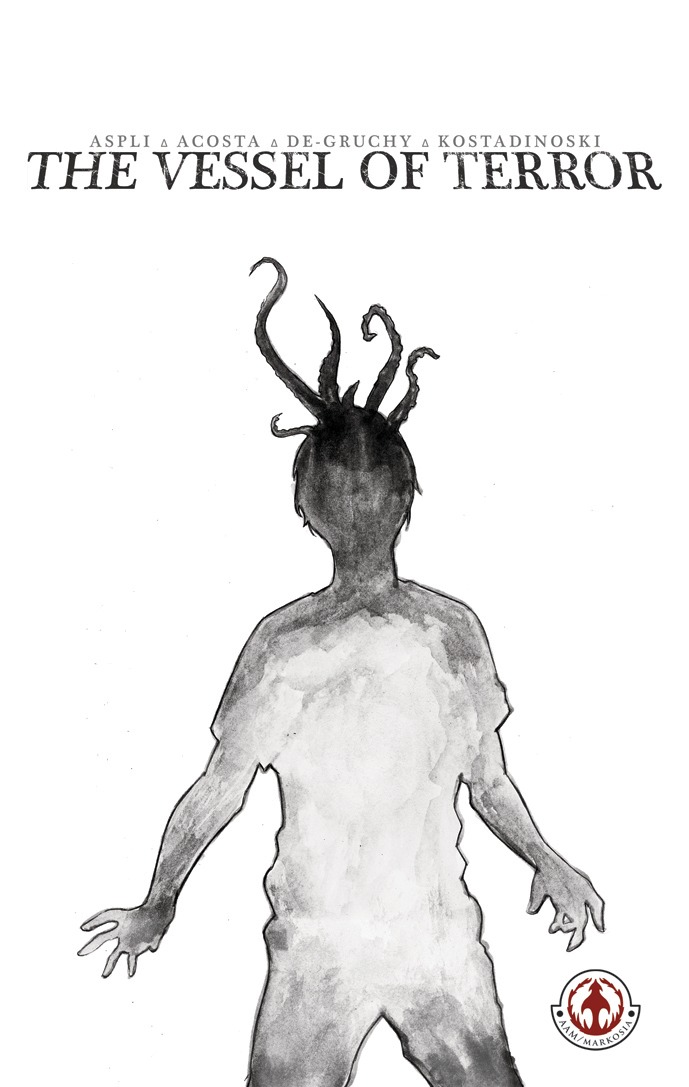
Tommy's Take on The Vessel of Terror

I've been reading a lot of Lovecraft lately, so it was probably a pretty appropriate time to have The Vessel of Terror fall into my lap, as it wears its Lovecraftian influences on its sleeve.

***WARNING: I TRIED TO KEEP SPOILERS TO A MINIMUM, BUT BEWARE***

WHAT YOU NEED TO KNOW: The Vessel of Terror is a graphic novel currently slated for an October 2011 release by Markosia Enterprises and will retail for $17.99 in print (judging from the links on the Markosia website, I would guess that digital versions will be coming as well). You can pre-order it at the link at the top of the page. Written by Magnus Aspli with art by Dave Acosta, the graphic novel is primarily in color, with "historical" segments in black and white.

The primary story thread follows the crew of the research vessel Alesia, where they find a bizarre squid-creature in the depths of the ocean and then bizarre behaviors begin to befall the ship. The second story arc is a flashback to The Black Plague around 1349, following the efforts of Dr. Ludwig Virchow as he tries to save his small village from the Plague and begins to sense that there is...something...else out there, in the water.

The writing is good and easy to follow, even in the face of a couple of odd word balloon placements. It is a little stiff throughout the story, more noticeable in the modern day story thread (I think I've just been conditioned to expect dialogue to be stilted in period pieces).

Every character in the back stands out with a unique appearance, so you never have to struggle to figure out which character is which while reading the book. The men are especially distinct from one another...the women, as it often the case, tend to fall a bit more into the realm of "same person, different hairstyle/hair color" (at least in the modern story thread).

The content is very graphic, with some rather gory scenes of murder depicted, as well as some nudity. None of it feels out of place or gratuitous, however.

WHAT WORKS: The story feels very much like a Lovecraftian tale, with mankind helpless in the face of things that it just does not understand (in both time frames). The squid...good grief, the squid. It goes from a "creature we haven't seen before" to "GOOD GOD WHAT IS THAT" by the end...and in true Lovecraftian fashion, we have no idea what it is by the end.

WHAT DOESN'T WORK: Probably the only character I developed any kind of investment in was Dr. Virchow, with the fates of the other characters coming like story beats and not something that I "felt"...although, to be honest, I tend to feel the same about the fates of most of the characters in the Lovecraft stories I've read, so maybe that "works" better than I think. There was one scene that broke my suspension of disbelief (based off of the internal logic of the story, entirely), in which a possessed character seemingly takes forever to strike a helpless target in a secluded room, but manages to lash out and attack a third character when they enter the room, and another that seemingly wasn't followed up on (implying that the ship's captain was at greater fault for the events of the book), although that may be chalked up to "hallucination".

CONCLUSION: The Vessel of Terror is definitely a case in which the story is stronger than the characters, but again, there's a reason why people know the names Cthulhu, Hastur and Nyarlathotep rather than many of the hapless souls that lost their lives and minds in his tales. The artist brings some great imagery to life in both eras, and the afterword that explains where the inspiration for the story came from frankly creeped me out. The story itself has a slow first act, but builds to a very appropriate climax that should please genre fans.