Showing posts with label comedy. Show all posts

Tuesday, April 4, 2017

Tommy's Take on The Goon RPG


Got a chance to crack into the second book in Pinnacle's current double shot Kickstarter, The Goon. People say they sometimes like to hear my thoughts on these things, so here we are.

Sunday, December 6, 2015

East Texas University: Freshman Year - Meet The Cast!


So we have started East Texas University, and I am probably going to post my ETU stuff up here on the blog, for those interested. With this campaign, I went the route of having the group "cast" their characters with actors and such.

I'll try to keep up with at least rudimentary actual plays as well.

SO...let's meet the cast of ETU: Freshman Year!

Russ "Bad Moon" Rison, Pinebox Texas' Favorite Son!


Russ "Bad Moon" Rison (three time State Champion Quarterback) had his season - and dreams of being a Texas Longhorn - ended when he tore up his knee his Senior year. His cannon arm and football mind, combined with an intense rehab schedule, left him in prime position for a scholarship from the ETU Ravens, especially when his old Wide Receiver "Racin'" Mason Holmes transferred from Texas University after being cut from the Longhorns for disciplinary reasons.

"Bad Moon" and "Racin'" Mason are dead set on leading ETU to its best football years ever...even if players keep mysteriously disappearing.

Major: Agriculture (But really football)
Extracurricular Activity: Athlete
Agility: d4
Smarts: d6
Spirit: d8
Strength: d8
Vigor: d6

Cha: 0     Pace: 6     Parry: 5     Toughness: 5     Academics: 0

Edges
Local Favorite
Command

Hindrances
Overconfident
Party Animal
Trouble Magnet
Minor Phobia (Woods)

Skills
Knowledge (Agriculture) d6
Fighting d6
Tracking d6
Boating d4
Driving d4
Shooting d4
Throwing d6
Knowledge (Football) d6
Notice d4

Transportation
Used Pick with slick tires (-1 to Driving)

Becka Nicole Lane, Just a Girl, Trying to Make Her Way in the World


Becka came to ETU mostly because it was affordable. Here for her teaching degree, she gets pulled along into wacky adventures by her roommate Brandi, who is a Pinebox native and Bad Moon's biggest fan. Becka and Brandi are a liiiittle on the scatterbrained side, though Becka takes life and college a little more serious than Brandi does. Becka hasn't talked much about her life before ETU, but her sweet appearance seems to hide a harder edge.

Major: Education
Extracurricular Activity: Tutoring
Agility: d8
Smarts: d6
Spirit: d6
Strength: d4
Vigor: d8

Cha: 0     Pace: 6     Parry: 5     Toughness: 6     Academics: -2

Edges
Ambidextrous
Fast Healer

Hindrances
Major Phobia (Bugs)
ADHD
Annoying Roommate (Brandi)

Skills
Knowledge (Education) d4
Fighting d6
Shooting d6
Driving d6
Healing d4
Notice d6
Lockpicking d6
Streetwise d4
Persuasion d4

Transportation
Used Midsized Car with an engine that slips (-10 to top speed)

Jonathan T. Wolfwood, aka Europe, The Vampire of Pennsylvania


Jonathan T. Wolfwood, Anthropology Major and son of the East Coast Wolfwoods, has come to ETU to get out from under the thumb of his overprotective parents (yeah, right). While he is genuinely curious about the mysteries of the world, he is quick to rationalize anything out of the ordinary, even when the supernatural is staring him in the face. "Racin'" Mason and "Bad Moon" Rison are convinced he's a homosexual European vampire, but they don't care, as long as he can kick a football (which he can't, and has no interest in doing).

Major: Anthropology
Extracurricular Activity: Part-Time Job (Teacher's Aide)
Agility: d6
Smarts: d8
Spirit: d6
Strength: d4
Vigor: d6

Cha: +2     Pace: 6     Parry: 2     Toughness: 5     Academics: +2

Edges
Noble
Test Taker
Brave

Hindrances
Curious
Doubting Thomas
Overprotective Parents

Skills
Knowledge (Anthropology) d6
Healing d4
Investigation d6
Notice d6
Repair d4
Driving d4
Shooting d6
Swimming d4
Taunt d6

Transportation
New Pick-Up Truck

With Special Guest Stars (aka NPCs)...

"Racin'" Mason Holmes


Mason Holmes could have been a huge college star if he had kept his head on straight, but his freshman year at Texas University ended with him kicked off the football team for disciplinary issues, and him transferring to ETU, where his former High School Quarterback "Bad Moon" Rison was about to start school. Mason...isn't the brightest tool in the shed, laser focused on football above all else, and his views towards women are a bit...suspect...but he is loyal to a fault.

Major: Undeclared (But really football)
Agility: d10
Smarts: d4
Spirit: d6
Strength: d6
Vigor: d6

Cha: +4     Pace: 8     Parry: 5     Toughness: 5

Edges
Very Attractive
Fleet-Footed
Quick

Hindrances
Loyal
Clueless
Misogynistic
Major Phobia (Fire)

Skills
Climbing d6
Driving d6
Fighting d6
Notice d4
Intimidation d6
Persuasion d6

Brandi Jo Miller, Becka's Roommate and Bad Moon's Girlfriend (Maybe)


Brandi is Pinebox born and bred, and has a huge crush on "Bad Moon" Rison. They had Chemistry class together and she once accidentally caused Bad Moon to fail a test, because she let him cheat off of her notes, which were kind of bad. She has decided that her and Becka will be besties, and her and Bad Moon are totally going to be a thing, to the point that she's considering trying out for the Ravens Cheer Squad.

Major: Criminal Justice
Agility: d6
Smarts: d6
Spirit: d6
Strength: d4
Vigor: d6

Cha: +2     Pace: 6     Parry: 2     Toughness: 5

Edges
Attractive

Hindrances
ADHD
Fraidy Cat

Skills
Driving d6
Knowledge (Criminal Justice) d4
Notice d6
Persuasion d6
Taunt d6

And there's the main cast! Stats actually reflect two adventures down (which I'll try to get recapped soon).

Thursday, March 24, 2011

Tommy's Take on Invaderz Pocket Edition

Invaderz is a "beer and pretzels" RPG by Postmortem Studios about a bunch of little green men invading Earth (or, in theory, other planets). The Pocket Edition is the second edition of the game, shrunk down to inflate the page count and make you think you're getting more for your buck (that's what the Pathetic Human that wrote the introduction says!).

Fair warning: Most of the book is written "in character", from a Jerkian (those would be the Invaderz in question) perspective, though we do get little sidebars by Biblios of planet Tee'Em'Eye, which helps you "pull back the veil" a little bit.

We also get a Piracy Notice which is pretty standard in Postmortem Games books, as I understand, appealing to you to seek out and purchase other works if you enjoy the game.

ORIENTATION

This is, not surprisingly, the beginning chapter. Jerkians are all cloned from the tissue of the Jerkian Emperor, on the planet Clonius (it's the cloning planet, you see). We get the basics of the Jerkians here: They are made up of brain meat and body meat, have one eye, they are all male (although there is a whole moon rumored to be made up entirely of lesbians), and every Jerkian has a "spine worm" that keeps them standing upright.

We even get a helpful diagram of Jerkians and their "parts".

Naming is completely random: You roll 4d6 twice to get your three letter name, then roll 3d6 and that's your three digit code, such as Sop-443.

The Jerkian Empire is described, alternately in Jerkian propaganda and lampshaded by Biblios, as a bunch of insensitive jerkwads who are impossible to like, and basically do whatever the Emperor (who has gorged himself up to the size of a planet) tells them to.

As part of their invasion of Earth, they are focusing heavily on America (specifically the Bible Belt), because the people there (of which I am one, actually) are prone to "believe lies"...with Biblios pointing out huge flaws in their logic, I'm not sure if I should be offended or amused here, the implication being that my redneck kin and I are liable to give the Jerkians more violence and hostility than they are prepared for.

The Jerkian training regiment is laid out, culminating in determining what job your Jerkian performs, which is randomly determined via die roll.

CAREERS

Jerkians only really begin to show any individuality once they get their career, of which there are 13 (including the possibility of being one of the slave races instead - some of whom are actually independent contractors who just put up with Jerkian crap for the work).

There are also the Automated Robotic Servile Entities, which can be used as last minute back-up, especially if someone's Jerkian bites it with half the session left to play. All of the careers have accompanying pictures, and some have some downright hilarious mechanics, like the Assault Trooper's giant metal hands, which means they are liable to break anything - ANYTHING they try to manipulate with their hands. Hamstoid Minesweepers are the last ones who will ever be targeted in combat...great, right? Except their sole purposes are to provide sadistic amusement for Jerkians and, well, they don't get any special equipment when looking for thoose mines.

RANK

Yes, there is advancement in the game. Someone is determined to be the Commander and they get Merits that they can dole out. Whoever has the highest number of Merits at the end of the mission is promoted...whoever has the lowest number is demoted. There are 13 Jerkian ranks from 1 (Slave) to 13 (Emperor - which you can't be promoted to because, well, there's already an Emperor).

RULES OF ENGAGEMENT

This actually even begins with the "What is an RPG" stuff, with the disclaimer that it is INCREDIBLY unlikely that this is going to be anyone's first RPG.

For those who haven't caught on by now, you are not meant to take the game too seriously, with the GM encouraged to accept bribes and players encouraged to not overthink things.

Character creation involves taking the info from your Job, adding something else that you are Good at, and then (if you choose) raising an Statistic (Meat, Brain Meat, Expertise or Luck), but this requires lowering another in response.

At the beginning of every mission, the highest Ranked Jerkians determine who is the Commander, and then everyone randomly rolls for assigned equipment.

The mechanic is simple: Roll a die, add a stat, add +1 or +2 if you are Good or Very Good at it. In an opposed situation, whoever rolls higher wins, otherwise the GM has set the difficulty for you (usually 1 to 8).

Health is measured on three levels: Fine, Disabled and Splattered. In most cases, a successful hit means the target is Disabled, a second one means they are Splattered.

35 pieces of Standard Equipment are available, like Armored Vests (extra level of Fine), Decoys (remember those little capsules that you can throw in water and they turn into spongy dinosaurs and stuff? Yeah, them), laser knives (the smaller version of laser swords), monoculars (it makes sense when you remember Jerkians only have one eye), plank with a nail through it (call-out to Kang and Kodos!) and Stealth Suits (which can be Space pirates, ninja, monkey, cardboard robot, tuxedo or a spare uniform). And that's just a sampling of the STANDARD stuff.

There are 34 pieces of Experimental Equipment, which are very cool and very likely to kill you or have some other side effect. Black Hole Grenades will sometimes open up TOO wide, with nasty consequences for the thrower. You can have a Dehydrated Reserve Clone, though it may wind up being a freakish mutant (I know, right?) instead. A Heat Ray is pretty useful, with a surprisingly tame backlash, and the Orbital Death Ray Controller doesn't SEEM to put its user in any immediate danger. The Time Watch can pause time...or accidentally pitch its user through time...and the Universal Remote basically lets you control ANYTHING...if it doesn't cause it to go completely haywire instead.

EARTH FIELD GUIDE

This is a pretty amusing take on the primary specimens on Earth (according to the Jerkians): Cows, sheep, dogs and humans. Jerkians have figured out that humans a) like sex and b) don't like metal objects shoved in their butts...so they're on the right track, at least!

ENEMIES

Once you get through the Jerkian take on human society, you get stock stats for most earthling adversaries like Soldiers, Cops, Rednecks, Scientists, Earth Females and Men in Black.

BATTLE PLANS

These amount to 20 mission seeds for the Jerkian Emperor to toss at the unit, from destroying a city to get back at Men in Black, to hijacking Santa Claus to rounding up babies for the Emperor to feast on.

PLANET GUIDE

These are the planet of the Jerkian Empire, all humorous parodies of the Star Wars trope of a single purpose planet: Clonius is the clone planet, Fac-Tor is a gigantic storage shed (essentially), Lesbia would be where all the (alleged) female Jerkians (allegedly) live, Jerkia is what the Emperor has become, Threed...is a giant planet of yarn (it's a tourist attraction).

CONCLUSION

While some other humor RPGs are more joke than game, Invaderz is perfectly playable (just don't take it too seriously). The author tossed some biting commentary in there without ever being heavy handed, and did it in such a way (through the Jerkians, who were already called out as being full of it by Biblios) that I wasn't sure if I should have been offended or not...and then I decided that I was thinking about it too much, laughed, and went on.

There were even some references that I didn't get until I said the Jerkian words out loud phonetically, face-palmed for not getting them, and laughed...and I'm sure I still missed some references on top of that.

If you like humor RPGs AT ALL, pick up the PDF of Invaderz, which is "app-priced" at $1.99. It's the best humor RPG I've read because of the wittiness of the writing combined with an actual (albeit simple) game being there. (I thought Gnomemurdered was great, but it essentially broke down into a coin toss...I think my players would feel cheated there. Here, they would be in on the joke.)

If there had been a "random mission generator", this thing would have been gold.

Friday, August 27, 2010

Tommy's Take on the API Demon Packs

I am reviewing these next three products together because of both the length of the titles and the subject matter involved.  The titles in question are the API Demon Packs 1 & 2, as well as the free Crooners supplement.

The Demon Packs micro supplements designed to add new demons to the mix, be they PCs or NPCs.  Each Demon Pack retails for $2.99 and includes a three demonic races.  Crooners is free and includes a single race.  No art is used in any of the entries, just pure text.

First, let's tackle The Demon Pack 1:

The first race present are the Naga, a race of devoutly religious vaguely humanoid snake men.  They lived perfect, idyllic lives of peace and labor until two vain Naga Queens, also sisters, pushed their followers into a war over who was the more beautiful.  This war raged until long after the Naga had forgotten the roots of the war, and continued even longer.  A handful of Naga on a special mission found themselves on earth, a Buddhist monastery specifically...where they had their warlike ways shocked back, and they reconnected with their spiritual roots.  Worshipped as divine beings but themselves enamored with religion, Naga went out into the world becoming consumed with learning about the various faiths and began taking an active role in the conflicts involving their chosen faiths.

The Naga get two Passions, the first being Faith and the second being player defined.  They also get a little combat prowess due to striking like a snake, regardless of actual training.  They absolutely abhor technology, however.  This means no cyborg Naga but it also means no e-mail Naga or cell phone Naga either.  This can cause a problem with travel as well, I would imagine.  Also, Naga largely fear magic and their reaction to another Naga learning magic is usually...violent.

The Jaguar Warriors are closer to the Wolf People or especially the Wendigos, in that they are animalistic demons who are very much from this dimension.  Like Wendigos, they are made and not born, selected by other Jaguar Warriors to join their bloody crusade. Many Jaguar Warriors prefer to feast on the flesh of humans, earning them no friends at API and any newly turned Jaguar Warrior that does not embrace their new life is brutally turned on and killed.

Jaguar Warriors are also known as Werejaguars because they can shift back and forth between human form, jaguar form and (sometimes) half-jaguar form.  They are also addicted to flesh, preferring human meat, and can use the Path of Blood like the Taylari.  They also have a hidden, hazardous weakness that I won't reveal here for any potential players that may be reading.

The last race in the first pack are the Hopkins, who may well be the source for all the crazy talk of “Grays”.  Hopkins lived real basic, solitary lives in their own dimension, feeding off of the star there until things we wonky and they started zapping through dimensions, with some crashing here on Earth. 

Mechanically, their big deal is that once a day or so, they have to release pent up energy as an EMP burst or they develop a major glow.  That burst can zap anything around them, including shorting out a cyborg's implants, making them bad candidates for teaming with cyborgs.  They are small, featureless humanoids, looking a lot like the aliens people have come to call “Grays”.

Demon Pack 2 first gives us Dunbars, which are giant rock monsters.  They hail from another dimension, but have spent a great deal of time in our own, and are responsible for Stonehenge in the API reality.  The only thing they devour is other stone, and they cannot stomach synthetic building materials like concrete.  Upon death, they revert to inert stone, appearing to be random, abandoned statues.

Not only can Dunbar shapeshift into other stone forms, but they can also possess other stone constructs.  However, they have no fine manipulation skills and they have a voracious appetite though, unlike some other races, they eat stone and not flesh or the like.  Three days without hitting their allotment of stone and they starve to death, turning into giant, dead statues.

Grandels add to the list of aquatic races in API, fitting in nicely with the options provided in the Lochs book.  They are basically giant, humanoid Angler fish, hailing from a dying planet in another dimension.  They haven't made any attempt to adapt with human society like Lochs have, only recently encountering Lochs and having their eyes opened to a much wider world.  They have a built in story hook, as a statue of one of their Gods has gone missing and could be used to suck them away, back to their home dimension.

Though they are often struck by Earth as they explore it, they aren't often cowed...and they look pretty ferocious themselves with giant teeth and an eerie glow (being like angler fish and all).

The final race in the 2nd Demon Pack are the Olivers, a whole race of impish rapscallions, taking their name from the Charles Dickens character Oliver Twist.  Pretty much sneaks and thieves, they still get work with API because of being so sneaky and fearless.

Olivers have razor sharp hairs on their bodies, and so tend to wear larger than normal clothes, adding to the “street urchin” look and helping the Demon in the Trenchcoat rule.  They also have the interesting ability to mentally “steal” items, so long as there is no solid obstruction between them and the item.  However, they can rarely resist a dare...even one that's not directed at them.

The final race (and product) is a free download released by Third Eye Games called Crooners...and it is an adaptation, essentially, of Lorne from the TV Show Angel, released after actor Andy Hallett's death.  Now, Angel is one of my favorite shows ever, and Andy Hallett's death was an utter tragedy brought on by medical issues beyond his control and not self destructive lifestyle choices, which makes it all the worse...so do I approve of the “Crooners”?  Darn straight.

Whereas Lorne was an exception among his people, Crooners are written as being the standard for their race and, unlike many other races, they didn't travel to Earth...API found them.  API fought to liberate them from the giants that held them as thralls, and the Crooners that came to Earth have rather fallen in love with its music.

Crooners are not fighters, and are a useful alternative to Oracles, as they have some sense of the future without all of the crazy bad luck effects that the Oracles tend to have.  Mechanically, they are based very much on Lorne, being able to read auras by listening to people sing, but only being able to advise the subjects of the reading in general terms.

Are they worth the cash?  Well...not if you hate API, obviously...but if you do, I think you're crazy.  Entitled to your opinion, yes...but crazy.  Crooners are awesome and free, while the only real strike against the Demon Packs is the lack of art, and that was due in large part to budgetary concerns.  However, you can get the Demon Packs together in a $5 bundle.  My thoughts on the races themselves?  Werejaguars are going to be MUCH better antagonists than PCs...and Olivers might just invoke the hatred people had toward Kender back in the heyday of Dragonlance.  I really dig the implementation of the Crooners, and the Naga and Dunbar are rather cool.  There is nothing bad here...if you like API, my recommendation is to pick up the Demon Packs.

Thursday, August 26, 2010

Tommy's Take on API Worldwide: Europe

Okay, my streak ends at two.  I admit it, I don't know what the cover of API Worldwide: Europe is.  Not that it's, like, indecipherable or anything...I just don't recognize it.  Is it the European Union flag?  I am a flag-waving, jingoistic American...I can't be expected to know this stuff.  (Editor's note: Apparently it is the EU Flag.  Yes, I should have known that already, but at least common sense mostly worked that out for me.)

Europe is about 90 pages and the PDF does have one strike against it: No bookmarks.  Sorry, I need bookmarks anyway.  I like to be able to pull 'em up and click around as I see fit.  It is searchable and includes an index, but bookmarks would have been great.

We get a five page fiction piece that actually ties in with the adventure included in the book.  Its not bad, really, as it serves to show the difference in the temperament between API US Agents and API UK Agents.

Chapter one begins with a brief and almost apologetic overview, noting that there is just a ton of diversity to cover in Europe.

A Cliff's Notes version of the European Union is presented, along with a sidebar on how the fall of the Iron Curtain has affected API operations in Europe, and how the London and Moscow offices are increasingly at odds.

The overview of London provides a pair of plot seeds: A cyborg serial killer known as Red Jack, as well as a Spectral claiming to be Shakespearean actor John Gielgud...who has drawn a crowd of other Spectrals, as well as Spirit Eaters.

Big Ben is a giant antenna for magical energy, while Merlin's Eye, the giant ferris wheel, is a mass hypnosis device!

In fact, all the little “zoom ins” on London have at least one plot hook that could be expanded into a full blown adventure or two with a little work.

Zooming out into England outside of London, we get towns sacrificing virgins for power and longevity, ghouls that feed on fear and more.  Other fun nuggets include a peaceful demon uprising in Wales seeking to limit API's control.

As the chapter looks to the rest of Europe, again it takes a slightly apologetic approach, because there is just So Much.  Grendel, apparently, is alive...or at least something big and scary that the Danes believe is Grendel.  Four Taylari singers called the Bridez of Dracula are secretly using their music to call out to the dread lord Dracula, in hopes of bringing him back...assuming he was ever real at all.

Honestly, for the first time, I feel like the line stumbles a bit.  There is clearly a sense that they are trying to cover too much ground here, leaving it all feeling a bit flat.

Chapter two delves into the European branch of API and their operations.  The API was forged in Europe, doing battle with the Rat Queen, who unleashed the Black Plague.

Two other power groups exist in England, and have very different outlooks on API: The Knights of Solomon consider them upstarts who should not have interfered against The Rat Queen, while API and the Rosicrucians have had a pretty open exchange with one another.

The Great Fire of London was an attack on API by The Knights of Solomon, which devastated the Taylari, but ultimately allowed API to rebuild bigger and better.  Later, while API London's leader (at the time) Damon Nesbitt was out of the area, Fauns converged on London and started a panic.  Trying to calm the people, they used their music...invoking a wave of orgies.  Nesbitt cut a deal with the Chiron (centaurs), who mass poisoned the Fauns to end the problem.  Nesbitt was removed from power, sparking a rivalry with his replacement, his brother Brennan.  This ultimately ended in Damon's death.

We also get a sidebar here like we did in the Canada book, showing some of the techniques specially used by the Elites in Europe...my favorite being Ghost Hands, which allows them to affect Spectrals and the like with their bare hands.

We also begin to learn about the importance of Oaths, and Oathkeepers.  Oaths are apparently a Really Big Deal, and it is the responsibility of the London Branch to watch them make sure API doesn't go around accidentally breaking them.

The London HQ itself is actually divided up into a network of places beneath London, with my favorite bits being that King Arthur's Round Table is still being put to use by current Director Jonathan Nesbitt, and the Trove: A vault of magical goodies.

Next up, we get to learn about how the various demon races interact with API Europe: Burners are second class citizens, Carriers have a pact with the Nesbitt family, the Company deals somewhat reluctantly with Chirons (who are not Nice Guys), Ondine have pacts with API London, which is causing problems when Lochs attack Ondines as it puts the London office in a tricky political position, and Spectrals from throughout Europe's history hang around, playing a role.

Finally, we get profiles on important staff in the London office.

Chapter three gets into some of the other organizations in the area, beginning with the Rosicrucians.  The Rosicrucians are staunch allies of API, teaching them magic in exchange for combat training, and both sides joining forces to face off the impending Apocalypse.  The two sides are such allies, in fact, that API cells ofter call on Rosicrucians for assistance on missions.

The Inner Circle are a bunch of corrupt politicians that are making deals with demons and circumventing API...but have something FAR more sinister than even that going on.

Knights of Solomon are dangerous foes who could easily have been allies of API...except for the whole “demon” issue.  API thinks some are okay, the Knights do not.  The Drawbacks almost make playing one of these too difficulty (you have to make a check to avoid flying into a rage if you even encounter someone who is friendly with demons), but they make a very cool addition to the world.  Impressively, they even have the Holy Grail among their resources.  Seriously, the Knights of Solomon are one of the coolest additions to the game, by fair.

The 7 Keys are the descendants of seven British soldiers who (kind of) fell under the sway of a powerful demon in World War II.  I say “kind of” because the demon is imprisoned and needs the “7 Keys” to set it free...however, the families have instead used the demon's imprisoned state to leech off of it.  The book only provides five of the Keys, giving you free reign to decide the other two as you will.

The Greyfire Club are adventurers and artifact seekers who will do whatever it takes to acquire their targets...destroying half of the rain forest, murdering relatives, killing villages, you name it.  To make it worse, often times their efforts wind up allowing demons a foothold into the world or allow artifacts to fall into the hands of those that should not have them.

Chapter four gets into the new crunch, starting with the Path of Oaths, where we learn about the power in Oaths.  Oaths require two willing participants, and Oath magic used to be used in marriage ceremonies, although nowadays, they don't bother.  There are three “levels” of Oaths: Lesser, Greater and Legendary, with examples of both duties and punishments.  And Oaths really are big deals, as magic backs up the pact, meaning it backs up the punishment if someone breaks the oath.

The Path of Fortune also gets a few spells added to it, including a spell that allows a caster to take his own life to save another.  Nice flavor, but I don't see that one getting used a ton.

New equipment gets added here, including the “required by the London office” Demon Scanners and the pretty awesome Black-Flame Thrower that is designed to only hurt demons and leave everyone and everything else be.

Then we get to some awesomeness: artifacts!  Caliburn leads off the list, and all artifacts have both cool bonuses and heinous drawbacks.

New Antagonists include Basilisks, The Furies, Pegasi, Unicorns and the Sphinx, as well as antagonist stat blocks for the new races in this book.

Speaking of: Chiron, Fauns, Hidden Folk and Morgane are the new races added in API: Europe.

Chiron are centaurs, and are vicious, nasty creatures that API has a grudging pact with.

Fauns are also known as Satyrs, and are essentially under the rules of Chirons, whether they like it or not.

Hidden Folk are elves, but are really spirits who hop from body to body.  Initially, they look just like their host, but over time the body begins to transform into more traditional elven characteristics.

Morgane are virtually immortal, mysterious manipulators.  Merlin, in fact, is a Morgane.  In their normal form, they have sunken, black holes for eyes and featureless faces and they must consume human souls to remain on Earth.

Included in the book is an adventure called “Elsewhere?” that picks up with the agents from the prologue, as well as Big Ben, being sucked away into another dimension.  The disappearance of Big Ben is being covered up by magical veils, preventing a giant panic.

The trip into The Wastes allows for fun with giants that utterly dwarf humans, as well as creepy ice spiders native to the dimension.  The fate of Big Ben, the agents and the 500 ft radius around Big Ben is revealed...with a little twist.  In the end, the Agents have the opportunity to put down a giant demonic prince as well as establish diplomatic relations with giants...so long as they don't get stranded in the Wastes.

A London branch specific debriefing form is provided, followed by an index.  One other small change from the previous books, though, is that the last few pages are filled with advertising, a noticeable amount more than was present in the previous books.

In the final analysis?  I like it...with a “but”.  There's some really good stuff here (I love the Knights of Solomon, The Morgane, the artifacts and the Path of Oaths).  The adventure is another great example of what you can do with API that isn't quite like any other adventure released for it so far.  I also love that things like the Ondine were not ignored, even though they appeared in another book.  They didn't shoehorn, say, Wendigo in just because...but if they fit in, like Ondine?  Absolutely use them in the text, building on what came before.  Also, I love a lot of the plot seeds dropped around to be expanded on (from the big, obvious ones like the 7 Keys to John Gielgud drawing his crowd of ghosts)...but whereas API: Canada managed to make the Great White North feel like it was bursting with adventure potential, API: Europe tried to cover too much for its page count, and that made Europe feel a little...lacking.  Honestly, I think I would have preferred API: London, with a slightly less detailed look at the rest of the UK, rather than also trying to cover France, Romania, Italy, Greece and so on.

There were a few other niggling issues worth noting, the first being at least a couple of instances of “see page XX” popping up in the text, placeholder page markers that never got filled in.  It is also worth noting that we get introduced to our third straight beast that is a mass of tentacles and teeth (Grendel, like The Thing Under The Ice and The Vastness before it), although “Grendel” is left vague enough that it could just be a manifestation of The Thing Under The Ice's global reach mentioned in Canada.

It's still a very good book with some great ideas (I LOVE the Morgane, *really* like the Chiron and Hidden Folk, and like the Fauns), just next to Canada it kind of stumbles, unfortunately.

Wednesday, August 25, 2010

Tommy's Take on API Demon Codex: Lochs

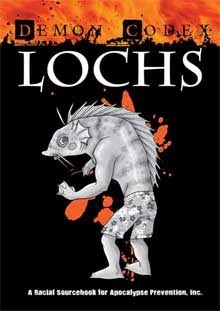
The first (and thus far, only) release in the Demon Codex series for Apocalypse Prevention Inc. is Lochs, detailing the fishy race found in the API corebook.

One minor strike against Demon Codex: Lochs right off is that the cover art is recycled from the interior of the API corebook...the Loch wearing surfer's shorts.  Otherwise Lochs, in PDF form for $9.99, is a fully searchable, indexed, bookmarked digital tome clocking in at 85 pages.  Obviously, its all about the Lochs...but is it worth buying, especially if you're not a big fan of them?  Let's take a look...

The book opens with a piece of short fiction introducing Jonah, a Loch who serves as a quasi-narrator/POV character in the book.

The Lochs are a fish-like demon species who have been cursed with the Contagion, which makes them unable to breed normally.  However, on earth they have discovered that they can implant eggs into humans...though only women have successfully given birth to the new Half-Lochs.  Men...not so much.

Anyway, that's the basic background.

The Codex begins with the history of the Sedrone, more or less what the Lochs were called before they came to Earth.  To sum it up, they were a savage, conquering race who took what they wanted and killed all that opposed them...until a rebel faction plagued them with the Contagion, which killed 90% of the Sedrone and left them unable to reproduce with one another!  A number of Sedrone tried to escape the Contagion by fleeing to Earth in portals, but it was too late.

The Voltics had answered a distress call by the rebels and came to aid them against the Sedrone...but they arrived after the Contagion had ended the war, and so they pretty much enslaved what was left.  API has crossed paths with the Voltics a few times since, and it hasn't been pretty.

Chapter one provides a lot of detail on Domainya, the watery dimension that was home to the Sedrone...literally a dimension entirely underwater...lit by glowing plants on the ground and no overheard source of light, as it all just fades into the Dark Horizon once you get too far removed from the floor.

In the present day, API has a contingent present in Domainya, helping aid the fight against the Voltics in the presumed interest of turning the Spandrels (which was the cradle of the Sedrone empire) back over to the Sedrone.  The human in charge of the operations has developed a growing fondness for the Rebels, while API's official stance backs the Lochs/Sedrone.  This chapter sets the conflict up nicely, then lays out three “this might happen” scenarios for the conclusion of the conflict.

There are a number of cool little layers in this war, such as API recruiting the Ondine (an Earth-based aquatic race) for help, who are motivated entirely by the idea that if they help the Lochs, the Lochs will leave the Earth and essentially stop challenging their supremacy of the seas.  Also, one of the Rebel races, the Scryers, is planning a second Contagion, this time aimed at the Voltics.  Chapter one basically lays out what could be a whole campaign on its own, completely aside from anything else presented thus far in the API line.

Chapter two details the exodus to Earth.  It started off as an invasion, as the Sedrone mustered up a massive army of 500,000 soldiers...then promptly went a different route once they realized how bad they were screwed numbers wise.

Their first portal transport to Earth was in a little body of water called Loch Ness, where they encountered API agents...and thus, they became known as Lochs.

The Lochs arrived en masse in Brazil, and wound up in open conflict with API, which they lost.  They were quarantined and then registered, with a large number of Lochs embracing human culture and even The Company.  However, there are still more than a few “anti-human” holdouts.

As extinction, due to The Contagion, loomed over the Lochs they grew desperate.  Given their dominating and violent nature, some Lochs engaged in rapes of humans and discovered...that they could breed together.  The Lochs have since learned that every attempt to breed, though the child may survive, results in the death of a parent.  So now the Lochs and humans are exhausting every procreational method they can to try to save Lochs from extinction.  Half-Lochs are being born, and the oldest right now is about four years old...so they may yet save the Lochs from extinction.

The human friendly Lochs have utterly embraced human culture, from movies to popular music and so on.  They stole hold out some traditions for themselves, but by and large, they had tried to integrate as much as they can on Earth.  This isn't universal, of course, as a number of other immigrants still hold tightly to their culture and frown on Loch integration...these immigrants also still use “Sedrone” as their identifier and not “Lochs”.

We get a little sidebar here by Jonah, from the beginning fiction, talking about the other demons and how Lochs view them overall...perhaps surprisingly, they like Burners the best and don't care much for...well..most anything else besides humans.

In another nice little touch, API has set up a series of underwater bases that they use Loch agents to man, in the Sea of Japan, Jamaica, the Mediterranean Sea, Antarctica, off the coast of India and in the Pacific Ocean.  Each base serves a specific purpose and has their own internal quirks.

A community in the Florida panhandle, called Black Moss Lake, is also detailed...being the place where the API first brought the Lochs after quarantine ended.  Its described as being a bit of a hodge podge of human and Loch architecture, but the Lochs who are there still consider it very much home.

Lochs and their relations with four other races are also provided, closing out the chapter: The Linx, which were a bit of a servant race back on Domainya, are split: Some still stick close to Lochs, others have begun to latch onto humans.  A very rare few are becoming overtly independent.  Ondine are not demons, but an aquatic race the developed on Earth and have had many a violent conflict with Lochs over the Earth's oceans, as they consider themselves the rules and Lochs as interlopers.  Scryers, the race that infected Lochs with the Contagion, obviously have very strained relations (at best) with the Lochs.  Finally, there are the Voltics.  Much like the Tarks from the core rules, they hit Earth for specific missions...however, their portals also allow the great Kraken known as The Vastness to access Earth as well, making it DOUBLY bad for everyone involved.

Oh, and a final note is included on Lochs...apparently they LOVE cybernetic implants and, unlike Changelings, it doesn't limit their usefulness as agents.

Chapter Three gets into Loch groups...helpfully noting that not all Lochs like humans and not all Lochs are on board with API.

Aquatic Alchemists are creepy.  Aquatic alchemy is where the Contagion was spawned from, and it has been frowned upon ever since if killed 90% of the Lochs and sterilized everyone it didn't kill.  Everything from herbs to animals to people can be used as ingredients...and they are.  Currently, Alchemists are divided into two main groups now: Those striving to cure the Contagion and those who are striving to create a new Contagion...to be used on humans.

Deep Green isn't a Loch group exactly...its a plastics corporation who has inflicted damage to Lochs living in the ocean with their illegal dumping, and sparked a war with them over it.

The Forgotten Tribes are the Lochs that arrived in South America during the initial migration, and have become weakened over the years...the elder immigrants having largely died off now and the younger ones trying to make their way.

Hooks were kind of like the CIA on Domainya, and now are pretty much bounty hunters and PIs.  They welcome any law-abiding member of an aquatic race and are often used as sub-contractors by API, and as an alternate solution for demons that don't want to deal with API for matters.

The Hope Foundation is a group dedicated to save the Lochs from extinction.  It arranges two Lochs and a human, who attempts to carry the Half-Loch to term.  Only two Half-Lochs have been born through the organization, and they have done some...spotty ethical things to get that far, using the salvation of the Lochs as their justification.  They are a huge thorn for API, who would love to take them out, because they couldn't end the operation all at once, and a large number of Lochs look to The Hope Foundation for, well, hope.

The Red Steps are somehow creepier than the Aquatic Alchemists, being Lochs who have taken over Michigan slaughterhouses and are now pumping various races through there, turning them into food that they are selling off to fast food places.

Yeah.

Superior City is an Ondine city in Lake Superior that Lochs overtook.  Nestled in the heart of the city, much like Excalibur, is a trident that is trapped in a statue.  Full stats are provided for the Trident, should you wish to insert it into your game.

Chapter four gets more in depth into actually playing Lochs.

First off, it provides three methods for Lochs to work among humans, from Image Emitters, to the Trenchcoat Rule to the very creepy alchemists who use human skin as a disguise.

A reminder is provided on the creepiness of Loch-human sexual relationships, which have involved rape more often than once in the past.  Also, while Lochs make good fighters, the book provides tips on playing non-combat themed Lochs as well.

A new Passion, Redemption, is provided.  New Gifts include Aquatic Alchemy as well as other physical modifications such as tentacles and crab claws, which have their own advantages.

A new Drawback, Water Breather, is provided for those who just don't breath well out of water.

New equipment includes the H.I.C.C.U.P., an underwater transport, as well as M.U.E.s, which are special diving suits, and Compressor Cloth, which helps condense a large-framed individual who is using an image emitter.

New cybernetic options are provided, such as Waterproofing, a Current Generator (torso mounted, creating strong currents) and Air Lungs, which allow the recipient to adapt between two environments, such as land and sea.

A list of Aquatic Alchemy items are included, like the Siren Choker, which gives a bonus to Perform Checks, Aqua Lung (gives a land lubber the ability to breath in the water), the Infinite Box (made from the pieces of a Husk) and Human Skin, which makes for the ultimate disguise.

New Antagonists include The Afflicted (Scriers altered by the Contagion), Charcadons (scary, shark beasts), dolphins and sharks, krakens, The Vastness' Tentacles and more.

The new races are given profiles like those in the corebook.

The Linx are odd little guys...a single Linx is born into four bodies, which operate with one mind.  They cannot willingly go more than 300 ft apart, and being forced apart is Very, Very Bad.

Ondine claim to be the children of Poseidon, and are essentially merpeople...and as they were The aquatic race on Earth for thousands of years, they don't like Lochs at all.

Scriers are the guys that created the Contagion, and also have a second set of eyes, which allow them to see into the magical spectrum.

Voltics are war mongers who occasionally make in-roads into Earth and are considered very much illegal by API.

Finally, for those who want to run the timeline ahead or play around with the setting in other ways, rules for playing grown Half-Lochs are included, even though there aren't currently any older than the age of four, officially.

Two adventures are included as well, the first being Deep Run in the Tunnels, which serves as a primer on Domainya.  Reports are that a female Loch is apparently pregnant by another Loch, which could be huge news for the future of the Lochs.  The Agents are sent after the missing Agent who reported this phenomena.  The Agents get to experience some Domainya politics as well as possibly snatch up a Loch artifact.

Jaws Snapping In The Dark is a hunt involving a batch cloned Lochs gone bad.  It is pretty much a straight forward investigation culminating in a big, bloody fight (most likely).

Honestly, the adventures are the weakest part of the book...but that might be because the book is just TEEMING with plot hooks, seeds and goodness.  Seriously, even ignoring the adventures this is an amazing book.  The information on Domainya is enough to run a whole campaign on, and then throw in all the great stuff with the factions, plus five new races.

The Lochs are presented as complicated creatures...you can play them as fun-loving joke characters...giant fish wandering around in trenchcoats...or blood thirsty conquerors...or a fallen, tragic species driven to desperate measures in order to survive.  Throw in the quirky Linx, the poor Scriers who are stuck in a bad place no matter what they do, and the Voltics as pretty much unambiguous bad guys, and this is just a great resources.

Some minor failings bring the book down just a hair, but this is by and large an amazing supplement that really sets the bar for future Demon Codices.

Monday, August 23, 2010

Tommy's Take on Apocalypse Prevention, Inc. Core Rulebook

Apocalypse Prevention Inc. is a cool game that was offered up as part of the awesome Haiti Bundle on DriveThruRPG earlier this year, and as cool as it looked, I got more than a tad overwhelmed with EVERYTHING that came in the bundle.  However, API has caught my attention all over again, because Third Eye Games just announced at GenCon that API will be coming to Savage Worlds as a Savage Setting!  That tickles me pink, I'll be honest...'cause I loves me some Savage Worlds.  This review, however, is for the first edition of the game, using Third Eye Games' Dynamic Gaming System.

The cover is a striking black and orange, with the silhouette of a city skyline up top and what appears to be flames behind it.  On the center of the page is a blood splatter in the shape of the continents.  The PDF itself is fully bookmarked and searchable, and is available for $12.95 at RPGnow.  Additionally, a print version is available for $24.95.

Written by Eloy Lasanta, API is an action-horror RPG with a bit of a comedy twist...or, as I've heard it mentioned before, it's “Joss Whedon's Men in Black”.  The book begins with a brief overview of the setting, which is about a shadow corporation protecting the world from all the ooky demons that might threaten it, and touching briefly on just what those demons are (many of which are playable races in the game).  As well, it gives a brief paragraph about the core mechanic of the system, which is d20+attribute+skill.

A “What Is Roleplaying” section follows, but it keeps it brief.  Not bad, but nothing you haven't read before, and I appreciate the brevity.

Finally, an in-character memo is posted, welcoming the “New Agent” to Apocalypse Prevention Inc.

The table of contents is a bit broad, listing just the chapter headings...but since there is a full index (as well as bookmarks in the PDF), this isn't a huge strike.  Even in the hardcopy version I would forgive it because of the index.

Character Creation is up first, and broken down into five steps, the first of which is Concept, Passion and Race.

Concept is pretty broad, but should be distilled to a couple of words or so.  Passion is picked from a list, each of which has a situation in which the PC can earn bonus XP, such as Honor providing XP whenever the PC abides by their code even in the face of negative consequences, Rivalry giving a bonus when you get a leg up over your rival, or Death providing bonus XP whenever you survive a near death experience.  As well, a helpful sidebar is provided, giving examples of how different Passions can alter the same Concept.  Finally, you select your race: Human, Burners (fire demons), Changelings (shape shifting demons), Lochs (giant fish demons), Spectrals (ghosts who failed to move on), Taylari (living vampires) and Wolf People (kinda like werewolves).  As well, there are three “illegal” races provided, Carriors (disease eating demons), Oracles (demons who can see the future) and Tarks (massive demonic hulks).  The illegals are held to the back of the book, but are playable with GM permission.

For concept, I'm going with “Boring Pencil Pusher”.  Passion?  Revenge.  Race: Spectral.  Bart Angleman was an API file clerk who had fallen in love with Alyssa, a lovely changeling of indeterminate age.  They cohabitated for a few years, though Alyssa never really returned Bart's feelings, but privately told those she spoke with that “he loves me enough for the both of us”.  Bart, for his part, subconsciously understood that Alyssa needed more than him, and rarely questioned her comings and goings.  He returned home from the office to find their apartment wrecked, and Alyssa dying on the floor.  Angleman never realized that the trio of hunters that had tracked her down and attacked her were still there, and murdered him, assuming him to be a Changeling as well.  He was not...he was just a heartbroken schlub who refused to let go of the mortal coil...now, he walks the earth as a Spectral Agent of API, specializing in shutting down monster hunters who would kill otherwise harmless, friendly demons.

Next, we spend 30 points on our attributes, which are Power, Agility, Vigor, Intellect, Insight and Charm.  These are ranked from 1-10, with 9-10 costing 2 points per level instead of one.  Being a pencil pusher, we're going to go a little heavier on the mental than physical attributes, I think.

POW: 3  AGI: 2  VIG: 4  IQ:  9  INS: 7  CHM: 4

There we go...I think that'll work nicely.

Step 3: Distribute 30 skill points, plus an additional point for every level of IQ.  There are 20 standard skills, plus 12 combat skills, as well as a list of Spectral Skills, which is what Bart will need in order to actually affect the outside world.  At different thresholds (4, 7 and 10), the PC gets a Specialty for the skill (when available) as well, something to keep in mind.

Affect Senses (Repetitive Typing Sounds) 4, Computers 5, Float 4, Knowledge (Bureaucracy, Demonology) 8, Manifestation 8, Possess Object (computers) 5, Stir (Typing) 5.

There we go: His main marketable skills from API are represented, and he's quickly become a fast study on the ghost stuff.  Good times.

Unless I am horrible mistaken, Bart gets Appearance (Fear 13), plus Ghost Form and the Drawback Sealed Inner Circles for being a Spectral.  This essentially means he's kinda creepy, and can't affect anything (or even be seen, other than giving people a cold chill) without the skills he took above, and he can't use much in the way of magic.  He also gets a further 10 points to spend on Gifts (or Attributes and Skills if he chooses), but he can also take up to 10 points in Drawbacks.

Perfect Memory (3) seems like a good one for Bart.  Let's take Punctual (1) as well.  Years inside a cubicle has given him Iron Will (4), and he has amassed a huge Library (4).  Now he needs at least 2 points of Drawbacks...I'm thinking Speech Impediment.  Howabout...Stuttering?

Now derived stats:  Using the formulas in the book we get Health of 22, Initiative of 9, Stamina 33, Walking is 5 ft and running speed is 100 yards per minute.  Jumping is only 3 ft horizontally, and he can't swim...poor guy.

Not bad, not bad.  The concept may have been kinda grim for setting, but I could see it working.  Especially with lots of “Office Space” humor.

It's worth noting that there is a lot more depth in the skill system getting into the combat skills, I just ventured entirely into a non-combat character here.  The six attributes are pretty much the d20 Ability Scores renamed, while a lot of the character generation reminds me of White Wolf's character creation standards.  Definitely not a rip-off of either, but I do see what appears to be influence, especially from White Wolf.  In fact, much like White Wolf's books, API provides a character generation summary nestled into the first couple of pages of the section, where it gives an overview of Concept and spells out the Passions and their rewards.

From there, each of the legal Races get a profile, including common nicknames for the race (such as Humans being called Baselines or Spectrals being known as  Caspers), as well as common stereotypes (Burners are hot-headed, Lochs are wise).  Each section, about two pages or so on average, gives the story of the species, their common lifestyles,  how they are commonly recruited into API (Changelings make great spies), any starting Gifts or Drawbacks a well as unique ones available for each race to purchase.  Finally, each race has a picture included, as well as a sample NPC representative of the race, complete with a hook for using them in your game.  There are some nice quirks here: Taylari drink blood, are allergic to garlic and dislike sunlight, but are otherwise living and breathing beings.  However, if they die, they become feral Taylari Mortus.  Lochs are a fallen noble race who mate with humans when they can in order to propagate their species...but humans die in childbirth with a Loch child. 

The Attributes section is well laid out, listing each of the six attributes, with relevant tables and formulas immediately underneath each Attribute (such as the formula for holding one's breath under Vigor).

Skills have a very basic formula for difficulties: 10 is the base difficulty, and each level of complexity one tries to achieve is ten points higher, with a 40 being near impossible...(as it would require having a 10 in the Attribute, 10 in the relevant Skill and rolling a 20, or an 18 with a relevant specialty).  Untrained Skill Checks don't have penalties, they are just Attribute-only checks.  Natural 20s are an automatic success, Natural 1s an automatic failure.  Specialties provide an additional +2 on a roll.  It's a straightforward system, laid out very clearly.  Each skill listing provides common specialties, as well as examples as to just what each benchmark may entail, like a Moderate (20) Discipline check helping you keep your cool in a gunfight.

Combat Skills are a little different, as only Fighting Style: Basic can be purchased through normal skill points alone...each of the trained styles require a a Gift to unlock them.  Each style has a table showing your bonuses at each level, and you gain a Technique at levels 4, 7 and 10, ala Skill Specialties.  Probably my biggest gripe here is the combat Technique “Close Line”.  As a pro wrestler, I HAVE to point out that it should be “clothesline”.  Other than that, the Combat Skills provide a fairly crunchy system without being overwhelming, reminiscent somewhat of the old Palladium Martial Arts system, in a good way.

Gifts and Drawbacks are explained in detail, though a handy reference with point totals is provided at the beginning of this section.  There's very likely room for expansion, but there's still a good number of Gifts and Drawbacks provided here.  Access to Magic is bought through here, as well as quirky Gifts like Dumpster Stomach, which allow the PC to eat pretty much whatever he wants with no issue.

Equipment acquisition is handled through the Wealth Gift, which ranges from 0 to 5.  Every item has a Cost score, and you simply compare your Wealth to the Cost to see if you can purchase it...and yes, people can combine Wealth for more expensive items.

Some of the items listed are fairly normal: Nightvision goggles, first-aid kit, gas mask...but there are also faerie guns, which fire a foam that kills faeries (and also rats), image emitters (which Lochs often use to get humans to mate with them), ectoplasmic reorganizers (which let Spectrals change their “death” appearance) and Blood Beer (a human-safe alternative for Taylari that don't want to kill).

The weapons list hits a number of common favorites, such as swords (including the ever-popular katana), axes, chainsaws and ranged weapons from bows to boomerangs to shotguns.  Armor is also listed, from chain mail to kevlar and rules for breaking objects.

There is a pretty big sci-fi aspect to the game as well, and rules are included for cybernetics.  You use Bonus Points to buy your enhancements, with “aftermarket” cybernetics being cheaper but coming with some “quirks”.  Each basic implant also includes a list of potential upgrades, one of my favorites being the grenade launcher loaded into the cybernetic leg.

Combat is the biggest break I've seen in the game, system wise, from anything I've played before.  Each combat round has 20 Counts, each Count lasting half a second.  Everyone rolls initiative, with the winner starting on Count 1, and for every four points that each other participant rolled below him, they start one Count up.  I.e., if Zachariah the Taylari rolls an initiative total of 25 and the cyborg killer DED-HED only got a 16, Zachariah starts at Count 1.  DED-HED is 9 less than Zachariah, which moves him down the track by three steps, starting him at Count 4.  Typically, each character gets two Actions per round, and every action costs both Stamina and Speed.  The Speed cost means that performing the action moves you that many spaces down the Combat Tracker.  Your opponent can take Reactions, which cost Stamina and Speed, but don't count against actions.  Some of the Reactions have very low Speeds, the lowest being “Take The Hit”...so if you think you can handle what your opponent is swinging with, put your chin out and there's a good chance you'll get to strike him next.  If you go full defense, he's liable to keep pressing the attack before you get a go.

If your actions taken push you past the Count of 20, then for every Count you go over, you get a -2 on the next Round's initiative.  So if you roll a bad initiative, unless you are just convinced you can take the opponent out, you're probably better off letting some actions go, and rerolling an unpenalized initiative the next round.

A natural 20 is a big deal on both Actions and Reactions, including bonus damage or, in the case of some Reactions, draining Stamina from the attacker.  Similarly, rolling a 1 is bad, no matter what you're doing when you do it.

There is just a fairly shocking amount of depth in the combat rules, including an extensive list of Grappling options that include turning an opponent's weapon on them, using a grappled opponent as a Meat Shield and more.  Other combat options including sacrificing Health for Stamina, Feints, and three levels of basic strikes, starting with quicker and weaker and ending with slower and stronger.

The ranged combat rules remove a common RPG trope, which is the Dodge skill being used with firearms.  Doesn't happen here unless someone is at extremely close range, making guns incredibly useful.

The chapter rounds out with a number of common modifiers, such as Targeted Strikes (called shots), Blind Fighting and more, as well as a number of common damage rules such as fire, falling, poison, etc.  Finally, a two page example of the combat system, in full glory (including Combat Tracker) for clarification's sake.

Again, as noted in the styles: It's definitely crunchy, but I think it's laid out in such a way that it's not overwhelmingly so, especially once you get the initiative/combat tracker stuff down.

Chapter Three brings on the magic section.  API magic does spell lists, divided up into 18 “Paths”.  Anyone who can cast spells is an Adept.  You can dip around into Paths, so you don't have to focus on any one.  The Paths have three Circles, with magic effects getting more and more mindbending as you go.  For instance, one of the spells in the 1st Circle of The Path of Death allows you to commune with the dead.  With the 2nd circle, you can exorcise spirits.  With the 3rd, you can raise the dead (think zombie, not resurrecting a buddy back to full health).  Magic is powered by Mana, which you get by converting Stamina.

Half a dozen magical Orders are provided, each focused on a certain type of magic.  As well, the book clearly states that magic is not inherently good or evil, but is based off of the intent of the spell...and using magic for good or evil over time can have a transformative effect, making one glow with a holy aura, or aging them prematurely, etc.

As well, while the magic system uses spell lists, you can use experience points to upgrade your spells, tweaking the ones that you like to use, by making them stronger, or less draining to use, and so on.  Much like the combat system, the API magic system comes across as a very robust, yet not overwhelming system...with enough crunch to play around in it.  If you're all about freeform magic, you're probably not going to be thrilled with this...but it does look far less tedious than, say, the D&D tomes of spells system.

Chapter Four delves into the world in general, and the organization specifically.  History, especially in the US, makes a pretty large divergence in 2008 when the first female President is elected, and she manages to dramatically restrict gun ownership rights (remember the paranoia from gunowners when Obama was elected?  Yeah, a lot like that, but actually executed by the governnment).  API itself has been around in some form since the 1600s, and is a corporation with approximately 120,000 employees.  It is a known entity, but just what it really IS is the part that the public is unaware of.

API has a main HQ in California and a secondary HQ in Florida, with two cells per state, giving you a good amount of flexibility with the campaign structure.  As well, there are other worldwide HQs, and the entire HQ structure is given a full page (note that Canada and Europe each have their own sourcebooks while I will review as well).

API enforces registration on the part of demons, monsters and anyone interacting with the supernatural, and penalties for infractions can range from small fines up through death or incarceration.

As well, API stays on top of all manner of prophecies, be it from The Bible, Nostradamus, The Dead Sea Scrolls or what have you, and tries to discern the true trouble points.

This chapter also delves into the recruitment and training of Agents, as well as providing details on Elite Martial Arts training, which has some cool tricks to it like Mana Leak, which causes an Adept to lose extra Mana when trying to cast a spell after this is hit.

The details for an Agent cutting ties with their old life are detailed, which even include subtle DNA alterations...once you're in the system, you are no longer who you once were.  A section is devoted to Agents going rogue, which API does take very seriously...however, since they tend to give their Agents the benefit of the doubt, the Agents tend to do a fair amount of damage before API comes down on them.

A sidebar is devoted to The Watchers, a mysterious organization who doesn't actively interfere with API, but is amassing information at a rapid rate.  The belief is that they are hording the information in the event that API fails...but no one has been able to confirm this yet.

Finally, this chapter also covers the effect of cybernetics on the world, which include underground cybernetic fight clubs and doctors that implant extra goodies in their patients, making cyber-slaves out of them.

Chapter Five deals specifically with demons, such as the Trench Coat Rule (meaning that if a demon is making an attempt to be MOSTLY covered, the human mind will fill in the rest).  This chapter also takes the six demonic races from earlier in the book and relays their full racial history, from their home dimension to how they fit into earth society, including how Lochs try to breed with humans and exactly why humans tend to not survive the breeding process.

This chapter is a lot of information that never feels overblown or unnecessary.  It is very easy for game settings to go too far to opposite extremes when detailing their racial options...either painting them with too broad of a stroke to make it easy to grasp just how they are different, or go into sooooooo much detail that, frankly, you just stop caring.  I think API hits a pretty good sweet spot with this chapter.

The final chapter is the GMing chapter, starting with the three main themes: action, horror and humor.  Common squad structures are provided, as are tips for setting up the game world.  A very nice section is included for playing within the game world, but outside of API, from PIs to beings in the supernatural underground to monster hunters who have decided they've had enough.

Two adventure hooks are given for three difference experience levels (rookies, 30+ xp and 50+ xp), giving you some ideas for what it appropriate for a given group within the setting.  Suggested experience awards are also provided here, as well as the point costs for character advancement.

A slew of stock statistics are provided, from basic animals to different types of people (normal schmoes, mental patients, monster hunters) to various demon types, including stock stats for the PC races.  A Random Demon Maker is also provided, in a d20 table that you roll twice on...this can be used for PCs or a random NPC you need quickly.

The chapter ends with the three “illegal” NPC races: Carriers, Oracles and Tarks.  Carriers are often peaceful, but are outlaws because they unleash their digested diseases upon their deaths, leading to a potential pandemic.  Oracles, as well, are not inherently evil...but they cause bad luck around them, and since it does not effect them, they tend to not care about the effects.  Tarks are sent to earth for the express purpose of abducting babies and toddlers, and thus are treated as pretty much a massive honking threat.

The book rounds out with a glossary, index, character sheet and combat tracker that you can print off.

 I think parts of the system are going to be a tad crunchy for some folks...but I dig this game.  After doing this review, I'd not only love to give the game a spin, but I'm pretty pumped about tackling the rest of the game line.  The book is very clearly written, which is a must no matter how crunchy or lite a system is, and while humor is an important part of the setting, the author doesn't beat you over the head with it like, say, the Demon Hunters (from Margaret Weis Productions) or even the Buffy the Vampire Slayer core rules do.  On the flip side, it also doesn't take itself nearly as seriously as CJ Carella's Witchcraft or The World of Darkness does.  The art in the book isn't anything GREAT, but I didn't see anything actively bad, either.  Fully functional and thematic.


I'm going to be awfully intrigued to see the Savage Worlds version, as there are some areas where I could see SW really fitting it, and a few areas where I hope API actually steps Savage Worlds up a bit (I'd personally like to see API bring more to the Powers System, rather than just force the Paths into the existing Powers System, but we'll see).

With good, but not GREAT, production values, Apocalypse Prevention Inc. really brings the goods with the substance, as the corebook alone is chock full of goodies, but the line has a good amount of support ready to go as well.  Remember how I said earlier that it reminded me a fair bit of a mixture of d20 and White Wolf stuff?  It still does, with a little bit of Palladium thrown in...I just like it a lot more than I do any of the above.  Strong recommendation.