

The Proof Is In the Fun

Showing posts with label vigilance press. Show all posts
Showing posts with label vigilance press. Show all posts
Friday, June 6, 2014
Tommy's Take on Tianxia: Blood, Silk & Jade
Used to be, this would have been a hard sell for me...but more and more I've been getting my martial arts geek on, and given my new found interest in Fate, I wound up backing the Tianxia Kickstarter, a martial arts setting and sourcebook for Fate Core by Vigilance Press! Before I get started, I do have to offer a huge shoutout to my blogging colleague Jay Steven Anyong, who is doing a great Let's Study series on Tianxia over on his blog.


Wednesday, March 7, 2012
Tommy's Take on Hacking 2.0, IZ GM Screen and Oktobermen
INTERFACE ZERO: HACKING 2.0
 WHAT YOU SHOULD KNOW: This mini PDF requires Savage Worlds and Interface Zero for maximum use, as it is an overhaul of the hacking rules from Interface Zero. The PDF has a short intro from Gun Metal Games' David Jarvis, explaining why this document was released (folks having issues with the hacking/virtual world/etc)...IZ 2.0 is coming later this year and will provide both Basic and Advanced Hacking rules. This document is presenting the Basic rules in advance of IZ 2.0's release. Some of the changes on the character creation end is that Hacking gets its own skill, some Edges have been removed (like Programming 101 and Advanced Programming) and new Edges are introduced (Cool Under Pressure lets you ignore penalties when a system goes on Active Alert and Interference makes you harder to hack, for example). There are also three Hacker specific Hindrances, with advice warning the GM to not allow them if a character who isn't REALLY a Hacker is trying to take a Hindrance that won't affect him. Hyper Gloves are also introduced (the first example that comes to mind to me is the FBI Agent from Heavy Rain, but you have seen them in various other media). The system for Hyper Gloves is pretty simple, a basic stat set that can be upgraded. The Gloves determine everything for the Hacker: Armor, Damage, Hacking Bonus and Range and can be set into three modes: Control (in case you need to manipulate a gun turret or an elevator), Edit (for heavy changes to things) and Destruction (when you need to inflict damage). Additionally, Hyper Gloves have additional MODS that can be used to provide extra bonuses. The hacking itself takes up the final few pages: Essentially, it's a normal skill roll in Savage Worlds, with the level of security providing a penalty to the roll and the Hyper Glove and/or Edges providing a bonus. Unlike most skill rolls, however, Hacking is NEVER without risk: Any Hacking roll failure will have consequences (determined on a die roll against the table appropriate to the type of security firewall).
WHAT WORKS: That cover art is awesome. I'm not sure what it has to do with Hacking, but that is probably the single most compelling piece of artwork I have seen on an Interface Zero product. I like the Hyper Gloves a lot. It's a clean, easy to modify system that fits the Savage Worlds vein.
WHAT DOESN'T WORK: Well, if you're planning on buying IZ 2.0, you might not want to pay for content that's going to be in the eventual release.
CONClUSION: Though designed for Interface Zero, there's not much here that you can't use without it, and it's both inexpensively priced and not a huge document, so if you are running any kind of game in which futuristic hacking would be helpful, it's worth a pick-up. Interface Zero got kicked around (a tad unfairly) for changing "too much" about Savage Worlds, but this is a step back to the feel of SW without sacrificing the unique flavor of IZ.
INTERFACE ZERO GM'S SCREEN

WHAT WORKS: Great art, all the relevant IZ setting rules...about what you would want from a GM screen.
WHAT DOESN'T WORK: It feels a TAD cluttered...but there's just a metric crap ton of tables on this thing.
CONCLUSION: Unless you hate GM screens, this is a very good pick-up for $3 if you have access to a good printer. Much better deal than the $20 GM screen standard we've seen in the past, especially if you have one of the clear Savage Worlds screens to slide the panels into.
DUE VIGILANCE: OKTOBERMEN

Bookbinder - An escapee from a mysterious organization called The Library, Bookbinder is the most reluctant of the Oktobermen, having joined up when Springheel Jack saved her from The Library. The can use magic in some powerful and freaky ways, like trapping people in stories or summoning literary characters to do her bidding.
The Floating Skull - He is not unlike a D&D Demilich, the floating skull of a powerful sorcerer. He can never use the same spell on a given target more than once. Luckily, he knows 666 of them.
Hexenwulf - Hexenwulf is a werewolf, but not of the common type. No, he's a werewolf of the "wearing wolf skins" type. Heavily resistant to magic, so he's usually the lead man in taking out sorcerers.
L'Enfant Terrible - The prototypical Creepy Kid, born with a soul of evil. Often used to take people by surprised...has a "bodyguard" named Mr. Bear who has a VERY disturbing secret.
Sister Sanguine - A creepy (ex)nun who answers to evil fae and gains powers from drinking blood.
Springheel Jack - A half-demon in charge of The Oktobermen, Springheel Jack is on a quest to consume take a number of souls and become a Lord of Hell. There is even a sidebar explaining how to alter his stats if he succeeds.
Also included are four plot seeds (including two related NPCs) and a set of standees fot the Oktobermen.
WHAT WORKS: Some GREAT character concepts here, as well as some nice tidbits hinting at the larger world (like The Library). I also love the amount of detail as to how the villains operate and treat each other, making this more than just a set of stats.
WHAT DOESN'T WORK: My only real complaint is the dramatic art shift from the cover to the interior. I don't think either one is inherently better than the other, though the cover seems to fit the source material better, while the latter fits the ICONS feel better.
CONCLUSION: Another fantastic product by Vigilance Press, providing a slew of baddies that are just downright frightening (in power level as well as concept). At one point, this product wasn't going to be released for ICONS, but I'm glad it ultimately was.
Tuesday, January 3, 2012
Tommy's Take on Smoke & Mirrors, Teen Force 5 and The Globalist
DEVILISH DUOS: SMOKE & MIRRORS

WHAT WORKS: Each villain has some unique twists, and have backstories open enough that they could be used in a variety of settings. A few general plot seeds are included, in case you just really have no idea how to use them. Also, the PDF includes printable stand-ups of Smoke and Mirrors, if that's your preference.
WHAT DOESN'T WORK: One plot seed includes a sidebar for using the Oktobermen from Due Vigilance #1, a Mutants & Masterminds supplement that hasn't seen an ICONS release yet. Smoke's powers indicate that she can become "hard to see", but I'm not sure how that's reflected mechanically, unless it's meant to be part of the Blinding stunt off of her Mental Attack power.
CONCLUSION: Strong art by James Dawsey combined with interesting writing by Jack Norris and an "impulse purchase" price point make this a winner, unless you only like to use ICONS for "animated series" type games, then these two are going to be a tad too dark for that sort of thing. Impressive product.
WATCHGUARD ICONS: TEEN FORCE 5

WHAT WORKS: Zero is one of the better power concepts I've seen in a while. HardKnox having his name printed backwards on his Knuckles threw me at first, until I realized this way they would leave a "Hard Knox" impression on anything he hit. Standees are always great. The artist on Jupiter does a nice job of drawing her as an attractive woman with muscles, and not just a regular comic book female who happens to be super strong.
WHAT DOESN'T WORK: The only background information for the setting is buried in the backstories of the characters, leaving references to things like Summit City and the MHx-trait chromosome pretty meaningless for someone picking this book up (and it is the only Watchguard release for ICONS thus far). Bluechip's bio is (mostly) written in past tense, for no reason that is ever explained. Superhero mind controllers are always really awkward to pull off. The price point versus the content just does not hold up well to other Vigilance releases.
CONCLUSION: At a lower price point, I would have a higher opinion of this product. None of the characters really stand out as anything I haven't seen before, but they also aren't noticeable rip-offs or homages of existing characters, either. Not usable as a starting point for the WatchGuard universe, but certainly mineable for your own games (I'd especially swipe Zero...fun challenge right there).
WARGAMES: THE GLOBALIST

WHAT WORKS: The Globalist has a CRAZY secret in his backstory that is almost impossible to just guess, and makes him and his Peacekeepers MUCH more dangerous than you would think. He's also a villain of a radically different philosophy than General Venom, providing a "balanced outlook" to the crazies of the Wargames universe.
WHAT DOESN'T WORK: Oh, the backstory twist may be TOO much for some people. Not in an offensive way, just an oddball way. I, personally, think it's great. Yes, I'm reaching for "complaints" here.
CONCLUSION: I love the Wargames series by Vigilance Press, and this entry continues to impress me with a unique villain who pays homage (in appearance) to another classic Cobra Commander look (mirror face instead of hood), but with a unique backstory and approach all his own.
Sunday, September 18, 2011
Tommy's Take on Museum Mayhem, Moreau-1 Files and Copperhead Guard
MUSEUM MAYHEM
WHAT YOU SHOULD KNOW: This Action Scene for ICONS is a little pricier than the Vigilance Press Battlescenes that have been released in the past, but you're also looking at about an additional 10-12 pages this time. The premise is a hostage situation at a museum, in which a sorcerer and his minions are repelling the authorities, so your superheroes get called in to do the deed.

What ensues is a nice set-piece against a sorcerer who has a variety of minions from generic thugs to mystics to mummy wraiths. If the villain's plan succeeds, it provides (intentionally or not) a shot out to the X-Men villain the Living Monolith. The adventure has lots of sidebars and "What Ifs" to help you out in case the whole thing is going too smoothly or two simply.
Two pages of figure flat stand-ups are included, for those who like such things (and I do), as well as a new power: Summon (more commonly used by villains than heroes, but laid out here just the same).
WHAT WORKS: Some VERY nice art here, my favorite piece being an action scene on page 6. A good amount of flexibility is written into the adventure, to help the GM along. The adventure is set in the USHERverse, the "modern day" of Vigilance's WWII setting, but you could easily replace USHER with SHIELD or AEGIS or whoever, if you wanted to move it into a new setting.
WHAT DOESN'T WORK: And here we start getting into the problems of open content: Redundancy. Misfit Studios' DOOM filled in the same gap of a missing "Summon" type power, so now we have two third party versions of the power out there...and what happens when Adamant decides to do it themselves? My only other gripe is that I wish Vigilance had handled the new power the way Adamant handles new powers, by providing a "substitution suggestion" for the Summon power, for folks who prefer rolling up characters versus point buy (I hate ICONS point buy).
CONCLUSION: Not surprisingly, this is another great product by Vigilance, with sleek production values, lots of stat blocks you can use for your own stuff, printable stand-ups and more. I believe Vigilance will continue to be a growing force in supers gaming in the future.
MOREAU-1 FILES

WHAT WORKS: Moreau-1 and Erapato both have interesting character hooks, with Moreau-1 serving both as a supervillain arms dealer and a mad scientist, and Erapato perhaps attempting betrayal of Moreau-1 could make for some fun gameplay. As noted, the characters could fit well into a variety of supers settings with little work.
WHAT DOESN'T WORK: Not much, especially for the price.
CONClUSION: Personally, I see a fair amount of potential use just out of this release (the first of three). There seemed to be a weird shift in fonts on the adventure seeds, but nothing to get too excited about. Thumbs up.
WARGAMES: COPPERHEAD GUARD
 WHAT YOU SHOULD KNOW: A while back I reviewed WARGAMES: HEROES AND VILLAINS OF THE COLD WAR, which introduced General Venom (who is really kinda cool)...this supplement is The Copperhead Guard, General Venom's elite force of female assassins. Incidentally, the sole character image works, because the women all wear uniforms and tend towards similar hair styles (reddish, what with the copperhead image and all).
WHAT WORKS: Well trained mook stats are always nice. And really, anything without an individual name shouldn't be much more than that.
WHAT DOESN'T WORK: Qualities and Challenges got swapped, unfortunately. This really just feels like an add-on to General Venom, as they are his bodyguards with nary a real personality to be found.
CONcLUSION: Not bad, but nothing particularly interesting, especially compared to, say, Moreau-1 Files, which is the same price but feels "heftier". It is worth noting that the Copperhead Guard aren't complete pushovers, especially when you factor in their Specialties.
Sunday, June 19, 2011
Tommy's Take on Wargames: Heroes and Villains of the Cold War

WHAT YOU SHOULD KNOW: Wargames is normally listed as being being $6.95, but is currently free for the weekend. It comes in two files: A timeline and a profile on General Venom, who kinda resembles a star-spangled Cobra Commander or Baron Zemo.
The Timeline is 42 pages and has a note up front that it should be considered one canon with Phipps Studios Halt Evil Doer! While I've never read it, I recall hearing of it and it certainly sounded cool.
The 42 page timeline is as it sounds: A timeline of major events (as well as recommended reading and viewing for capturing the feel of the setting). While there are some big, full blown changes to the real world timeline, such as Nixon being a bonafide traitor to the country who commits suicide in order to avoid trial, others are more subtle (JFK was still killed, and Russian supers were suspected, but never proven). There is a bit more confusion as well, as some of the WWII team names also show up in this timeline, but are presumably meant to be different entities, since we've seen the USHER Dossiers, which lay out the future of the WWII timeline. The Wargames Timeline covers from 1937 through 1991, pretty much at the end of the Cold War.
The book is a mix of photos and art, the latter of which seems to be drawn from multiple sources and clashes in some places.
The General Venom PDF details the history of General Venom and his terrorist organization, the House of Serpents. General Venom is the son of a patriotic former hero who believes that America has become completely corrupt, and he's intending to shake the whole country to its foundation in order to "fix" it. Fair warning...a lot of the political themes present in this book echo some modern philosophies, taken to a terrorist extreme. If you have strong political beliefs, especially in the more hardcore libertarian/Tea Party bent, it is possible that you will be less than thrilled with the presentation of this entry. In addition to a full character sheet for Venom, the PDF has three plot hooks, as well as a generic stat block for his powered armor minions.
WHAT WORKS: General Venom's character design is very swell, and Vigilance Press again shows that ICONS can be used for more than just "animated series" type stuff that people seem to think it is limited to. The cover is also great, using trade dress that resembles a GI Joe action figure card. Venom, himself, is another fantastic example of how Vigilance pays homage to certain characters without ripping them off - While it is easy to see the image and the House of Serpents, combined with the GI Joe action figure call out, and think "Oh, it's Cobra Commander"...you would be dead wrong, as there are a number of elements included (even a bit of Iron Man), making Venom feel like a fleshed out character, rather than athinly veiled knock-off like you get in many supers products.
WHAT DOESN'T WORK: While I'm not terribly hardcore in my ideology, I've figured out that I'm a biiiit to the right of the Vigilance Press guys - which is fine, as I think folks should feel free to believe what they believe until they start hurting someone else - but there were points where I was a tad uncomfortable with the first villain presented for the Wargames setting being presented as a worst case scenario for a superpowered Tea Partier. There were also a few points, especially in the Venom PDF, where the layout seemed to have a bit of wasted space that a different font size or something might have fixed.
CONCLUSION: The setting certainly has promise, although it is definitely in less politically "safe" territory than World War II, so it is possible that a given segment of the gaming population may not be thrilled with the presentation. It is absolutely worth getting while it's free, and if the Cold War-esque setting appeals to you, then it's probably worth purchasing as well. With a little tweak, Venom and the House of Serpents could easily be dropped into a number of settings (despite my comments above, I would have zero problem using him in a game - and could have much fun using him alongside The Patriot from the Villainomicon, in the right game, of course). Thumbs up on the overall presentation, just be aware that Wargames is NOT just WWII, with Russians inserted in place of Nazis.
Tuesday, February 8, 2011
Tommy's Take on the USHER Dossiers
I'm gonna put my cards on the table here.
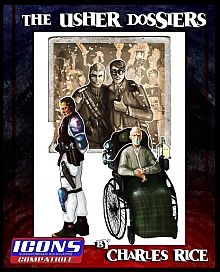
As far as I'm concerned, and no disrespect intended to anyone else, but Vigilance Press is the best thing to happen to the ICONS game, period. It's not just the volume of support, as impressive as that is, but it is the quality of support, and they are trying to raise the bar all of the time.
A while back we got Public Enemies, which was a sneak peek at the future of their World War II universe. Now, we have The USHER Dossiers, which should truly open it up for us. The PDF is 137 pages, in color, and is fully bookmarked. It is available for $7.95 from RPG, certainly a fair price for the size of the product, and is made with ICONS in mind.
INTRODUCTION
The author notes here that this is advancing the World War II timeline up to the present, and it is apparently being left open for individual games to develop, rather than pushing a continued plot.
TIMELINE
We do hit one snafu right off, as there is a placeholder for art that was never filled...and is still sitting there calling for a black and white picture of two heroes, photo style.
We do get a heads up that the timeline is not meant to be a major history lesson, but to focus on metahuman events specifically. We also learn that the metahuman population exploded pretty dramatically from World War II on.
ERAS IN METAHUMAN HISTORY
The first such major era is the Era of the God Kings, which ran from about 5,000 BC, up through 200 CE. Metahumans were scattered among human history and were largely tied in with what we consider myths now.
The Era of the Warrior Saints also tracked the decline of Pagan religions and the rise of Christianity and other monotheistic religions, with many of those metahumans being hailed as saints.
The Era of National Heroes began around 1700, and helped lead to the metahuman-powered World War II that Vigilance Press has released so many cool supplements for.
The major Metauman events start with the birth of a man in South Africa in the year 70,000 BC, who has multiple powers, including immortality, known as the Forever Man. He was THE Major superpowered being for thousands of years.
Around 5000 BC to 2300 BC, we get a number of nods to Greek and Norse myth, such as Hercules rising up and helping to kill Zeus, and the decline of the Aesir, culminating in war between Thor and Loki.
During the Roman Empire, the Forever Man resurfaces and plays an integral role in events, though even he is unable to prevent Rome's fall.
As we get into the 1100s, some nods to the World War II era heroes begin to surface, laying the groundwork for later legacies.
The timeline runs through the late 30s, where the rise of the Eugenics Brigade occurs, and the bulk of the World War II material is set. We begin to learn the aftermath of World War II in the USHERverse, as Old Glory and Captain Amazing are given full blown military posts running USHER in its secret base under Liberty Island.
1949 sees the rise of Aegis, a NATO sponsored superhuman group, led by Big Ben (who has been in legal struggles with England since the end of the war). 1954 gives us an army of mutated ants in Brazil, whose true source isn't uncovered until 1956, and 1957 sees some of the living legends of World War II tragically killed putting an end to it.
Captain Amazing (now known as Savant), creates what will ultimately be a thorn in USHER's side when he constructs Medusa, a dangerous artificial intelligence.
2001 sees a major turning point when Scion, a member of a metahuman family originally from Earth, returns from the stars and suckers the planet, taking over as Emperor of Earth...the metahumans rise up against him and ultimately prevail, and it is in the aftermath of this that we take over the Vigilance universe in our games.
One thing I want to make clear: I did not do the history section justice at all. Not even a little bit. There are some great narratives weaved in and out of the history, and a great job is done providing a universe that has "real time" instead of the Marvel and DC "sliding time", as well as a universe that's not necessarily dark and gritty, but does have consequences (like people dying and staying dead, rather than a big Revolving Door of Life and Death).
ORGANIZATIONS
These are a number of organizations prominent in the universe, and each are given a brief overview of history and purpose, as well as a sidebar detailing any specific requirements for joining, plus suitable Qualities and Challenges for members, and relevant timeline references for each group.
The Doleman Center for Advanced Studies is kinda like Xavier's School for Gifted Youngsters...okay, not exactly, but that's what came to mind. It began as a safeguard against mutant oppression, and is a benevolent organization as written. It does currently serve to train mutants how to use their powers responsibly.
I really like The Institute, who are disabled veterans given a new lease on life through cybernetics, in order to wage a covert war against aliens. We get a "standard" operative here as well.
M.A.N is the Mutant Army of Nationalism...I don't know if I see how that exactly makes sense, but crazy extremists generally don't. These guys are the setting's Brotherhood of Evil Mutants/Mutant Liberation Front.
Medusa is the agency that has been built on the back the Medusa super computer created by The Savant. They are not EXACTLY bad guys...but they are not EXACTLY good guys, either. A generic operative stat block is provided here as well.
The Old Guard are a bunch of racist toe rags. Luckily, they tend to fight M.A.N. as much as, or more than, anything else...leading to bad dudes fighting each other. A White Knight of the Old Guard is provided.
The Omega Syndicate are an organization of assassins, all of whom wear the same "face". He can be everywhere, and if he dies...well...it never lasts, because there's someone else to wear the mask. A generic "Omega" is provided.
The Pawn Broker provides supervillains with henchmen (Pawns and Knights), as well as equipment and the like. A sample Pawn is provided, as is a Knight. I can't help but think the pictures here are mixed up, as the Knights are carrying guns (with no skill), and have a much higher Strength than the Pawn, who is built like a typical brick.
TEA is the Time Enforcement Agency, a group of Time Cops. USHER still treats them with suspicion, as they have yet to figure out their true agenda.
USHER is the main metahuman peacekeeping organization, and their write-up includes a sample agent.
Four subdivisions are provided as well: The Atlas Battalion, The Blue Knights, the Nighthawks and the Pegasus Squadron.
KNOWN ALTERNATE TIMELINES
Pretty standard trope for comics stuff. This is set up with an in character interview with Chronicle (of TEA).
Dark Future is a the world that spawned The Black Knight, the leader of The Old Guard. In addition to a breakdown of the timeline, we get a list of the notable refugees from Dark Future (and there are a few).
Hell is the name given to the reality that helped "make" Walter Frazier, a psychotic time traveler who first appeared in Public Enemies.
Post-Apocalyptia is a very bleak place with a bright ray of hope...and some unusual healing properties, apparently.
Reverse World is a complete flip flop. Heroes are villains and vice versa.
The Thousand Year Reich is a reality in which a powerful Thule sorcerer tipped the scales for the Axis powers, winning them World War II, and putting them in control of pretty much everything.
METAHUMANS
Ironically, the first NPC listed doesn't appear to be a Metahuman. The Benefactor is a United States senator who offers heroes extra goodies and information, but hides his identity.
Black Knight comes from a future where USHER has gone bad...and he's here, having taken over the Old Guard and using them to continue his mutant hating agenda.
Chronicle is an immortal time traveler and the founder of TEA. In theory, he's a good guy...USHER suspects he has an agenda.
Exclusive is a superpowered journalist that no one really likes.
Forever Man has been around...pretty much forever.
Minute Man is a patriotic time manipulator.
Old Glory is a bonafide living legend, and the leader of USHER.
Professor and Moll are kinda creepy. A drug pusher and his superstrong (female) henchman...with a twist.
Savant would be Captain Amazing, aged and ravaged by cancer.
Last is Scion, the now imprisoned former Emperor of Earth.
THOUGHTS
I've made no bones about being a fan of the Vigilance Universe and the World War II releases. Some great work was done in creating a setting with actual time progression, and the idea of playing in World War II and then zooming ahead to the here and now to see how it all turned out is pretty cool.
As is common with the Vigilance stuff, there are a lot of people, places and things that are clearly inspired by existing comic source material, but nothing that feels overtly ripped off, and that's a good thing. For better or for worse, depending on your point of view, there is still room for expansion as some noted characters, like Crusher (leader of MAN) are never really expanded upon (and there is no mention of him no longer being in power).
The worst part, unfortunately, is the editing. I mentioned what appeared to be a picture swap between Knights and Pawns, and the missing picture at the beginning of the book...but typos abound. Not just inside the text, but in headers as well (such as the Post-Apocalyptia timeline). These issues are common enough and large enough that it drags the overall presentation of the book down, unfortunately. Extra time or an additional editor probably would have made a world of difference.
It is also worth noting that the book lacks both a table of contents and an index. Personally, I don't think that's a huge deal in a bookmarked PDF (though a couple of those are out of place), if this were to be released as a print product, that is basically unforgivable for a book that is larger than 100 pages, in my opinion.
Technical issues aside, it is still a very good product that manages to have its own feel, rather than just a Marvel/DC mash-up or the like. If you have liked the previous Vigilance Press releases, you will probably find a lot to like here.
As far as I'm concerned, and no disrespect intended to anyone else, but Vigilance Press is the best thing to happen to the ICONS game, period. It's not just the volume of support, as impressive as that is, but it is the quality of support, and they are trying to raise the bar all of the time.
A while back we got Public Enemies, which was a sneak peek at the future of their World War II universe. Now, we have The USHER Dossiers, which should truly open it up for us. The PDF is 137 pages, in color, and is fully bookmarked. It is available for $7.95 from RPG, certainly a fair price for the size of the product, and is made with ICONS in mind.
INTRODUCTION
The author notes here that this is advancing the World War II timeline up to the present, and it is apparently being left open for individual games to develop, rather than pushing a continued plot.
TIMELINE
We do hit one snafu right off, as there is a placeholder for art that was never filled...and is still sitting there calling for a black and white picture of two heroes, photo style.
We do get a heads up that the timeline is not meant to be a major history lesson, but to focus on metahuman events specifically. We also learn that the metahuman population exploded pretty dramatically from World War II on.
ERAS IN METAHUMAN HISTORY
The first such major era is the Era of the God Kings, which ran from about 5,000 BC, up through 200 CE. Metahumans were scattered among human history and were largely tied in with what we consider myths now.
The Era of the Warrior Saints also tracked the decline of Pagan religions and the rise of Christianity and other monotheistic religions, with many of those metahumans being hailed as saints.
The Era of National Heroes began around 1700, and helped lead to the metahuman-powered World War II that Vigilance Press has released so many cool supplements for.
The major Metauman events start with the birth of a man in South Africa in the year 70,000 BC, who has multiple powers, including immortality, known as the Forever Man. He was THE Major superpowered being for thousands of years.
Around 5000 BC to 2300 BC, we get a number of nods to Greek and Norse myth, such as Hercules rising up and helping to kill Zeus, and the decline of the Aesir, culminating in war between Thor and Loki.
During the Roman Empire, the Forever Man resurfaces and plays an integral role in events, though even he is unable to prevent Rome's fall.
As we get into the 1100s, some nods to the World War II era heroes begin to surface, laying the groundwork for later legacies.
The timeline runs through the late 30s, where the rise of the Eugenics Brigade occurs, and the bulk of the World War II material is set. We begin to learn the aftermath of World War II in the USHERverse, as Old Glory and Captain Amazing are given full blown military posts running USHER in its secret base under Liberty Island.
1949 sees the rise of Aegis, a NATO sponsored superhuman group, led by Big Ben (who has been in legal struggles with England since the end of the war). 1954 gives us an army of mutated ants in Brazil, whose true source isn't uncovered until 1956, and 1957 sees some of the living legends of World War II tragically killed putting an end to it.
Captain Amazing (now known as Savant), creates what will ultimately be a thorn in USHER's side when he constructs Medusa, a dangerous artificial intelligence.
2001 sees a major turning point when Scion, a member of a metahuman family originally from Earth, returns from the stars and suckers the planet, taking over as Emperor of Earth...the metahumans rise up against him and ultimately prevail, and it is in the aftermath of this that we take over the Vigilance universe in our games.
One thing I want to make clear: I did not do the history section justice at all. Not even a little bit. There are some great narratives weaved in and out of the history, and a great job is done providing a universe that has "real time" instead of the Marvel and DC "sliding time", as well as a universe that's not necessarily dark and gritty, but does have consequences (like people dying and staying dead, rather than a big Revolving Door of Life and Death).
ORGANIZATIONS
These are a number of organizations prominent in the universe, and each are given a brief overview of history and purpose, as well as a sidebar detailing any specific requirements for joining, plus suitable Qualities and Challenges for members, and relevant timeline references for each group.
The Doleman Center for Advanced Studies is kinda like Xavier's School for Gifted Youngsters...okay, not exactly, but that's what came to mind. It began as a safeguard against mutant oppression, and is a benevolent organization as written. It does currently serve to train mutants how to use their powers responsibly.
I really like The Institute, who are disabled veterans given a new lease on life through cybernetics, in order to wage a covert war against aliens. We get a "standard" operative here as well.
M.A.N is the Mutant Army of Nationalism...I don't know if I see how that exactly makes sense, but crazy extremists generally don't. These guys are the setting's Brotherhood of Evil Mutants/Mutant Liberation Front.
Medusa is the agency that has been built on the back the Medusa super computer created by The Savant. They are not EXACTLY bad guys...but they are not EXACTLY good guys, either. A generic operative stat block is provided here as well.
The Old Guard are a bunch of racist toe rags. Luckily, they tend to fight M.A.N. as much as, or more than, anything else...leading to bad dudes fighting each other. A White Knight of the Old Guard is provided.
The Omega Syndicate are an organization of assassins, all of whom wear the same "face". He can be everywhere, and if he dies...well...it never lasts, because there's someone else to wear the mask. A generic "Omega" is provided.
The Pawn Broker provides supervillains with henchmen (Pawns and Knights), as well as equipment and the like. A sample Pawn is provided, as is a Knight. I can't help but think the pictures here are mixed up, as the Knights are carrying guns (with no skill), and have a much higher Strength than the Pawn, who is built like a typical brick.
TEA is the Time Enforcement Agency, a group of Time Cops. USHER still treats them with suspicion, as they have yet to figure out their true agenda.
USHER is the main metahuman peacekeeping organization, and their write-up includes a sample agent.
Four subdivisions are provided as well: The Atlas Battalion, The Blue Knights, the Nighthawks and the Pegasus Squadron.
KNOWN ALTERNATE TIMELINES
Pretty standard trope for comics stuff. This is set up with an in character interview with Chronicle (of TEA).
Dark Future is a the world that spawned The Black Knight, the leader of The Old Guard. In addition to a breakdown of the timeline, we get a list of the notable refugees from Dark Future (and there are a few).
Hell is the name given to the reality that helped "make" Walter Frazier, a psychotic time traveler who first appeared in Public Enemies.
Post-Apocalyptia is a very bleak place with a bright ray of hope...and some unusual healing properties, apparently.
Reverse World is a complete flip flop. Heroes are villains and vice versa.
The Thousand Year Reich is a reality in which a powerful Thule sorcerer tipped the scales for the Axis powers, winning them World War II, and putting them in control of pretty much everything.
METAHUMANS
Ironically, the first NPC listed doesn't appear to be a Metahuman. The Benefactor is a United States senator who offers heroes extra goodies and information, but hides his identity.
Black Knight comes from a future where USHER has gone bad...and he's here, having taken over the Old Guard and using them to continue his mutant hating agenda.
Chronicle is an immortal time traveler and the founder of TEA. In theory, he's a good guy...USHER suspects he has an agenda.
Exclusive is a superpowered journalist that no one really likes.
Forever Man has been around...pretty much forever.
Minute Man is a patriotic time manipulator.
Old Glory is a bonafide living legend, and the leader of USHER.
Professor and Moll are kinda creepy. A drug pusher and his superstrong (female) henchman...with a twist.
Savant would be Captain Amazing, aged and ravaged by cancer.
Last is Scion, the now imprisoned former Emperor of Earth.
THOUGHTS
I've made no bones about being a fan of the Vigilance Universe and the World War II releases. Some great work was done in creating a setting with actual time progression, and the idea of playing in World War II and then zooming ahead to the here and now to see how it all turned out is pretty cool.
As is common with the Vigilance stuff, there are a lot of people, places and things that are clearly inspired by existing comic source material, but nothing that feels overtly ripped off, and that's a good thing. For better or for worse, depending on your point of view, there is still room for expansion as some noted characters, like Crusher (leader of MAN) are never really expanded upon (and there is no mention of him no longer being in power).
The worst part, unfortunately, is the editing. I mentioned what appeared to be a picture swap between Knights and Pawns, and the missing picture at the beginning of the book...but typos abound. Not just inside the text, but in headers as well (such as the Post-Apocalyptia timeline). These issues are common enough and large enough that it drags the overall presentation of the book down, unfortunately. Extra time or an additional editor probably would have made a world of difference.
It is also worth noting that the book lacks both a table of contents and an index. Personally, I don't think that's a huge deal in a bookmarked PDF (though a couple of those are out of place), if this were to be released as a print product, that is basically unforgivable for a book that is larger than 100 pages, in my opinion.
Technical issues aside, it is still a very good product that manages to have its own feel, rather than just a Marvel/DC mash-up or the like. If you have liked the previous Vigilance Press releases, you will probably find a lot to like here.
Friday, December 10, 2010
Tommy's Take on Panzer-Ritter, Werewolves & Stormtroopers
 DER PANZER-RITTER
This ICONS BattleScene isn't the first encounter with a giant robot, but this one is markedly different than the previous one, a Japanese Robot in Operation: Bookbinder. In this one, Der Panzer-Ritter is a fusion of magic and technology, powered by a combination of German scientists and Thule wizards.
In fact, this one has an interesting extra option that can be unleashed if the fight with the Panzer-Ritter goes too easily, as the robot's very power source can prove to be hazardous to the PCs.
This one feels incredibly "to the point", and a bit lighter than some of the other Battlescenes, but is also a very nice twist on a similar encounter that has already been used.
THE WEREWOLVES OF THE GESTAPO

Again, we keep the focus on the Germans, this time with their lycanthrope stormtroopers.
Like the previous WWII adventures, it is assumed that you are using Vigilance Force, The People's Revolution or The Crown Guard, though you can make your own characters for it. There are two separate "set-ups" provided, with one being for the Russians and the other being for either Americans or British.
In either case, it is an extraction scenario, requiring that you deal with the werewolf gestapo (as the name implies), with the actual target changing based off of your "home" faction.
While none of the Battlescenes are meant to be in-depth (they are, in fact, meant to be combat set pieces), this one does have a little more potential for variation in the outcome of events, with the PCs approach possibly altering the number of soldiers - werewolf or otherwise - that they have to deal with, as well as potentially taking it from an extraction scenario into a chase scenario.
Provided are stats for werewolves, Silver Warwolves and Psychic Agents of the Nazi Occult Bureau, which can easily be lifted for your own scenarios. A very nice addition to the line-up.
STORMTROOPERS OF THE DEEP

This scenario puts the PCs out to see, guarding a mysterious package on a convoy, amid the news that the Nazis have another new trick up their sleeve, some kind of aquatic attack force. Though it is only mentioned as a possibility, if you're running the scenario, the PCs will encounter the new bad guys.
This Battlescene entry is pretty robust, providing a new heroic NPC as well as a few new NPC statblocks. The scenario is easily expanded to switch from merely having the PCs hold off the convoy attack, to allowing the PCs to find the undersea base that the Nazis have launched from and try to take it out.
Plenty of bang for your - literal - buck with this one as Vigilance Press continues to impress with their WWII entries for ICONS.
Tuesday, November 23, 2010
Tommy's Take on the Field Guide to Superheroes! Vol. 1 (ICONS)
The ICONS Field Guide To Super Heroes is an interesting product by Vigilance Press. Normally known for their wonderful World War II stuff, this is a stark change of pace from your typical supers supplement: It's a book of HEROES...not JUST pre-made heroes, but an examination of hero archetypes for players to use as inspiration. It seems that it will ultimately be a four volume series, with this holding the first ten.

The first volume is $7.95, full color and contains 10 archetypes...it also runs 75 pages. The version I have lacks both a table of contents and bookmarks, and seems to lack searchability since I punched several of the archetypes into the search bar and got no results.
First up, we get a classic goodie in the Alien Hero. Dan Houser provides all of the art, and we essentially get 20 character shots as we get a nameless Alien Hero (who mixes some features of a Skrull, the Martian Manhunter in his "true" form and a completely different coloration) as well as a fleshed out sample Alien Hero (the golden skinned Matrix). Every entry gets handled this way.
The first entry cites example Alien Heroes from the comics (such as the aforementioned Martian Manhunter), as well as Challenges and Qualities common to the character type, plus typical powers. Abilities, Specialties and even a tip on making up an all Alien Hero team (citing Guardians of the Galaxy, which I'm reasonably sure has never had an all Alien line-up due to the presence of at least one earthling on each team).
Matrix gets a completely fleshed out character sheet including three pages of background and plot seeds. He's an alien hiding among humans as a mutant, and gets a new power (detailed in this book) called Adaptation - meaning he gets the power that helps him the most against his opponent, but has no control over what power it is.
The Android gets a very nice treatment, with a focus on how Androids can always be rebuilt, after all, and so Android heroes tend to be selfless.
We get the Android hero Victor - who a sidebar does acknowledge is incredibly stacked - who gets rebuilt after every destruction more powerful than the last time.
The Animal Hero gets a very light treatment despite ackowledging that there are two types: Powerless heroes with gadgets and empowered "totem" heroes.
The Eagle's entry boasts what amounts to a utility belt power, and is a bit of an American symbol with wings.
The Armored Wonder covers your Iron Man types, complete with a patriotic sample named...The Patriot (not to be confused with Norman osborn's Iron Patriot). In fact, in a nice twist, The Patriot is a female inside the suit of armor.
The Astronaut is the Adam Strange type Astronaut, and includes Moonshot, who as a brainy, gal-next-door type...just in space.
Avatars are Gods, or close to it. Here we get our Thors as well as New Gods like Orion. The sample here is the Greek Prometheus, cursed with Immortality and fighting as a hero, inspired by the superheroes in the world.
I take issue with the Comic Relief entry, namely with the samples: The art makes me think of Speedball, who isn't listed, and cites Squirrel Girl (Who has defeated DOOM - okay, maybe I'm overthinking this) and Elongated Man (I admit I'm not familiar with his earlier stuff, but in all of the recent stuff I've read, he's FAR more capable than Comic Relief)...I would have accepted Slapstick or Plastic Man, though. Wundermaus has, among his qualities, the humorous "voiced by Samuel L. Jackson".
The Creepy Hero kinda confuses me as well...I guess I'm just not seeing Nightcrawler and Spider-Man as "creepy". We get the Fabulous Frog Girl as our iconic here.
The Dark Avengers entry looks pretty great, other than the questionable addition of Nightwing there among the samples. Again, not an example I would use. It is noted that Dark Avengers tend to not have Powers, and tend to clock in at 6s on at least a couple of abilities. Our sample here is an interesting character called Veil, a dual-gun weilding arab woman.
Finally, we get the Defender, which are heroes who - er - defend...usually specific tracts of land.
The book concludes with a 9 page Lexicon of important names and terms from the setting each of the sample characters belong to, the Worlds of Wonder setting.
CONCLUSIONS
At 75 Pages, bookmarks at least would have been great. I like the book, but I don't love it. Honestly, a bunch of hero write-ups as samples are a good idea, but where this book should shine is on the making the archetype stuff...and that's generally a page or two versus a four or so page NPC write-up (none of whom just jump out at me like some of the NPCs in other Vigilance Press products). I won't judge the setting yet, as we're only getting glimpses...but yeah, you can't hang much on that part of the book yet, because there's still (presumably) so much to uncover. I can't even get too excited about the story seeds, because most of those really seem like they will only work with players actually playing the sample heroes, and wouldn't work as well with the samples in an NPC role (though there are exceptions).
Other than a few questionable examples, I generally enjoyed all of the archetype stuff however, and there is some great advice on building and playing each type of hero.
Honestly, I think I would give this a stronger recommendation if the archtype material and the sample heroes/setting material had been seperated and sold in seperate products...as it is, the archetype material is really, really good while the whole idea of laying out the world in characters' backstories over four volumes is...not the way I would have gone.
Recommended, but not a strong recommendation.
The first volume is $7.95, full color and contains 10 archetypes...it also runs 75 pages. The version I have lacks both a table of contents and bookmarks, and seems to lack searchability since I punched several of the archetypes into the search bar and got no results.
First up, we get a classic goodie in the Alien Hero. Dan Houser provides all of the art, and we essentially get 20 character shots as we get a nameless Alien Hero (who mixes some features of a Skrull, the Martian Manhunter in his "true" form and a completely different coloration) as well as a fleshed out sample Alien Hero (the golden skinned Matrix). Every entry gets handled this way.
The first entry cites example Alien Heroes from the comics (such as the aforementioned Martian Manhunter), as well as Challenges and Qualities common to the character type, plus typical powers. Abilities, Specialties and even a tip on making up an all Alien Hero team (citing Guardians of the Galaxy, which I'm reasonably sure has never had an all Alien line-up due to the presence of at least one earthling on each team).
Matrix gets a completely fleshed out character sheet including three pages of background and plot seeds. He's an alien hiding among humans as a mutant, and gets a new power (detailed in this book) called Adaptation - meaning he gets the power that helps him the most against his opponent, but has no control over what power it is.
The Android gets a very nice treatment, with a focus on how Androids can always be rebuilt, after all, and so Android heroes tend to be selfless.
We get the Android hero Victor - who a sidebar does acknowledge is incredibly stacked - who gets rebuilt after every destruction more powerful than the last time.
The Animal Hero gets a very light treatment despite ackowledging that there are two types: Powerless heroes with gadgets and empowered "totem" heroes.
The Eagle's entry boasts what amounts to a utility belt power, and is a bit of an American symbol with wings.
The Armored Wonder covers your Iron Man types, complete with a patriotic sample named...The Patriot (not to be confused with Norman osborn's Iron Patriot). In fact, in a nice twist, The Patriot is a female inside the suit of armor.
The Astronaut is the Adam Strange type Astronaut, and includes Moonshot, who as a brainy, gal-next-door type...just in space.
Avatars are Gods, or close to it. Here we get our Thors as well as New Gods like Orion. The sample here is the Greek Prometheus, cursed with Immortality and fighting as a hero, inspired by the superheroes in the world.
I take issue with the Comic Relief entry, namely with the samples: The art makes me think of Speedball, who isn't listed, and cites Squirrel Girl (Who has defeated DOOM - okay, maybe I'm overthinking this) and Elongated Man (I admit I'm not familiar with his earlier stuff, but in all of the recent stuff I've read, he's FAR more capable than Comic Relief)...I would have accepted Slapstick or Plastic Man, though. Wundermaus has, among his qualities, the humorous "voiced by Samuel L. Jackson".
The Creepy Hero kinda confuses me as well...I guess I'm just not seeing Nightcrawler and Spider-Man as "creepy". We get the Fabulous Frog Girl as our iconic here.
The Dark Avengers entry looks pretty great, other than the questionable addition of Nightwing there among the samples. Again, not an example I would use. It is noted that Dark Avengers tend to not have Powers, and tend to clock in at 6s on at least a couple of abilities. Our sample here is an interesting character called Veil, a dual-gun weilding arab woman.
Finally, we get the Defender, which are heroes who - er - defend...usually specific tracts of land.
The book concludes with a 9 page Lexicon of important names and terms from the setting each of the sample characters belong to, the Worlds of Wonder setting.
CONCLUSIONS
At 75 Pages, bookmarks at least would have been great. I like the book, but I don't love it. Honestly, a bunch of hero write-ups as samples are a good idea, but where this book should shine is on the making the archetype stuff...and that's generally a page or two versus a four or so page NPC write-up (none of whom just jump out at me like some of the NPCs in other Vigilance Press products). I won't judge the setting yet, as we're only getting glimpses...but yeah, you can't hang much on that part of the book yet, because there's still (presumably) so much to uncover. I can't even get too excited about the story seeds, because most of those really seem like they will only work with players actually playing the sample heroes, and wouldn't work as well with the samples in an NPC role (though there are exceptions).
Other than a few questionable examples, I generally enjoyed all of the archetype stuff however, and there is some great advice on building and playing each type of hero.
Honestly, I think I would give this a stronger recommendation if the archtype material and the sample heroes/setting material had been seperated and sold in seperate products...as it is, the archetype material is really, really good while the whole idea of laying out the world in characters' backstories over four volumes is...not the way I would have gone.
Recommended, but not a strong recommendation.
Sunday, November 14, 2010
Tommy's Take on The Ice Palace
 The Ice Palace, like previous ICONS adventures by Vigilance Press, assumes that you are playing in World War II, as Allied heroes. In fact, any of the previous team books can be used with no adjustments at all, both as PCs and NPCs.
The product is very light on art, which translates into being a lot of text crammed into the $2 package.
To be safe, there are spoilers after the jump:
Tuesday, October 19, 2010
Tommy's Take on Public Enemies

The art, by the Louis Porter Jr. design crew, all has a very "90s" feel to it, and if you read comics, you probably know what I'm talking about. Lots of armor, grittiness, scars and ponytails. That's not a criticism, just an observation. Though not every piece was done by the same artist, there is a uniformity (is that a word?) to the art, giving it a distinctive feel.
In the introduction, we learn that Alcatraz has been converted into a Super Prison...although no one is sure exactly WHEN that happened...appparently supers have been locked away there since before the prison as we know it was shut down.
Presumably more of the setting will be revealed over time, as bits and pieces keep getting dropped here and there, such as something about the Scion, who are apparently an alien race that attacked the earth. This is relevant due because it ties into the backstory of Armory, the first villain on the list. She reminds me a bit like what would happen if Screaming Mimi had gotten the Moonstones instead of Karla Sofen (and if you don't read Marvel Comics, that sentence was lost on you).
Atrocity is the first callback to the World War II books, as he was the head of a program trying to duplicate the Eugenics program...now he's a nearly mindless, rampaging giant of a monster. After being turned loose on aliens, he's now even scarier. All I'm saying is, if you and your players thought Troll was a tough fight from the corebook? Eeeeesh...
Next, we meet Brainstorm, the Smartest Man Alive...and yeah, he probably is. Note that while he's not the physical juggernaut you expect from worldshaking villains, his Stamina IS still stacked, due to his willpower.
Remember how Plastic Man was a small time hood? Now picture him as a ruthless assassin. That's Garrote. He may sound like a joke, but he's got some scary stats.
Equinox are four elemental themed villains, genetically engineered to survive on other planets. They cover Earth, Air, Fire and Cold, instead of Water, with an even male-female split. My main gripe here is that we find out how they were created, but they are not mindless creatures and we don't really get anything on THEM...in fact, they have no Qualities or Challenges, except Gale Force, who is the CEO of Equinox Industries. (They do have Team Qualities and Challenges, but that doesn't tell us anything about them as individuals, making it hard to look at them as anything but a collection of powers).
Ground Zero actually isn't a villain...he's just a threat to all life on Earth, aside from Atrocity. He's also an incredibly interesting character because of it.
The Hollow Men are a group of superpowered homocidal killers led by a man who claims to be from the future, and his collected his band of maniacs to drive the population down below 1 billion. Unlike Equinox, these guys are pretty well developed...with Frazier absolutely convinced that he's only doing what is best to protect humanity from itself...and most of his killers seem to agree.
Omega is a CIA spook turned supervillain after acquiring an amazing weapon...and then turned themselves in so that USHER (this world's equivalent to SHIELD) could protect them from the creators of the amazing weapon...'cause they kinda wanted it back.
Overtone started off as a hero...until the other heroes realized that he meant to clean up the streets via murdering villains instead of locking them away.
Shillelagh is one of the fey folk, but he doesn't look like any kind of fey you typically see, bearing more of a resemblance to Hercules, physically speaking.
Skullcap is a soldier gone mad, who had has body heavily modified until he's now superhuman. Reminds me a bit of Crossbones from Captain America, upgraded to an A-list villain.
Stigma is the grandson of Big Ben (from the Crown Guard), and the twin brother of the current Big Ben...they kinda wound up on opposite ends of things, as comic book twins tend to. In a nice twist, he was scarred in battle with his brother and no matter how his face is repaired, his scar reappears every time he uses his growing powers.
Finally, we have Tower, who is a homocidal robot built by The Savant (who is apparently a former ally of USHER, and perhaps the only man as smart as Brainstorm...and not currently imprisoned in Rock City, hence his lack of inclusing in this book).
Once again, Vigilance Press impresses me with another strong entry, and their largest one to date. I'm curious to see if we are getting a full setting book, or more small supplements building a larger picture.
As for the book itself, several of the villains have no HARD ties to a setting...I mean, almost all of them have "Enemy: USHER"...but you could cut that out and replace it with the government watchdog agency of your choice. Others, you might have to tweak a bit more if you wanted to use them in your own setting as opposed to this one...(not tweak mechanically, other than changing the odd Challenge like Enemy: USHER, just tweak backstories)...Stigma is probably the one most heavily tied to the setting. Even Atrocity could have his backstory switched up with little effort if you wanted to remove him from the WWII-verse Vigilance Press has laid out.
If you like ICONS, get this. If you like supers stuff, it may still be worth it for idea mining, given the price point. As for me, I could see myself piecemealing a setting together from various ICONS products...
Friday, October 8, 2010
Tommy's Take on Vigilance Force, Eugenics Brigade and Crown Guard


Vigilance Force: Heroes of WWII is the first supplement for ICONS by Vigilance Press.
Here's the thing about ICONS: I want to like it, I really do. The whole package looks very charming. The Marvel FASERIP influence is great. The writing is just...I feel like too much got glossed over with a "Hey, if you don't like a rule, change it, champ!" approach. And in actual play, I didn't really feel like it held up.
Why am I saying all of this? Because there is some cool third party stuff coming out for ICONS, like ION Guard. Vigilance Force is the first book establishing a World War II setting for ICONS, and it is not all happy, Silver Age fun like the ICONS core leans towards. Instead, it comes across fairly hard nosed, with some very lovely, gritty art by Jon Gibbons (supplemented by art by Dan Houser which is nice, but a sharp contrast).
For $2, you get 14 pages of setting and superheroes, designed to be used as PCs for a WWII game. They do provide the Team Qualities, Challenges and Resources for those who wish to use the team rules in the ICONS rulebook.
There are some very cool characters here, my favorite being Freight Train, a super speed brick (not a combo you usually see outside of Superman). Agent Liberator is a lot like an amalgam of Captain America and The Comedian (from the Watchman) and Marauder sure seems heavily inspired by (though far from ripped off of, don't get me wrong) Wolverine.
In fact, there are very cool influences all over Vigilance Force that are nice homages and not just "serial numbers filed off".
The downsides? Unless I am just missing it, Captain Miracle has no backstory. Dan Houser contributes one piece, and it's fine, but it sticks out like a sore thumb next to Jon Gibbons. Not calling either style better than the other, just saying they clash...bad. I would have liked individual pics, instead of trying to figure out who was who in the group shot, personally. Finally, I don't run games with pregens, so for a guy like me, a team of superHEROES isn't incredibly useful. Not useLESS, just not the most useful. That said, for $2, there is some great inspiration in here.
I'd jump all over a BASH version, personally.
THE EUGENICS BRIGADE: VILLAINS OF WWII
The Eugenics Brigade are the counter balance to the Vigilance Force. In fact, they are the reason Vigilance Force was formed, and they are far more useful because villains tend to be far more useful for a GM than heroes do.
One of my gripes from Vigilance Force is present here as well, as several characters don't get any art, though there seems to be more individual art here than there was in Vigilance Force.
The first villain we get is a scantily-clad, nazi slutbomb stereotype (though she is a ballerina and not a dominatrix) named Charismatic, and thankfully she gets a picture. She has a twin sister with Luck Control powers to complete the ensemble.
Fireproof is the Nazi answer to the fiery hero Old Glory, and War Hound plays the Sabretooth to Marauder's Wolverine.
The two that impress me the most are Uberkrieger and Ubermensch, the Super Soldier and the Super Man. Underkrieger is just UGLY, with a large rifle and metallic jaws, while Ubermensch is, thankfully, not nearly as versatile as the real Superman.
There are other villains, as well as some cannon fodder such as soldiers in jetpacks, mystics and the rejects from the Eugenics program.
For $2 this offers much more bang for its back than its predecessor, due to villains simply being more useful, as noted above. Definite recommendation.
THE CROWN GUARD: HIS MAJESTY'S HEROES OF WWII
The latest in the ICONS WWII releases by Vigilance Press, The Crown Guard were the British super team that was fighting WWII before the US got involved, fending off the Eugenics Brigade.
Despite being outgunned and outmanned, the Crown Guard managed to keep Winston Churchill alive and convinced the Eugenics Brigade that they were better off attacking Russia than England.
As with Vigilance Force, this is a collection of heroes, so there is probably less utility for the average purchaser than there is with, say, a villain collection.
The PDF does include the necessary Team rules to fit the ICONS Team rules, if you wanted to run a Crown Guard game.
We get Big Ben, the prototypical giant brick.
Espirit is a French agent with phasing and invisibility, hence the name. Reminds me a lot of a random character I generated back for Marvel FASERIP who was ALSO a spy, and also had Mind Control...so I have a certain fondness for the character type.
Excalibur actually carries Excalibur, as well as a couple of other artifacts, making him a tough customer.
Grizzly is an animalistic Canadian hero, who seems a bit like a Wolverine riff taken the opposite direction from Marauder in Vigilance Force.
Illustrious is a bit of an enigma...a compulsive liar with amazing luck and an assumed name.
Ironclad is a living machine, the greatest creation of a dying scientist.
Repulse is The Crown Guard's Master of Magnetism.
Swordfish is the setting's answer to Namor/Aquaman.
Armorer is a supergenius inventor, trying to liberate his native Poland.
And last is John Bull, the only "successful" attempt at recreating the Nazi supersoldier project...leaving him with the appearance of a minotaur.
Again, like with Vigilance Force, there are a lot of obvious homages, but nothing I would call overtly ripped off. Even Swordfish feels like his own man and not like either Namor or Aquaman specifically.
There's the odd piece of art, but there is a big, group picture that you can use to suss out just who is who in the group. It's a good product in a good line...if World War II in ICONS interests you, then I recommend picking it up.
Subscribe to:
Posts (Atom)