Hey all,
Wiggy Wade-Williams, RPG writer and longtime friend of this blog, is in bad shape after suffering *three* strokes this year, and Bundle of Holding has released a Necropolis 2350 bundle to support him.
If you're not familiar with Wiggy's work, he was foundational in the early days of Savage Worlds (including the Savage World of Solomon Kane, which is a bonafide masterpiece in my book), before going on to create Triple Ace Games, where he released Hellfrost and Necropolis 2350 for Savage Worlds, as well as a slew of great games for the Ubiquity System, such as Leagues of Adventure, Leagues of Gothic Horror, and All for One: Regime Diabolique.
He's also spoken very highly of me as a reviewer, citing me as one of his only three reviewers he reads, because of my objectivity in my reviews, and how I "review games for what they are, not what he(I) would like them to be".
He is a ridiculously talented, and prolific, dude, and hopefully he can get back on his feet. His contributions to my gaming, and his vote of confidence in my blogging and reviewing, cannot be understated by me.
Tommy

The Proof Is In the Fun

Showing posts with label Hellfrost. Show all posts
Showing posts with label Hellfrost. Show all posts
Thursday, November 14, 2019


Wednesday, June 20, 2018
TAG @ Ten Sales
In case you hadn't heard, Triple Ace Games turned 10 years old, and they are celebrating with a pair of "Greatest Hits" style bundles for Savage Worlds and Ubiquity.


This may surprise you, but I own more books in the Ubiquity Bundle than I do the Savage Worlds bundle.
I previously reviewed All For One.
The upside is, these bundles are a GREAT deal for the price. The downside is, they are not set up like traditional RPGNow bundles, meaning you don't get a discount for the books you already own, which is an unfortunate decision.
Still a great celebration of a great publisher.
DISCLAIMER: The links in this article contain my affiliate link. Purchases made via that link may provide me with a percentage of the sale in store credit.

SAVAGE WORLDS BUNDLE
This includes all four main Hellfrost books (Player's Guide, Bestiary, Gazetteer and Land of Fire core rules), the Arcane Lore and Atlas supplements, Necropolis 2350 and Incinerator's Handbook, All For One Savage Worlds version and Sundered Skies. And this is all for $30.
There's some great stuff here. Hellfrost is especially brilliant, as I opined in my reviews, and I'm actually using a lot of Hellfrost stuff in my current Savage Pendragon campaign.
Hellfrost Player's Guide
There's some great stuff here. Hellfrost is especially brilliant, as I opined in my reviews, and I'm actually using a lot of Hellfrost stuff in my current Savage Pendragon campaign.
Hellfrost Player's Guide

UBIQUITY BUNDLE
The Ubiquity Bundle is also $30 and includes some great stuff, like Leagues of Adventure (plus Plateau of the Ape Men and the Weird Science Compendium), Leagues of Gothic Horror (plus the Ministry of Unusual Affairs, the Guide to Apparitions and the Guide to Mordavia), Leagues of Cthulhu and the Ubiquity version of All For One: Régime Diabolique and Adventure Companion 1.
I previously reviewed All For One.
The upside is, these bundles are a GREAT deal for the price. The downside is, they are not set up like traditional RPGNow bundles, meaning you don't get a discount for the books you already own, which is an unfortunate decision.
Still a great celebration of a great publisher.
DISCLAIMER: The links in this article contain my affiliate link. Purchases made via that link may provide me with a percentage of the sale in store credit.
Friday, November 23, 2012
Camp Myth, Land of Fire and War of the Dead Kickstarters
It's holiday crunch time, and I'm dealing with electronics failures around the house, as well as missing work due to holidays, plus my kid's birthday just passing and Christmas around the corner, so I'm having to back off of supporting any Kickstarters financially for the time being, much as I'd like to.
That said, I can sure point them out to you, so here's a trifecta of Kickstarters I feel deserve your support:
Camp Myth by Third Eye Games
Using the same system found in Mermaid Adventures, Camp Myth seems to be a good alternate for those guys who were looking for an RPG for their kids, but found Mermaid Adventures to be a hard sell. In Camp Myth, you play a mythical creature attempting to score merit badges by doing things like Kraken Fishing, Golem Building and Unicorn Taming. Honestly, it sounds really cool. With 9 days left to go, it still needs nearly $2,000, however.
$15 gets you the book in PDF, along with the Phoenix Watching e-book, while $35 gets you the print version.
Hellfrost: Land of Fire by Triple Ace Games
Honestly, I'm hard pressed to find a better example of a small press publisher with a track record for both content and quality than Paul Wade-Williams (better known as Wiggy), but Land of Fire, the Arabian Nights expansion for the amazing Savage Worlds setting Hellfrost, is still about 4,000 lbs pounds shy of its goal with 14 days left. Hellfrost, like most of Triple Ace Games' material, is pretty amazing and I have little doubt that Wiggy would work his magic again with Arabian Nights.
7 pounds (about $11, I think) will get you the PDF, while you can get the PDF and an adventure for 16 pounds or the print version for 38 pounds.
World of the Dead by Daring Entertainment
Okay, I want to see this come to fruition for a few reasons...1) I think it'll be great and 2) there's a fair chance I'll be working on the book (I AM listed on the Kickstarter team). World of the Dead is the full blown setting book and Plot Point Campaign follow up to War of the Dead, the expansive, 52 week zombie apocalypse adventure saga. World of the Dead is over halfway funded with 27 days left to go.
$12 scores you World of the Dead in PDF, $25 gets you that and an exclusive adventure, $40 gets you the hardcover and an alternate adventure opening and $50 is the extravaganza, getting you World of the Dead, War of the Dead and The Paper Dead...and if you go to $60, you can complete a trilogy with that exclusive adventure from the $25 level. It's pretty much the perfect page to feed your Walking Dead obsession.
That said, I can sure point them out to you, so here's a trifecta of Kickstarters I feel deserve your support:
Camp Myth by Third Eye Games
Using the same system found in Mermaid Adventures, Camp Myth seems to be a good alternate for those guys who were looking for an RPG for their kids, but found Mermaid Adventures to be a hard sell. In Camp Myth, you play a mythical creature attempting to score merit badges by doing things like Kraken Fishing, Golem Building and Unicorn Taming. Honestly, it sounds really cool. With 9 days left to go, it still needs nearly $2,000, however.
$15 gets you the book in PDF, along with the Phoenix Watching e-book, while $35 gets you the print version.
Hellfrost: Land of Fire by Triple Ace Games
Honestly, I'm hard pressed to find a better example of a small press publisher with a track record for both content and quality than Paul Wade-Williams (better known as Wiggy), but Land of Fire, the Arabian Nights expansion for the amazing Savage Worlds setting Hellfrost, is still about 4,000 lbs pounds shy of its goal with 14 days left. Hellfrost, like most of Triple Ace Games' material, is pretty amazing and I have little doubt that Wiggy would work his magic again with Arabian Nights.
7 pounds (about $11, I think) will get you the PDF, while you can get the PDF and an adventure for 16 pounds or the print version for 38 pounds.
World of the Dead by Daring Entertainment
Okay, I want to see this come to fruition for a few reasons...1) I think it'll be great and 2) there's a fair chance I'll be working on the book (I AM listed on the Kickstarter team). World of the Dead is the full blown setting book and Plot Point Campaign follow up to War of the Dead, the expansive, 52 week zombie apocalypse adventure saga. World of the Dead is over halfway funded with 27 days left to go.
$12 scores you World of the Dead in PDF, $25 gets you that and an exclusive adventure, $40 gets you the hardcover and an alternate adventure opening and $50 is the extravaganza, getting you World of the Dead, War of the Dead and The Paper Dead...and if you go to $60, you can complete a trilogy with that exclusive adventure from the $25 level. It's pretty much the perfect page to feed your Walking Dead obsession.
Thursday, January 5, 2012
The Honorable Mentions
After compiling Tommy's Top Six, I did have a few other books that I felt needed special mention, so I'm going to do that here.
In alphabetical order:

Agents of Oblivion by Reality Blurs: This horror-espionage mash-up gives you the tools to run almost anything from James Bond to the X-Files to Men in Black. You can even amp it up further, making the PCs mutant super agents. It even meshes easily with Realms of Cthulhu for as much, or as little, crossover as you like.
WHY IT DIDN'T MAKE THE TOP SIX: Timing. If I had reviewed this in a separate year than Realms of Cthulhu, this would almost certainly have made it into the Top Six, but I have a "one book per publisher" limit that I impose on the Top Six, and at the end of the day, I feel Realms just brings more to the table.

Caladon Falls by Savage Mojo: Caladon Falls is a fantasy setting/campaign for Suzerain, taking a grittier and more warlike approach than you typically see from fantasy games. In fact, it is largely Band of Brothers meets Lord of the Rings, and it's a very impressive campaign that takes full advantage of the Savage Worlds strengths, namely the ease in PCs commanding NPCs and the Mass Combat rules.
WHY IT DIDN'T MAKE THE TOP SIX: Timing. Fact is, I had to choose between this and Savage Suzerain and as great as THIS book is, THAT book lays all the framework for the awesome twist on Savage Worlds that is Suzerain.


Hellfrost by Triple Ace Games: One of the coolest (no pun intended) fantasy settings that I was very much "late to the party" for, Hellfrost is a dark fantasy setting for Savage Worlds in a world that is freezing quickly. With some great setting rules and a gorgeous bestiary, Hellfrost won me over nearly as soon as I sprang for my copies.
WHY IT DIDN'T MAKE THE TOP SIX: Notice that I said "Hellfrost", which isn't a single book, but three books: The Hellfrost Player's Guide, The Hellfrost Gazetteer and the Hellfrost Bestiary. Honestly, I came very close to nominating both the Player's Guide (because the bulk of the setting is right there) and the Bestiary (because I love monster books, and this is a very well done monster book), but I ultimately split the difference and went with the Top Six that you saw on January 1st.

Horror Show by Bedrock Games: Bedrock Games impressed me with Terror Network and Crime Network, their anti-terrorism and mafia RPGs, neither being subject matter I'm particularly enthusiastic about. In 2011 they took their skill based system and applied it to cinematic horror, in a combination that probably shouldn't have worked as well as it did. In fact, Horror Show wound up being a very pleasant surprise for me, a well-researched horror RPG with a tested system and a lot of love behind it.
WHY IT DIDN'T MAKE THE TOP SIX: The biggest reason is that it is essentially a horror toolkit, and there are horror toolkits out there. It came THISCLOSE to making the Top Six, but I ultimately decided that Ghostories had the more unique hook that would sway someone into trying it even if they already had a go-to horror game, whereas Horror Show seems less likely to sway someone who is already pleased with their horror options.
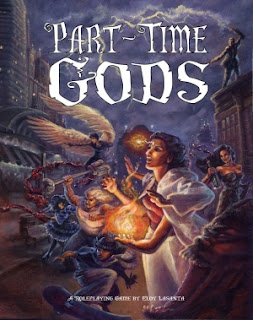
Part-Time Gods by Third Eye Games: The third corebook by Third Eye Games covers all new territory for the small, but impressive, company: Playing Gods. Sure, this isn't unheard of in RPGs, at all. Where this one is unique from those is that the Gods are still bound to their mortal lives, and have to strike a balance between being Gods and being humans. Utilizing a simplified version of the Dynamic Gaming System to bring the over the top powers of the Gods to life, Part-Time Gods is a worthy addition to the Apocalypse Prevention Inc. and Wu Xing line-ups.
WHY IT DIDN'T MAKE THE TOP SIX: Part-Time Gods was a HUGE success on Kickstarter, which led to a few top tier donors making it into the back of the book as characters. The "vanity buy-ins" just kind of annoy me. I'd prefer the page count being used for things I'll actually use...but I did only pay cover for the book, while they shelled out more. The other thing was that, for maybe the first time, I read an RPG that has multiple PC "factions" (Theologies in this game) and not one of them really GRABBED me. I can usually find a clan, tribe, group, whatever that "speaks" to me, but not this time. Kinda left me feeling like the White Wolf-esque clan approach worked against the game instead of for it this time.

Smallville High School Yearbook by Margaret Weis Productions: A fantastic resource for not only refocusing your Smallville games for a high school setting, but a great snapshot of "TV American High School". In fact, if you have the extra money and are running any kind of game set in modern American high school and need a refresher on things, I'd recommend picking it up.
WHY IT DIDN'T MAKE THE TOP SIX: In this case, I think the focus was specialized enough that if it were a complete game (like Tough Justice), I would have given it a nod. I couldn't quite do that given that it's a very specific (though well written) sourcebook for another game. Fantastic book, limited in scope, but incredibly useful for that scope.
In alphabetical order:
Agents of Oblivion by Reality Blurs: This horror-espionage mash-up gives you the tools to run almost anything from James Bond to the X-Files to Men in Black. You can even amp it up further, making the PCs mutant super agents. It even meshes easily with Realms of Cthulhu for as much, or as little, crossover as you like.
WHY IT DIDN'T MAKE THE TOP SIX: Timing. If I had reviewed this in a separate year than Realms of Cthulhu, this would almost certainly have made it into the Top Six, but I have a "one book per publisher" limit that I impose on the Top Six, and at the end of the day, I feel Realms just brings more to the table.
Caladon Falls by Savage Mojo: Caladon Falls is a fantasy setting/campaign for Suzerain, taking a grittier and more warlike approach than you typically see from fantasy games. In fact, it is largely Band of Brothers meets Lord of the Rings, and it's a very impressive campaign that takes full advantage of the Savage Worlds strengths, namely the ease in PCs commanding NPCs and the Mass Combat rules.
WHY IT DIDN'T MAKE THE TOP SIX: Timing. Fact is, I had to choose between this and Savage Suzerain and as great as THIS book is, THAT book lays all the framework for the awesome twist on Savage Worlds that is Suzerain.


Hellfrost by Triple Ace Games: One of the coolest (no pun intended) fantasy settings that I was very much "late to the party" for, Hellfrost is a dark fantasy setting for Savage Worlds in a world that is freezing quickly. With some great setting rules and a gorgeous bestiary, Hellfrost won me over nearly as soon as I sprang for my copies.
WHY IT DIDN'T MAKE THE TOP SIX: Notice that I said "Hellfrost", which isn't a single book, but three books: The Hellfrost Player's Guide, The Hellfrost Gazetteer and the Hellfrost Bestiary. Honestly, I came very close to nominating both the Player's Guide (because the bulk of the setting is right there) and the Bestiary (because I love monster books, and this is a very well done monster book), but I ultimately split the difference and went with the Top Six that you saw on January 1st.
Horror Show by Bedrock Games: Bedrock Games impressed me with Terror Network and Crime Network, their anti-terrorism and mafia RPGs, neither being subject matter I'm particularly enthusiastic about. In 2011 they took their skill based system and applied it to cinematic horror, in a combination that probably shouldn't have worked as well as it did. In fact, Horror Show wound up being a very pleasant surprise for me, a well-researched horror RPG with a tested system and a lot of love behind it.
WHY IT DIDN'T MAKE THE TOP SIX: The biggest reason is that it is essentially a horror toolkit, and there are horror toolkits out there. It came THISCLOSE to making the Top Six, but I ultimately decided that Ghostories had the more unique hook that would sway someone into trying it even if they already had a go-to horror game, whereas Horror Show seems less likely to sway someone who is already pleased with their horror options.

Part-Time Gods by Third Eye Games: The third corebook by Third Eye Games covers all new territory for the small, but impressive, company: Playing Gods. Sure, this isn't unheard of in RPGs, at all. Where this one is unique from those is that the Gods are still bound to their mortal lives, and have to strike a balance between being Gods and being humans. Utilizing a simplified version of the Dynamic Gaming System to bring the over the top powers of the Gods to life, Part-Time Gods is a worthy addition to the Apocalypse Prevention Inc. and Wu Xing line-ups.
WHY IT DIDN'T MAKE THE TOP SIX: Part-Time Gods was a HUGE success on Kickstarter, which led to a few top tier donors making it into the back of the book as characters. The "vanity buy-ins" just kind of annoy me. I'd prefer the page count being used for things I'll actually use...but I did only pay cover for the book, while they shelled out more. The other thing was that, for maybe the first time, I read an RPG that has multiple PC "factions" (Theologies in this game) and not one of them really GRABBED me. I can usually find a clan, tribe, group, whatever that "speaks" to me, but not this time. Kinda left me feeling like the White Wolf-esque clan approach worked against the game instead of for it this time.
Smallville High School Yearbook by Margaret Weis Productions: A fantastic resource for not only refocusing your Smallville games for a high school setting, but a great snapshot of "TV American High School". In fact, if you have the extra money and are running any kind of game set in modern American high school and need a refresher on things, I'd recommend picking it up.
WHY IT DIDN'T MAKE THE TOP SIX: In this case, I think the focus was specialized enough that if it were a complete game (like Tough Justice), I would have given it a nod. I couldn't quite do that given that it's a very specific (though well written) sourcebook for another game. Fantastic book, limited in scope, but incredibly useful for that scope.
Wednesday, August 17, 2011
Tommy's Take on Hellfrost Gazetteer
REMINDER: Hellfrost author Paul "Wiggy" Wade-Williams will be in the Beautiful Brains chatroom Thursday, 8pm Central time.
With two down, let's dive into the third of the Hellfrost "core": The Hellfrost Gazetteer.

WHAT YOU SHOULD KNOW: The PDF (which I am using) of the Hellfrost Gazetteer normally sells for $19.99, and the print version for $34.99. Again, it has the same gorgeous production values and is layed for printer friendly printing.
While it assumes you have at least the Player's Guide and the Savage Worlds rules, the Gazetteer takes a virtually system-neutral approach, providing only background information for the lands of Rassilon. There are no NPC stats here, or monsters, or Edges and Hindrances...nothing but "flavor".
The various lands of Rassilon are broken down in alphabetical order, with a census like breakdown starting off each section and then getting into proper text of each location, such as explaining how every settlement in the Crystalflow Confederacy maintains its own army, but the settlements are sworn to defend one another in the event of an attack.
Every land that has any kind of organization has a current events section which is dotted with plot seeds that a GM can expand into full adventures, and there are places which are purely "hunt-survive-kill", like the Frozen Forest (plagued by ice mummies and frost wights) and the Hellfrost (in which orcs and frost giants are the least of your concerns).
The Gazetteer takes the approach of giving you enough information to take a location and run with it, without painstakingly detailing every nook, cranny and aspect. Several locations only take up a single page, while some take up three or four. They were careful to ensure that each entry started on a new page for better organization.
In addition to the spotlights on the regions, several villainous organizations are detailed, like the Ashen Veil, who worship liches hoping to escape death and the Puppeteers, psionic manipulators who are playing a game that only they are aware of. The Guardians of the Wild are essentially eco-terrorists and the Sisters of Mercy are a seemingly benevolent organization being manipulated towards very dark ends. Each entry has a "Typical Members" section that usually refers back to the appropriate statblock in the Hellfrost Bestiary.
A two-page map of Rassilon is included as well.
WHAT WORKS: The writing takes care not linger too long on any one place and painstakingly drive it into the ground. There are some great plot seeds if Hellfrost isn't hampered with a metaplot (I haven't read any of the adventures yet, and there is no plot point campaign). This book runs fairly light on the art, which means there's a lot of setting material inside the pages.
WHAT DOESN'T WORK: I like extra crunchy bits, so I'm not quite as "Wowed" with the Gazetteer as I am the Player's Guide and the Bestiary, but that's just me. I caught an odd typo or two, like "Grey" and "Gray" being used for the same location within a sentence of each other.
CONCLUSION: While Hellfrost has a very central premise, the Gazetteer does a really nice job of establishing that the evil in the realm is not monolithic, meaning that there is more to do than just fight one bad guy and his minions. The Gazetteer gives you enough information to run with most places that might interest you, and they have a ton of microsupplements to "zoom in" on a given location if that interests you. In fact, if the setting only had the three books I just reviewed, it would still be a strong, fleshed out setting...but Triple Ace Games has released an amazing amount of support for it since its release. For me, I would place it near Midnight and Ravenloft among RPG fantasy settings (and I mean that as an extreme compliment). If, like me, you're a Savage who passed over Hellfrost in the past, you should probably rectify that.
With two down, let's dive into the third of the Hellfrost "core": The Hellfrost Gazetteer.
WHAT YOU SHOULD KNOW: The PDF (which I am using) of the Hellfrost Gazetteer normally sells for $19.99, and the print version for $34.99. Again, it has the same gorgeous production values and is layed for printer friendly printing.
While it assumes you have at least the Player's Guide and the Savage Worlds rules, the Gazetteer takes a virtually system-neutral approach, providing only background information for the lands of Rassilon. There are no NPC stats here, or monsters, or Edges and Hindrances...nothing but "flavor".
The various lands of Rassilon are broken down in alphabetical order, with a census like breakdown starting off each section and then getting into proper text of each location, such as explaining how every settlement in the Crystalflow Confederacy maintains its own army, but the settlements are sworn to defend one another in the event of an attack.
Every land that has any kind of organization has a current events section which is dotted with plot seeds that a GM can expand into full adventures, and there are places which are purely "hunt-survive-kill", like the Frozen Forest (plagued by ice mummies and frost wights) and the Hellfrost (in which orcs and frost giants are the least of your concerns).
The Gazetteer takes the approach of giving you enough information to take a location and run with it, without painstakingly detailing every nook, cranny and aspect. Several locations only take up a single page, while some take up three or four. They were careful to ensure that each entry started on a new page for better organization.
In addition to the spotlights on the regions, several villainous organizations are detailed, like the Ashen Veil, who worship liches hoping to escape death and the Puppeteers, psionic manipulators who are playing a game that only they are aware of. The Guardians of the Wild are essentially eco-terrorists and the Sisters of Mercy are a seemingly benevolent organization being manipulated towards very dark ends. Each entry has a "Typical Members" section that usually refers back to the appropriate statblock in the Hellfrost Bestiary.
A two-page map of Rassilon is included as well.
WHAT WORKS: The writing takes care not linger too long on any one place and painstakingly drive it into the ground. There are some great plot seeds if Hellfrost isn't hampered with a metaplot (I haven't read any of the adventures yet, and there is no plot point campaign). This book runs fairly light on the art, which means there's a lot of setting material inside the pages.
WHAT DOESN'T WORK: I like extra crunchy bits, so I'm not quite as "Wowed" with the Gazetteer as I am the Player's Guide and the Bestiary, but that's just me. I caught an odd typo or two, like "Grey" and "Gray" being used for the same location within a sentence of each other.
CONCLUSION: While Hellfrost has a very central premise, the Gazetteer does a really nice job of establishing that the evil in the realm is not monolithic, meaning that there is more to do than just fight one bad guy and his minions. The Gazetteer gives you enough information to run with most places that might interest you, and they have a ton of microsupplements to "zoom in" on a given location if that interests you. In fact, if the setting only had the three books I just reviewed, it would still be a strong, fleshed out setting...but Triple Ace Games has released an amazing amount of support for it since its release. For me, I would place it near Midnight and Ravenloft among RPG fantasy settings (and I mean that as an extreme compliment). If, like me, you're a Savage who passed over Hellfrost in the past, you should probably rectify that.
Tuesday, August 16, 2011
Tommy's Take on Hellfrost Bestiary
REMINDER: Hellfrost author Paul "Wiggy" Wade-Williams will be in the Beautiful Brains chatroom Thursday, 8pm Central time.

I'm one of "those" guys: Monster books are a pretty easy sell for me. I still have my AD&D2e monster books and several d20 era books for the express purpose of inspiration and re-statting...even picked up a couple of Pathfinder books for this reason. So...Hellfrost Bestiary? Let's do it.
WHAT YOU NEED TO KNOW: The Hellfrost Bestiary assumes that you'll at least be using the Hellfrost Player's Guide and the Savage Worlds rulebook. The PDF (which is what I will be reviewing) is normally priced at $19.99, and the print version is $34.99. Again, a little more than I prefer to pay for PDFs, but still well within reason for print.
The PDF is 132 pages and layered for easy printing. Much like the Player's Guide, it is a gorgeous book. The Bestiary introduces four new Monstrous Abilities (Demon, Plant, Susceptibility and Resistance) and also includes rules for generating Relics, which are the Hellfrost equivalent of magic items...and when I mean magic items, I mean "+1 daggers" not "Hand of Vecna"...so, low magic setting, definitely.
The bestiary covers pretty much the gamut of what you should need for most of your Hellfrost games, from basic animals (bears, wolves, etc...including how to hunt for them and the "food" value of them) and a slew of archetypes (like the Road Wardens, or several varieties of elves).
The entries are arranged alphabetically, with larger headings featuring sub-headings (like the Assassin heading featuring a regular assassin and a master assassin and so on).
Obviously, given the setting, there is a lot of focus on ice/snow/frost-based monsters, like the cryosphinx, but the bestiary is far from a one-trick pony: There are creepy, psionic Puppeteers and their spider-like Dominators, the Red Mist that drives people to violence, six different types of dragons (Forest, Hellfrost, Marsh, Storm, Sun and Undead), each with their own age chart reminiscent of D&D's take on dragons.
Black Knights remind me a little bit of Death Knights, and the mysterious Grey Riders (which appeared around the time the Siphoning began) are reminiscent of Ring Wraiths. Orcs alone have 13 templates to draw from, from Chieftains to Berserks to Engineers and so on...PLUS there are nine sample tribes, each with slight mechanical differences, to further modify them.
It's not all just monsters, animals and templates...traps and hazards are included as well (like the mechanical effects of cold snaps, quicksand, freezing rain and even creepier stuff like leech snow, which sucks the heat out of travelers that cross over it, and brings them back as Hellfrost Vampires if they die).
WHAT WORKS: As good of a setting bestiary as I have ever seen. The art is a mix of great color pieces and well-done pencil sketches, a combination that probably works better than it should. Some of the entries, like Assassins, have unique abilities that serve as a helpful reminder that not all adversaries need to come off a shopping list of powers and abilities. If you don't mind the over abundance cold-related enemies, many of these entries can be used in any Savage Worlds fantasy game with a little re-skinning.
WHAT DOESN'T WORK: Really just an odd bit or two...for instance, there's an agile, undead creature that can only be killed by being grappled...but there's never a reason given as to WHY a grapple does automatic damage to it. There's still that whole "three book buy-in", but looking at the sheer amount of information crammed into the first two thus far, I'm starting to see why it had to happen that way.
CONCLUSION: You might be happy with the Orc entry from the Savage Worlds rulebook. I love "Orc" being divided into 13 specialized archetypes, then further modified by the nine different tribes. It's just how I'm wired. The Hellfrost Bestiary takes the awesome of Savage Worlds and gives me that extra bit of mechanical goodness I love, rather than giving me a dozen entries and advice on just re-skinning orcs every time I want something mean and humanoid. Great product that makes me really want to run Hellfrost (I have a love-HATE relationship with wintery stuff...as in, I think winter is pretty much hell, but I love it from a setting/storytelling standpoint). Highly recommended even if you're just a Savage GM with the extra money to spare and stumped on monsters.
I'm one of "those" guys: Monster books are a pretty easy sell for me. I still have my AD&D2e monster books and several d20 era books for the express purpose of inspiration and re-statting...even picked up a couple of Pathfinder books for this reason. So...Hellfrost Bestiary? Let's do it.
WHAT YOU NEED TO KNOW: The Hellfrost Bestiary assumes that you'll at least be using the Hellfrost Player's Guide and the Savage Worlds rulebook. The PDF (which is what I will be reviewing) is normally priced at $19.99, and the print version is $34.99. Again, a little more than I prefer to pay for PDFs, but still well within reason for print.
The PDF is 132 pages and layered for easy printing. Much like the Player's Guide, it is a gorgeous book. The Bestiary introduces four new Monstrous Abilities (Demon, Plant, Susceptibility and Resistance) and also includes rules for generating Relics, which are the Hellfrost equivalent of magic items...and when I mean magic items, I mean "+1 daggers" not "Hand of Vecna"...so, low magic setting, definitely.
The bestiary covers pretty much the gamut of what you should need for most of your Hellfrost games, from basic animals (bears, wolves, etc...including how to hunt for them and the "food" value of them) and a slew of archetypes (like the Road Wardens, or several varieties of elves).
The entries are arranged alphabetically, with larger headings featuring sub-headings (like the Assassin heading featuring a regular assassin and a master assassin and so on).
Obviously, given the setting, there is a lot of focus on ice/snow/frost-based monsters, like the cryosphinx, but the bestiary is far from a one-trick pony: There are creepy, psionic Puppeteers and their spider-like Dominators, the Red Mist that drives people to violence, six different types of dragons (Forest, Hellfrost, Marsh, Storm, Sun and Undead), each with their own age chart reminiscent of D&D's take on dragons.
Black Knights remind me a little bit of Death Knights, and the mysterious Grey Riders (which appeared around the time the Siphoning began) are reminiscent of Ring Wraiths. Orcs alone have 13 templates to draw from, from Chieftains to Berserks to Engineers and so on...PLUS there are nine sample tribes, each with slight mechanical differences, to further modify them.
It's not all just monsters, animals and templates...traps and hazards are included as well (like the mechanical effects of cold snaps, quicksand, freezing rain and even creepier stuff like leech snow, which sucks the heat out of travelers that cross over it, and brings them back as Hellfrost Vampires if they die).
WHAT WORKS: As good of a setting bestiary as I have ever seen. The art is a mix of great color pieces and well-done pencil sketches, a combination that probably works better than it should. Some of the entries, like Assassins, have unique abilities that serve as a helpful reminder that not all adversaries need to come off a shopping list of powers and abilities. If you don't mind the over abundance cold-related enemies, many of these entries can be used in any Savage Worlds fantasy game with a little re-skinning.
WHAT DOESN'T WORK: Really just an odd bit or two...for instance, there's an agile, undead creature that can only be killed by being grappled...but there's never a reason given as to WHY a grapple does automatic damage to it. There's still that whole "three book buy-in", but looking at the sheer amount of information crammed into the first two thus far, I'm starting to see why it had to happen that way.
CONCLUSION: You might be happy with the Orc entry from the Savage Worlds rulebook. I love "Orc" being divided into 13 specialized archetypes, then further modified by the nine different tribes. It's just how I'm wired. The Hellfrost Bestiary takes the awesome of Savage Worlds and gives me that extra bit of mechanical goodness I love, rather than giving me a dozen entries and advice on just re-skinning orcs every time I want something mean and humanoid. Great product that makes me really want to run Hellfrost (I have a love-HATE relationship with wintery stuff...as in, I think winter is pretty much hell, but I love it from a setting/storytelling standpoint). Highly recommended even if you're just a Savage GM with the extra money to spare and stumped on monsters.
Monday, August 15, 2011
Tommy's Take on the Hellfrost Player's Guide
Welcome to the first in a three-part series of reviews covering the Hellfrost setting for Savage Worlds...and then, this Thursday at 8pm Central time, pop over to Beautiful Brains Books and Games and chat with Hellfrost writer Paul "Wiggy" Wade-Williams.
WHAT YOU SHOULD KNOW: The Hellfrost Player's Guide is a dark fantasy setting by Triple Ace Games that requires the Savage Worlds rules (written for Explorer's Edition, but Deluxe will certainly still work), and also relies heavily on the Hellfrost Bestiary and Gazetteer for maximum effect. The PDF is $19.99 (admittedly a bit more than I like to pay for PDFs), although the print version is a very reasonable $29.99.
The PDF is a gorgeous full color affair that is layered, allowing for printer-friendly printing, as well as being fully searchable and bookmarked.
The setting is Rassilon, a fantasy realm in which the good peoples have just won a 500 year war against the frozen forces of the North, only to discover that their world is still suffering the very harsh, wintery effects...and that, as of 30 years ago, magic has begun to fail as well.
Hellfrost does follow the standard Savage Worlds template of beginning with a character creation chapter that lays out examples of common character types in the world, before launching into detailed changes to character creation. Races include Engros (which mechanically make one think of Halflings/Hobbits, though the flavor text describes them as nomads), Frost Dwarves, Frostborn (which are frosty off-shoots of any race, and no one knows why they have suddenly began forming), Hearth Elves (kinda like wood elves), Humans (divided into four cultures) and Taiga Elves.
A slew of new Edges and Hindrances are provided, such as Cold Blooded (meaning you can't handle the cold well...obvious problem for this setting) and Magic Forbiddance, which means you have been cut off from magic altogether.
Some of the nicer Edges include Blood and Guts (which can reduce penalties in Mass Combat scenarios as the hero is used to facing overwhelming odds) and Favored Foe, which provides bonuses against a chosen enemy type. Additionally, characters can become Disciples of each of the Gods, taking an Edge that provides a bonus specifically geared to that God's profile. Perhaps my favorite is Tactician...the character makes a Knowledge (Battle) roll to attempt to score extra initiative cards...that he can then hand out to allies in place of the card they get normally. Frankly, that's awesome, and I would have given it to my Fearless Leader I wrote up a while back if I owned this book then.
Characters also have a Glory rating, which is a reflection of their deeds. This can have neat effects, like gaining the Followers Edge well before Legendary rank, or becoming immortalized in song, which carries its own in-game effects. You can also have negative Glory, which can spawn enemies for the character or even make them wanted outlaws.
Hellfrost ditches Power Points and casters can cast spells as often as they choose to risk it...the risk (with Arcane magic, anyway) including The Siphoning (which can cause Backlash and drain your magical powers) as well as the Hellfrost effect, which diminishes the effectiveness of fire magic.
24 deities are provided, complete with Holy Days, signature powers, you name it...as well as room for you to add minor deities as you see fit to fill out the Pantheon...and there is a VERY Norse bent to the mythology (including Hela appearing outright, while Thor and Loki are a little more subtle).
An extensive spell list is also provided, replacing the one from the rulebook (as any relevant ones from the rulebook appear in this book) and a slew of new ones (like Enhance Undead and Gravespeak). A two page summary table wraps up the section for easy reference.
The Life in Rassilon chapter provides an overview of the basics of the world, including trade customs, funeral rituals, and general description of the land, presumably expanded upon in the Gazetteer. There are a number of factions the characters can join, like the Grey Legion mercenary company, the Lorekeepers, the Roadwardens and the Hearth Knights.
At the back of the book, one can find the setting rules, including rules for temperature (since freezing cold can be a very big problem), and other winter-related effects (like snow blindness).
WHAT WORKS: Um, most everything. Gorgeous book, very affordable print price, a ton of great examples as to how to tweak Savage Worlds to fit a setting without mangling the core of the system, the well-done Glory rules and a couple of Edges that I'm already planning on swiping for other games (how you doin', Tactician?).
WHAT DOESN'T WORK: While we get a basic overview of the land, we don't get even a few monsters, so you either buy the Bestiary, play with the selection in the corebook or use entirely humanoid antagonists (nothing wrong with that last one, mind you). While it's not unheard of for Savage Settings to extend past one book, fact is that most of them are usually playable either alone or with the rulebook, and Hellfrost really feels like it does need at LEAST the Bestiary to get the most from it.
CONCLUSION: Wiggy knows his Savage Worlds, there is absolutely no doubt. I am ashamed that it took me this long to pick up the Hellfrost Player's Guide. Even if I never run the setting, there's a ton of mineable material and system tweaks to apply to other SW games, easily. The product reminded me a lot of cracking into new AD&D settings back in the day, and I mean that as a compliment. There's a reason Hellfrost is so well regarded, clearly. One of the best third party products...no, check that...one of the best Savage Worlds products I've read, despite the near-mandatory three-book buy-in. Up next: The Hellfrost Bestiary.
WHAT YOU SHOULD KNOW: The Hellfrost Player's Guide is a dark fantasy setting by Triple Ace Games that requires the Savage Worlds rules (written for Explorer's Edition, but Deluxe will certainly still work), and also relies heavily on the Hellfrost Bestiary and Gazetteer for maximum effect. The PDF is $19.99 (admittedly a bit more than I like to pay for PDFs), although the print version is a very reasonable $29.99.
The PDF is a gorgeous full color affair that is layered, allowing for printer-friendly printing, as well as being fully searchable and bookmarked.
The setting is Rassilon, a fantasy realm in which the good peoples have just won a 500 year war against the frozen forces of the North, only to discover that their world is still suffering the very harsh, wintery effects...and that, as of 30 years ago, magic has begun to fail as well.
Hellfrost does follow the standard Savage Worlds template of beginning with a character creation chapter that lays out examples of common character types in the world, before launching into detailed changes to character creation. Races include Engros (which mechanically make one think of Halflings/Hobbits, though the flavor text describes them as nomads), Frost Dwarves, Frostborn (which are frosty off-shoots of any race, and no one knows why they have suddenly began forming), Hearth Elves (kinda like wood elves), Humans (divided into four cultures) and Taiga Elves.
A slew of new Edges and Hindrances are provided, such as Cold Blooded (meaning you can't handle the cold well...obvious problem for this setting) and Magic Forbiddance, which means you have been cut off from magic altogether.
Some of the nicer Edges include Blood and Guts (which can reduce penalties in Mass Combat scenarios as the hero is used to facing overwhelming odds) and Favored Foe, which provides bonuses against a chosen enemy type. Additionally, characters can become Disciples of each of the Gods, taking an Edge that provides a bonus specifically geared to that God's profile. Perhaps my favorite is Tactician...the character makes a Knowledge (Battle) roll to attempt to score extra initiative cards...that he can then hand out to allies in place of the card they get normally. Frankly, that's awesome, and I would have given it to my Fearless Leader I wrote up a while back if I owned this book then.
Characters also have a Glory rating, which is a reflection of their deeds. This can have neat effects, like gaining the Followers Edge well before Legendary rank, or becoming immortalized in song, which carries its own in-game effects. You can also have negative Glory, which can spawn enemies for the character or even make them wanted outlaws.
Hellfrost ditches Power Points and casters can cast spells as often as they choose to risk it...the risk (with Arcane magic, anyway) including The Siphoning (which can cause Backlash and drain your magical powers) as well as the Hellfrost effect, which diminishes the effectiveness of fire magic.
24 deities are provided, complete with Holy Days, signature powers, you name it...as well as room for you to add minor deities as you see fit to fill out the Pantheon...and there is a VERY Norse bent to the mythology (including Hela appearing outright, while Thor and Loki are a little more subtle).
An extensive spell list is also provided, replacing the one from the rulebook (as any relevant ones from the rulebook appear in this book) and a slew of new ones (like Enhance Undead and Gravespeak). A two page summary table wraps up the section for easy reference.
The Life in Rassilon chapter provides an overview of the basics of the world, including trade customs, funeral rituals, and general description of the land, presumably expanded upon in the Gazetteer. There are a number of factions the characters can join, like the Grey Legion mercenary company, the Lorekeepers, the Roadwardens and the Hearth Knights.
At the back of the book, one can find the setting rules, including rules for temperature (since freezing cold can be a very big problem), and other winter-related effects (like snow blindness).
WHAT WORKS: Um, most everything. Gorgeous book, very affordable print price, a ton of great examples as to how to tweak Savage Worlds to fit a setting without mangling the core of the system, the well-done Glory rules and a couple of Edges that I'm already planning on swiping for other games (how you doin', Tactician?).
WHAT DOESN'T WORK: While we get a basic overview of the land, we don't get even a few monsters, so you either buy the Bestiary, play with the selection in the corebook or use entirely humanoid antagonists (nothing wrong with that last one, mind you). While it's not unheard of for Savage Settings to extend past one book, fact is that most of them are usually playable either alone or with the rulebook, and Hellfrost really feels like it does need at LEAST the Bestiary to get the most from it.
CONCLUSION: Wiggy knows his Savage Worlds, there is absolutely no doubt. I am ashamed that it took me this long to pick up the Hellfrost Player's Guide. Even if I never run the setting, there's a ton of mineable material and system tweaks to apply to other SW games, easily. The product reminded me a lot of cracking into new AD&D settings back in the day, and I mean that as a compliment. There's a reason Hellfrost is so well regarded, clearly. One of the best third party products...no, check that...one of the best Savage Worlds products I've read, despite the near-mandatory three-book buy-in. Up next: The Hellfrost Bestiary.
Subscribe to:
Posts (Atom)