Sunday, July 28, 2013

Deadlands Reloaded: But For The Grace of God Actual Play Volume 2


Volume 1

Nightmares of Kidd 

Deadlands Reloaded: But For The Grace of God Actual Play Volume 1


Continuing the archiving of my old Savage Worlds stuff from the Pinnacle boards onto my blog. This is the first of two archived actual plays, the third will be our most recent one, from last night, when we ran through the "Independence Day" dime novel. These are presented precisely as I posted them on the Pinnacle message boards.

Saturday, July 27, 2013

Marvel Accelerated: Wolverine and The Hulk

All of this Marvel Accelerated stuff is clearly still a work in a progress...but my son is enthused at the idea of playing Spider-Man in Fate Accelerated, so work will continue on the Marvel adaptations, and stuff will likely change and be tweaked over time. I've got four more to add to the mix today: Wolverine and The Hulk, as well as their arch rivals Sabretooth and The Abomination!


Name: Wolverine (Logan)
High Concept: Feral Mutant Loner
Trouble: Am I A Man, Or An Animal?
Aspects: What I Do Isn’t Very Nice, I Go Where I Wanna Go, I’ve Lived Longer Than I Can Remember

Approaches
Careful: +0
Clever: +3
Flashy: +1
Forceful: +2
Quick: +1
Sneaky: +2

Stunts
Because I have a Mutant Healing Factor, I can downgrade a Consequence by spending a Fate Point.

Because I am The Best There Is At What I Do, I don’t have to reduce damage to gain a Boost when I succeed with style.

Because I am Older Than I Look, once per game session I can reveal that I already know a character introduced in the session, and discover one of their Aspects.

Because I have Adamantium Claws, I can claw through any surface or material, given enough time.

Stress 3

Consequences

Refresh 2

Notes: I did read another conversion of Wolverine someone did, and I like the idea that he starts with fewer Fate Points, so he has to accept bad stuff happening in order to get the points to kick butt. I went with the "What I Do Isn't Very Nice" as an Aspect because it's a lot easier to use it for good or ill.


Name: The Hulk/Bruce Banner
High Concept: Gamma Powered Goliath
Trouble: Hulk Just Wants To Be Left Alone!
Aspects: Strongest One There Is!, You Wouldn’t Like Me When I’m Angry, Mild Mannered Bruce Banner

Approaches
Careful: +0/+2
Clever: +1/+3
Flashy: +2/+1
Forceful: +3/+0
Quick: +2/+1
Sneaky: +1/+2

Stunts
Because Hulk is Strongest One There Is, Hulk can spend a Fate Point to eliminate an opponent’s Forceful Approach modifier in a Physical Conflict.

Because the Madder Hulk Gets, The Stronger Hulk Gets, the Hulk can spend a Fate Point to add the Stress he’s accumulated when attempting to Forcefully Create an Advantage or Overcome an obstacle.

Because the Hulk is really Mild-Mannered Bruce Banner, once per session Hulk can shift back to Banner, gaining the second set of Approaches instead. Alternately, he can start the session as Banner and shift into Hulk once per session, gaining the first set of Approaches.

Because Hulk Just Wants To Be Left Alone, Hulk can leap from zone to zone at all, or exit a scene entirely by spending a Fate point.

Because Hulk Will Smash!, Hulk gains +2 when Forcefully Attacking in a Physical Conflict.

Stress 3

Consequences

Refresh 1

Notes: I almost left off the Hulk Smash stunt, but in the end, it felt wrong not having it there...and Hulk is an INCREDIBLY (no pun intended) effective brute. This is the most complicated FAE write-up I've done thus far, attempting to meld Hulk and Banner into one write-up, with Banner essentially serving as a very detailed Aspect of Hulk. Like Wolverine, Hulk will have to take some punishment (accepting Compels) before he can REALLY get rolling, but life tends to suck for The Hulk anyway.


Name: Sabretooth (Victor Creed)
High Concept: Sadistic, Unrepentant, Bestial Mass Murderer
Trouble: Can’t Let The Runt Be Happy
Aspects: Law of the Jungle, Weapon X Training, Psycho For Hire

Approaches
Careful: +0
Clever: +2
Flashy: +1
Forceful: +1
Quick: +2
Sneaky: +3

Stunts
Because I Heal Real Fast, I can spend a Fate Point to downgrade a Consequence.

Because I WILL Find You, I gain a +2 when trying to Cleverly Create an Advantage or Overcome an Obstacle while stalking my prey.

Because I Live Inside Wolverine's Head, once per session I can Create an Advantage against him automatically.

Stress 3

Consequences

Refresh 3

Notes: I stole his High Concept directly from TVTropes.Org. While Sabretooth is probably as strong as Wolverine, that's not what makes him scary in his best appearances. Sabretooth is sneaky, cunning and relentless. That last just came to me as I was posting it...the fact is, Sabretooth does revolve HEAVILY around Wolverine.


Name: The Abomination (Emil Blonsky)
High Concept: Gamma Powered Ex-Spy
Trouble: Banner Did This To Me!
Aspects: Nowhere to Call Home, Monster With A Brain,

Approaches
Careful: +2
Clever: +2
Flashy: +0
Forceful: +3
Quick: +1
Sneaky: +1

Stunts
Because I’m Smarter Than I Look, I gain a +2 when attempting to Cleverly Create an Advantage against an opponent.

Stress 3

Consequences


Refresh 3

Notes: This one was a little harder for me, but this is one of those cases where the villain probably isn't going to be as developed as the hero, in part because the "camera" doesn't focus as much on them. If there's any big time Abomination fans out there, I encourage you to offer suggestions, either for Aspects or Stunts.

Thoughts? Comments?

Wednesday, July 24, 2013

Marvel Accelerated: The Fate of Spider-Man


So a while back I backed the Fate Core Kickstarter, in part because of the INSANE amount of stuff you could get for a $10 pledge. I felt so guilty about how much I was getting for $10 that I ordered Fate Core and Fate Accelerated in print.

Now, Fate Core is more up my alley than Fate Accelerated, being the crunchier of the two without going overboard...but the more I look at Fate Accelerated (available in print for $5 or in PDF for whatever you want to pay), the more ideas intrigue me...until I thought about maybe converting my short-lived Marvel SAGA game I ran for my kid into Fate Accelerated.

Why? Fate Accelerated has that breezy, "Saturday Morning Cartoon" feel, so that's a plus. The other thing is that I'd like to run it in Spider-Man's wheelhouse: A Marvel Team-Up style...which Marvel SAGA is kind of a pain in the butt for.

So I decided to play around with the characters that I had used in the two sessions of SAGA I had ran, as well as The Kingpin (just because I felt like it), and I thought I would share those below. I'm still learning Fate (and Fate Accelerated), so even if we DO go this route, I'll probably tinker with stuff some more, as making supers in Fate Accelerated very much seems to be an art and not a science and my design ethos is going to be "capture their essence and their role in the series, not nitpick everything about them"...and I'll probably cherry pick at times, focusing on the parts of the characters I prefer most.

Name: Spider-Man (Peter Parker)
High Concept: Friendly, Neighborhood Spider-Man
Trouble: My Costume Is Alive!
Aspects: Hero or Menace?, Aunt May Worries About Me, With Great Power Comes Great Responsibility

Approaches
Careful: +0
Clever: +2
Flashy: +2
Forceful: +1
Quick: +1
Sneaky: +3

Stunts
Spins A Web, Any Size: Because I have webshooters, I get a +2 when I Cleverly create advantages when I can fire webs at an opponent.

Spider-Sense Is Tingling!: Because I have a Spider-Sense, once per session I can choose to go first in a physical conflict.

Stress 3

Consequences

Refresh: 3

Notes: This is a teenage Peter Parker with the symbiote costume, as those who read the actual plays would see. I was going to swap Hero or Menace? and My Costume Is Alive!, but decided the former had more positive uses than the latter, making the latter being his Trouble make more sense. And yes, I know Spider-Man is super strong, but you can always use Friendly Neighborhood Spider-Man for the relevant boosts there, as the others tend to fit his "style" more. Per Fate Accelerated rules, he still has another Stunt that can be named before his Refresh is affected.

Name: D-Man
High Concept: Pro Wrestling Superhero
Trouble: My Heart Can’t Take It
Aspects: Soft Spot for the Homeless, Trained By Captain America, Boosted by the Power Broker

Approaches
Careful: +2
Clever: +0
Flashy: +2
Forceful: +3
Quick: +1
Sneaky: +1

Stunts
Tag Team Partner: Because I’m a Tag Team Wrestler, I gain a +2 when I Flashily create advantages or overcome obstacles when I’m working with an ally.

Super Strength: Because I am Super Strong, I gain a +2 when I Forcefully create advantages during a physical conflict.
  
Stress 3

Consequences

Refresh 3

Notes: I love the Marvel Universe. You know why? Because I use guys like D-Man in my games. D-Man's not particularly a tag team wrestler per the standard Marvel Universe stuff, but making him one here gave me a viable stunt for him and fit the theme of the first adventure I ran. Trained by Captain America can be used against him as he's targeted by Cap's more powerful and competent foes, just like Boosted by the Power Broker can come back and haunt him, given how evil Power Broker is. I figure there's no need to get into his drug addict past for a "kid's" game, but the weak heart is fair game.

Name: Ares
High Concept: God of War
Trouble: Can’t Back Down From A Fight
Aspects: Violence Is Its Own Reward, Who Dares Challenge Me?, Smarter Than He Looks

Approaches
Careful: +1
Clever: +2
Flashy: +2
Forceful: +4
Quick: +1
Sneaky: +0

Stunts
Lord of War: Because I am a Master Tactician, I gain a +2 when I Cleverly gain advantages or overcome obstacles in a conflict.

Join My Army: Because I am The God of War, once per session I can use my powers to boost mooks, changing their aspects and increasing their stress boxes.

Stress 3

Consequences

Refresh 3

Notes: Ares was a little tougher. I ditched the starting bonuses and gave him a higher Forceful because he's a God. Join My Army was my first attempt at really playing around with Stunts, and tied into his actions in the SAGA adventure, where he powered up two pro wrestlers to make them powerhouses. I played with the idea of Ares being a bit smarter than he's generally portrayed, being a God of War and all.


Bonesaw McGraw and Crusher Hogan
Magically Empowered Pro Wrestlers, Beholden to Ares
Skilled (+2) at: Grappling, Intimidating
Bad (-2) at: Out thinking opponents, knowing when to quit

Stress: 2

Notes: These were Ares' mook wrestlers (based off of Peter's opponents in his wrestling debuts in comic and film, obviously). As a former pro wrestler, these names almost offend me, but it's a continuity nod.

Slyde
The Teflon Coated Man, One Trick Pony
Skilled (+2) at: Getting Away, Chemistry, Robbing Banks
Bad (-2) at: Fighting

Stress: 1

Notes: I toyed with this one for a bit, but went with statting Slyde up as a mook. Why? Because he's not really a serious villain most of the time, but he's a bit better than your "average" mook because he has three things he's Skilled at and only one thing he's Bad at.

Name: The Kingpin (Wilson Fisk)
High Concept: The Kingpin of Crime
Trouble: My Wife Disapproves of My Position
Aspects: CEO of Fisk Enterprises, Sometimes A Man’s Got To Get His Hands Dirty, Mountain of a Man

Approaches
Careful: +2
Clever: +2
Flashy: +0
Forceful: +3
Quick: +1
Sneaky: +1

Stunts
The Streets Are Mine: Because I rule the streets, once per session I can summon an NPC ally to aid me.

This Isn’t All Fat: Because I am faster than I appear to be, I get a +2 when I Quickly create advantages in a physical conflict.

Stress: 3

Consequences

Refresh: 3

Notes: Kingpin is totally a guy I would only use in a long game and probably not as a one shot villain. I actually wanna give this one some more thought, because I think he needs a stunt or two that would have a larger effect on the game, above and beyond when he's directly involved in the action.

Anyway, that's kinda what I'm tinkering with right now. If it takes off, I'll expand the Marvel Universe dramatically (already mulling Hulk, Wolverine and Captain America...as well as some more obscure characters).

Thoughts? Comments? Suggestions?

Sunday, July 14, 2013

Tommy's Take on Anointed: Mantle of the Gods


Dark Skull Studios isn’t new to pen and paper RPGs…but they do have a brand new RPG called Anointed: Mantle of the Gods. In a Bronze Age setting, tribes are being hunted by demons and monsters…and only the champions of the Gods can rise to the occasion. The Anointed carry the mantles of their Gods (see how that works?) against those that would destroy their people.

WHAT YOU SHOULD KNOW: The book is available at RPGNow in PDF ($9.95) and print ($14.95), and is 124 pages. The book opens with a short fiction piece designed to unfold the world before the readers.

A lot of games encourage character creation as a group, but this book practically demands it. Why? Because the players have to create their God and their tribe in addition to their character. (To avoid potential intergroup conflict, everyone is assumed to serve the same God, because religion can get hairy.) You need to select the God’s domains, and a handful are provided, but you are probably going to either have to make up some of your own or reference the New Gods of Mankind book for more domains, as the PCs’ God should have three. Once the domains are in place, the God’s commandments must be defined as well.

Once the God is created, the Tribe is…and this directly impacts the PCs just as the God does. For instance, a PC from a Hunting Tribe may be skilled at Tracking or Stealth, while one from a Farming Tribe may be skilled at Herbalism or Animal Handling, etc. Once you get the Tribe defined (including location, population and so on), then you sit down and create the Heroes, as defined by the Gods and Tribes.

Each character has three attributes (Body, Mind and Spirit), and a d6, d8 and d10 to assign to each of them. They also have Speed, Health, Defense and Resistance. The first two are preset and the last two are defined by a combination of Body & Mind and Body & Spirit respectively. Characters have six skills, with one at d8, two at d6 and three at d4 (in addition to the skill you get from belonging to the Tribe). Next, you get a Power based off of one of your God’s Domains. Your Hero might be able to create Ice Daggers, Heal or cause Earthquakes, for instance. Each Domain has four powers listed, so between three Domains, you can get a decent spread of powers so that the Tribe’s Heroes don’t all feel the same. Your Hero gets up to three Advantages (so long as you take an equal number of Disadvantages). Advantages include Eagle Eye, Lock-Master and Intimidating, while Disadvantages include Brute Mind (you may be cunning, but not “smart” in the classic sense), Disfigured and Kleptomania. Heroes also have Favor, which is a mechanical representation of their God’s favor (of course). To simplify things, six Templates are provided for fast generation or inspiration.

The core mechanic involves rolling a small pool of what is typically an attribute die and a skill die and comparing the result to a Target Number (default is 4, but harder and easier tasks have different target numbers), with some tasks requiring multiple successes. Heroes can use Favor to modify these rolls, adding a d12 to their pool, add a d12 as a modifier to their highest die (depending on whether they need multiple successes or a higher roll), add dice to another Hero’s pool, Heal or activate their powers. If a Hero rolls a d12 on one of those Favor dice, he gets full blown Divine Intervention (in the form of an automatic success and generally something flashy from his God).

The rules cover a wide range of situations, from combat to haggling to hunting and so on, and discusses the use of each skill in detail.

The Powers Chapter covers the available powers in detail as well, starting with the abilities that all of The Anointed share, such as seeing spirits and demons, spotting other Anointed and what amounts to an exorcism. From there, each of the powers mentioned early in the book get explained, with full game effects and Favor costs. While the explanations of the powers are great, where this chapter really shines is the breakdown of how to make, and assign costs to, your own powers. It’s reminiscent of Cinematic Unisystem’s spell creation system, and I mean that in a very good way.

Combat assumes that you will use grids and minis (not surprising as Dark Skull Studios has their own line of printable figures), and each character is allowed to move, take a combat action and take a free action on each turn. In an interesting break from a lot of games, Initiative is based on Mind, rather than Body. Attack rolls are made against the opponent’s Defense and weapon damage is rolled against Resistance, with each success counting as a point of damage. One interesting rule says that if maximum damage is rolled on the weapon’s damage die, then the force of the impact actually breaks the weapon.

Between chapters five and six, we get a great painting showing the setting’s cosmology.

Chapter six covers trade and equipment, going around the world showing what kinds of exports are produced in each region, as well as a section discussing trade with each of the other races (like Sylphs, Gnomes and Undines).

The book ends with a solo adventure that is designed to allow the GM to play through and familiarize themselves with the setting, Choose Your Own Adventure style.

WHAT WORKS: For a game predicated on the notion that every PC is going to belong to the same tribe, be the follower of the same God and only have three attributes, there are enough options to make each Anointed feel completely unique. The Powers creation system is really great, as the guidelines combined with examples given make for an impressive addition to the rules. Lastly, the book is absolutely gorgeous.

WHAT DOESN’T WORK: Small editing bits (words being repeated side by side that were missed by proofreaders, at least one instance of improper punctuation, etc.). There is no bestiary, aside from picking through the solo adventure for statblocks (such as for Salamander slavers). A book essentially meant to launch a new line shouldn’t be referencing books in the previous line in anything but the most loosest manner…but it really feels like you’ll want to have extra books from the New Gods of Mankind line on hand for Domains and a bestiary.


CONCLUSION: Anointed has a ton of promise, but feels like it relies a bit too much on familiarity with the New Gods of Mankind game line, which is unfortunate because it can be easily missed that this game is connected to that series. Now, if you picked up books in that line but felt that the scope was a bit more than you wanted to deal with, then this is perfect. The character options are all simple but robust, which is right in my comfort zone. I particularly like the Powers, because you WILL want to make more powers, either because the PCs want something that’s not covered in the book, or you will want NPC Anointed to have Powers not listed there. With tighter editing, better organization and an actual bestiary (rather than scattered stat blocks in the solo adventure), this could have been a GREAT product, rather than a really good one. 

Sunday, July 7, 2013

Tommy's Take on Shaintar: Legends Arise

I intentionally made this HUGE because, well, it's an absolutely beautiful cover.

IN THE INTEREST OF FULL DISCLOSURE: Savage Mojo assisted in the creation of this book and are assisting in the Kickstarter for Shaintar: Legends Unleashed. I am still a freelancer associated with Savage Mojo, though I had no hand in this book and am receiving no financial compensation from this project whatsoever. I was provided a PDF of Shaintar: Legends Arise as a courtesy, one that I was glad to receive due to being a fan of Shaintar for years, when I picked up the previous edition from Talisman Studios, the forerunners to Savage Mojo. I write this as a blogger and a fan of Savage Worlds, epic fantasy and Shaintar, nothing more. That said, the affiliate link I am using does award a portion of sales through it to my own coffers to support the blog (generally always in the form of store credit that I can use to purchase products from RPGNow for review here later).

WHAT YOU SHOULD KNOW: You can get the full PDF from RPGNow for $20 and the Player's Guide under the "Pay What You Want" model. Legends Arise is meant to cover Shaintar gaming from Novice through Veteran, with the upcoming Legends Unleashed to cover Heroic and Legendary, and promising to rip the absolute lid off of what can and cannot be done in Savage Worlds in regards to "epic". Print versions of the book will be available soon via POD, and the Kickstarter page currently says they will be $35 each.

So, that said...what do you get in Shaintar? A full-blown fantasy setting for Savage Worlds. A lot of this is going to look familiar, as a lot of fantasy looks familiar. For instance, we have humans and elves and dwarves and so on. Sean Patrick Fannon spends the first chapter laying a groundwork for the setting, including the five sources of power for magic (Darkness, Life, Essence, Light and Arcmancy), including a series of helpful sidebars that speak to the reader author-to-reader.

Chapter 2 dives into character creation, a lot of which is easily stealable by anyone that is wanting to run a Savage Worlds-based fantasy campaign. There's even a group called Grayson's Gray Rangers that are an all purpose group of heroic types that can be used to provide easy rationale for the PCs to be joined together. From there a full list of character types is given, such as Knights, Rogues, Ex-Slaves, Alchemists and Common Folk. Defining Interests, from many of Reality Blurs' settings, are present as well. S:LA similarly takes a page from Savage Worlds Deluxe Edition and provides a series of Archetypes, two for each race present in the game. Those racial options include Aevakar (winged fae), Alakar (fae that are closely bound to the mortal realm), Brinchie (big cat dudes), Dregordians (big reptile dudes), Dwarves (c'mon, you know these guys), Eldakar (a lot like the classic mystical elves), Goblins (you know these guys, too), Humans (the most versatile of the races, of course), Korindians (half-elves who, in an interesting twist, have a whole culture to themselves rather than being the outcasts of the borders of elf and human society), Ogres (just as big and hulking as you remember) and Orcs (not as inherently evil as you remember from most fantasy). Each of them have a STUNNING amount of racial edges (which you can file the racial requirement off for your games) and the Korindians have a whole Martial Art of their own. One of my favorite Edges is for the Orcs, which allows them to fling themselves between an ally and a successful attack, which I think I'm going to steal for my Midnight game.

To encourage heroic characters, the author provides an optional rule in which characters with Heroic, Loyal or Code of Honor are allowed to carry over bennies from session to session.

A whole slew of new Edges are introduced, such as First Among Equals which allows a character with Leadership Edges to grant his bonuses to all allied Wild Cards within sight or sound of him, or a series of Edges designed to modify Powers (with included examples), to being Soul-Bonded to an item (giving the item special qualities). The bean-counting of a lot of fantasy games is done away with in favor of Resource Rolls. The author takes an approach I tend to: I don't get worked up over exact "dollar" amounts, nor do I sweat encumbrance too much, instead applying common sense where applicable.

The Powers section gets into the fact that there are seven different types of magic: Alchemy (whose practitioners like to bust out magic potions), Channeling (used by Druids and powered by Nature, Earth, Sea and Sky), Faith (which has one of the cooler Trappings - Penance - which causes a target to reflect on their misdeeds), Necromancy (that's generally bad), Sorcery, Thaumaturgy (which channels demonic power) and The Way (which is far more subtle than the rest).

Lots of new powers are provided as well: Analyze Foe, Arcane Shield (which essentially "casts" the Arcane Resistance Edge), Mind's Eye (kind of a "super sight"), Quake, Telepathy and more. Additionally, a full chart is provided which breaks down which powers are available to which magic types.

Lastly, several setting rules are provided, such as bypassing the *skull* on Called Shots, everyone getting to reroll damage rolls by spending a benny, spending a benny to *add* a d6 to your result, to outright divine intervention and a swell little rule to encourage folks taking Leadership Edges, allowing them to boost a skill each time they do (as long as it is below its governing attribute).

Shaintar also alters the Advancement scheme, from 20 points a Rank to 25, slowing it a bit.

The GM section goes into a discussion of Epic High Fantasy, attempting to set the stage for the campaign mindset before diving into the setting proper. This begins with a discussion of the adversarial forces in Shaintar, such as The Builders, an odd group of almost demonic dwarves. If Grayson's Gray Rangers are the big heroes of the setting, The Black Lanterns are their "not afraid to get their hands dirty" counterparts. A full timeline is provided, starting with the creation of Shaintar in -5000 and continuing to 3121, when the Gates of Hell burst open. (Year 0 is the Dawn of the Age of Hope and the beginning of the new fae calendar).

Chapter 4 doesn't provide Savage Tales or a Plot Point Campaign, but it DOES provide a series of campaign outlines one can use, with tips on the kinds of characters likely to be involved, as well as chapter-by-chapter breakdowns.

The bestiary makes it absolutely clear that anyone or anything can be a Wild Card as needed, then provides two sets of templates. The first are things like Corrupted and Demonic (the former tainted by Death, the latter by the Abyss), and the second are a series of Racial templates that can be added to "common" stats: so you can take a "generic" Thief statblock, for instance, and make him a Brinchie with little fuss.

Entries like Builder include the various roles found among the Builders, as well as their Golems. Celestials also come in varieties, like guides or the "Honored Dead" being summoned to fight for good once more. The Childer is a catch-all for the demonic spawn that have arisen, from Gargoyles to Minotaurs to Ratzin (rat guys) to Thratchen (goat guys). One of the more interesting entries are Hobgoblins: Orcs who have become Corrupted.

Yeah.

Corrupted also includes the more classic "dark" creatures like werewolves and vampires. "Fallen" elves are known as Shayakar, and are essentially Goth Elves. Wraiths, zombies and mummies are included, as are a number of "professional" templates like Paladins, Necromancers, Thugs and Scholars...and I'm still leaving out a bunch.

WHAT WORKS: Even if you have no desire to play Shaintar, if you're running a fantasy game in Savage Worlds, there's some heavy duty stuff to strip-mine here. At least a few Edges will make their way into my Savage Midnight game, and maybe even a couple of the Setting Rules. A lot of it feels very familiar, sure, but there's a lot of cool tweaks (like the Korindians having their own martial art), and the ready made excuses to put folks together (like Grayson's Gray Rangers). I would also be doing the book an injustice if I failed to point out that it's gorgeous, with an absolutely amazing cover by Tomasz Tworek. Did I mention there's not a laundry list of "More Powerful Than Your PCs" NPCs to have to explain your way around? Although, they may be coming in the next book for all I know. (See? Told you I'm not in the loop.)

WHAT DOESN'T WORK: The Talisman Studios version had a really sweet random adventure generator that used cards that this one lacked. Not that I won't just swipe that from that book, of course...but YOU don't have access to it. In MY copy of the PDF, there were still a lot of "see page XXX" left, which may have been corrected by now (and which will hopefully be corrected by print for sure). The information for the setting itself gets painted in pretty broad strokes, which some folks are going to hate and some folks are going to love. Given that I'm just really getting started with one Savage Worlds fantasy game, I doubt I'll get to actually run Shaintar myself anytime soon.

CONCLUSION: For Pete's Sake, at least get the Player's Guide so you can rip liberally for your own Savage Worlds fantasy games. Then if it looks good enough, there's the full version of the book and the Kickstarter to consider. I love a lot of the tinkering Sean did with the Savage Worlds rules, and I seriously cannot wait to see what happens with Legends Unleashed and how it opens up magic to fit an "epic high fantasy" feel.

Sunday, June 9, 2013

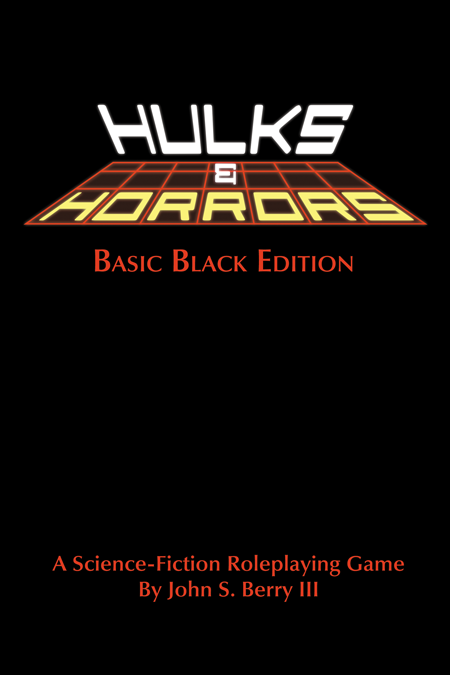
Tommy's Take on Hulks and Horrors - Basic Black Edition

Not every dungeon crawl has to take place in medieval fantasy ruins…Hulks & Horrors: Basic Black Edition takes the classic roleplaying structure and transplants it into a sci-fi setting.

WHAT YOU SHOULD KNOW: Hulks& Horrors: Basic Black Edition is a retroclone that takes D&D and places in space, with the PCs playing space travelers exploring the ruins left behind in the galaxy by a horrible Virus. Hulks & Horrors is available in PDF for $10 and print for $20 at RPGNow. This review is based off of the PDF version, which was provided to me for review purposes, and the affiliate link provided may provide this blog with a portion of all sales through it.

Hulks & Horrors keeps to simplistic layout reminiscent of early roleplaying books, which – I would imagine – is both cost effective and evocative.

You are probably familiar with character generation: Roll 3d6 six times, once each for Strength, Dexterity, Constitution, Intelligence, Wisdom and Charisma. From there, you pick a class. There are four Human classes (Pilot, Scientist, Soldier and Syker), as well as three alien classes (Hovering Squid, Omega Reticulan and Bearman). Interestingly, the last one is the only of the three that is human, as the Reticulans are amoeba and the squids are, well, squids.

The classes only go to level 6, and each class has a requirement. Pilots are built on Dexterity, and have a decent weapon and armor selection. They also get bonuses for using computers and attacking with ranged vehicle weapons, as well as getting to roll two 20 sided dice when making piloting maneuvers and taking the best of them. Scientists use a Multitool that allows them to perform extraordinary feats, and are Intelligence based. Soldiers use Strength and Dexterity and are the all purpose combat monsters, but get a bonus to stealth checks as well. Psykers use Wisdom and have Psychic abilities. Hovering Squids have a Dexterity requirement and a Strength *maximum*, can survive in water and have multiple arms that they can bring to bear on their opponents. Omega Reticulans are akin to Scientists, but with better weapon and armor options. Bearmen are a lot like Wookies...with psychic powers. Scary, huh? If you somehow don’t manage to qualify for any of the classes? You can be a Redshirt.

As mentioned, a couple of classes have Science! powers and a couple have Psychic powers. Science powers include Skin Graft (your basic healing power), Targeting Display (a bonus to hit), Smart Drone (think “moving landmine”), Create Nutrient Pill (so your whole party doesn’t starve while out exploring), Micro Wormhole (short range teleportation) and Neural Disruptor (which can KO opponents without harming them). Science uses Charges based on the level of the effect used.

Psychic Powers use a pool called Psi, and include abilities like Mind Trick (“These aren’t the droids you’re looking for”), Pyrokinetic Assault (“Burn!”), Levitation Leap and Mind Blank (which makes you invisible to organic foes).

Equipment runs the gamut of “basic” weapons like slug throwers and shivs, on up to laser swords and particle beams. Armor uses the descending armor class of older editions of D&D, and the various suits of armor serve to protect your PC from the environment as much as from damage. Other equipment includes shields, grenades, motion trackers, wrist computers…as well as synthetic rope, 10 ft. collapsible poles, backpacks and electric torches.

The basic mechanic is a d20 roll under stat check. Penalties are applied to the stat, not the roll. A Natural 20 is an automatic failure and a Natural 1 is an automatic success. Opposed checks go to the person that rolls the highest while still rolling under the relevant stat. Saving Throws are based on Dexterity, Constitution and Wisdom. Environmental effects like Temperature, Radiation and Gravity take on a larger role here than in the games Hulks & Horrors was based on. When leveling  up, at levels 3 and 6 you can increase a stat, gain more hit points, apply your new attack bonus and (if applicable) pick new Psychic or Science powers.

Combat is handled along the lines of pre-d20 D&D, complete with “To Attack Armor Class 0” (or TAACO) numbers and charts. Morale rules are also included.

Spaceships are important here, with Spaceships divided between Landers and Orbiters, with the smaller Landers able to enter the atmosphere, while Orbiters remain in space. The three methods of acquiring a ship are mortgaging one (which gives you more options, before is more expensive), buying used (cheaper than mortgaging, but you’re not always getting what you expect) and inheriting a ship (it’s yours, clean and clear…you just may not get what you want, and you may find the upkeep to be outside of your budget). Ships are defined by Hulls, Armor, Main Engines, Weapons, Thrusters and Additional Systems (waste recyclers, fighter bays, cloaking devices, Ground-Penetrating Radar, Sickbay, Gaming Room, Microbar, etc). If you buy new, just pick what you want and pay for it. With Used, you take the best of random rolls and with an inherited ship, you completely roll the ship randomly. A selection of sample ships is included. Ship to ship combat is included, but it seems like it would leave non-pilots on the outside looking in.

The chapter on space exploration wins points for a Hitchhiker’s Guide to the Galaxy reference (when traveling through subspace, things may go wrong…like making a sperm whale or bowl of petunias appear out of nowhere).

I’m a big fan of random charts, and there’s an extensive section that allows you to randomly generate star systems, on down to a planetary level…complete with what kind of civilization exists (or existed) there. A helpful worksheet is provided for this. Of course, once you have detailed the solar systems and the planets, you have to decide what kinds of structures are present to be explored, from Pod Colonies to Urban Ruins to Hulks, which are giant ships left floating in space. Random charts are provided to add “flavor” to the exploration, as well as loot tables. Random tables for the weapons can provide beneficial, and humorous, special abilities…from bonuses to damage against vertebrate life forms to built-in MP3 players. Extra special armor might have Cloaking Fields…or it might… “vibrate”. Some of the higher end items include The Meatpuppet (a suit of armor made from flesh) and The Axe – part guitar, part weapon.

The bestiary includes four random encounter charts, depending on the environment the PCs are exploring. Monsters include Blind Trolls (who are difficult to battle in melee, due to the cloud of diseased filth that surrounds them), Centipods (12 foot spider-centipedes), Gorilloids (purple apes with poisonous horns), Living Weapons (who are every bit as terrifying as they sound), Seeker Drones (dropped onto the planet to destroy anything that moves), Skinless (who will try to strangle you with their own intestines), Space Whales, Toxic Ooze and more.

The GMing chapter has a lot of common stuff in it, but it also reminds the reader that no room should ever be “empty”, even if there is no monster or loot (remember, you are exploring the dead remnants of intergalactic society…these places had reasons for existing). A little information is given on gearing the game towards a different type of space game over exploration, as well as alternate character generation rules and rules for extrapolating the character classes above and beyond level 6. There are also rules for converting from older editions of D&D (which is awesome, because I LOVE using monsters “out of genre”), as well as non-Psyker and Scientist players learning Science! and Psionic abilities as well.

WHAT WORKS: I love the random charts. I *always* love the random charts. The Redshirt option for characters that don’t qualify for a character class is great as well. I do like how the classes have been balanced for the game, instead of just doing a straight renaming of the D&D Classes. Some of the tongue in cheek effects for various pieces of loot are also great as well.

WHAT DOESN’T WORK: I’d prefer a d20 chart over a d12 chart every time. Less chance of repeating an option. The space combat rules seem like they would leave non-pilots in the cold…moreso than non-Pilots will be left out on the ground. Contested checks are just clunky (rolling higher than the opponent but under your stat).


CONCLUSION: I’m not a big fan of the older school D&Ds, and I think that’s where I wind up displeased with some of the mechanics here. That said, I actually like the premise of exploring space hulks and dead planets more than I do straight up dungeon crawls. The extensive use of random charts is always a plus, and I do like that there are multiple options for acquiring a ship. If you’re a fan of old school D&D and you want something more than a different coat of paint on it, then definitely check this out.

Sunday, June 2, 2013

Tommy's Take on Volant - Kingdoms of Air and Stone

Not really interested in yet *another* cookie cutter fantasy game? Well, clash bowley may just have a solution for that, with Volant: Kingdoms of Air and Stone.
Do flying cities and giant bird mounts interest you?

WHAT YOU SHOULD KNOW: Volant is available at RPGNow for $12.00. This review is of the PDF version, provided by the publisher for review purposes. Purchases made through the affiliate link I provided do provide this site with store credit at OneBookShelf.

That stuff out of the way, what IS Volant? Volant is a fantasy RPG set in a world after a magical catastrophe has sucked all the magic out of humanity and placed it into the stones, causing mountains to fly above the world. This is where the bulk of humanity now lives, traveling via giant birds and airships. Down on the blasted surface are the more primitive members of humanity, as well as the monsters moving across the surface. Magical effects as still possible, via Alchemy (as the opening fiction nearly explains in a nice and tidy piece).

Players of other games by clash will recognize a lot of what’s here on the structural level. For instance, the first thing you do is create the association your PCs belong to. They can be a religious sect, a group of assassins, treasure hunters, knights, military, mercenaries…whatever. Just as long as they belong to the same group, giving them a reason to share goals at the beginning of the game. The group has starting capital with which to purchase a headquarters, assets and so on, as is relevant to their association’s purpose.

Once the association is complete, then comes character generation. You pick a starting age, and the older you are, the more skills and experience you have…but as you get older, your attributes decrease. You have six attributes, assigned either an array of scores or determined by a pool of 45 points. PCs have a number of Template Points based off of their age to chart their professional development. The first two templates (Background and Apprenticeship) are free, the rest have point costs based on the benefits provided. You might have been a Street Rat who was taken in as an Apprentice Scholar. From there, they have become a budding Alchemist and so on. Each step gives skills and perks, based on your professional choices.
Several handy template tree charts are provided to guide one through the common career paths.

Characters are further defined by Traits, which are a mechanical definition of a character’s personality. If a trait is relevant to an action, you can use it to add points to your skill roll, while traits that would impact your action negatively can be used to gain points back. Edges are kind of like Traits, but not necessarily linked to personality.

Characters also gain Maneuvers, which are impressive tricks that they can utilize in gameplay, both in and out of combat. Shield Maneuvers let you stun the opponent with a quick shield strike. Sword maneuvers let you take small penalties on your attack roll, saving them up for one massive hit a few rounds later. Staff maneuvers allow you to do things like pole vault over the opponent for a free attack. Team maneuvers can let you apply “shock and awe” tactics to the opponent. You get the idea. While most of the maneuvers are combat-focused, there are a few social maneuvers as well. A lack of aerial-focused maneuvers seemed like an oversight, given the setting, though many of these maneuvers will be usable in the air as well as on the ground. I also couldn’t pin down whether or not a turn and a round are used interchangeably, but if not, then two of the pole fighting maneuvers have the issue of one being noticeably better than the other, for the same cost.

The StarCluster system has evolved in an interesting manner, as you can take the same basic stats and set-up, but choose your resolution mechanic from StarNova (the grittier option), StarZero (which produces more average results), StarPool (which has powered most of the StarCluster games I’ve reviewed) and StarWorm (which has more player negotiation, stake setting, that kind of thing). StarPool and StarWorm use d20 pools, while StarZero uses a d6-d6 (ala ICONS), and StarNova uses exploding d6s. With four different, varying, resolution mechanics, you have a lot of room to play around and find your comfort zone.
The equipment chapter has several tables for modifiers for weapon craftsmanship and materials which is neat…but doesn’t seem to have an impact other than cost. There is a section talking about station and how “clothes make the man”, so one can assume it also applies to weapons, but it does seem off to put that detail in there without any real follow-up.

The Alchemy section is simple but cool, with different ingredients giving you different Edges. This includes both plants (Cold Root giving you Ice and Cool Edges, or Lion Weed giving you Courage and Hope Edges) and Creatures (like Spider-Kin Venom giving Climb and Still Edges).

The Skylands creation chapter is similarly impressive, with lots of charts (with random roll distributions) to guide you in the creation of Skylands, from their government structure to the resources they produce and an optional set of charts to create a caste system if you choose.

Religion is also similarly defined by the GM. The game makes no assumptions regarding the number of deities or how they react to their followers.

Airships and birds are a big deal, each with their own creation section. My favorite of the two is the bird creation, as you can select their best senses, their reaction to aggression, their intelligence and so on. And, well, the idea of playing a guy riding around on a giant bird just sounds awesome to me.

With the Aerial Combat chapter, I think I can see why Aerial Maneuvers weren’t present earlier on, as there’s already a TON of options to keep track of, tactics-wise, when birds are fighting in the air. Generally, the riders are trying to get behind their opponents, and one need not necessarily kill their opponent or its mount, as birds face severe consequences from failing Vigor rolls in combat.

The chapter on the surface world follows the pattern of the rest of the book, giving you tools and options to create your surface world, rather than telling you just how it is. Wizard ruins on the surface often still have ambient energy that can warp and transform seeds or eggs, which some individuals will pay a pretty penny for.

There is no bestiary, per se, but there is another set of charts that one can use to construct their own.

The book does provide examples of character creation, monster creation, religion creation, nation creation, airship creation and so on. An aerial combat cheat sheet/picture guide and an index round out the book (although, oddly, the page numbers for the index are 1-6, despite being at the back of the book).

WHAT WORKS: I love the setting concept. I love the idea of playing an adventurer riding around on a giant bird. It’s just cool. I really appreciate all of the tools provided to make Volant your own, right down to the resolution mechanic used. All of the various examples at the back of the book are certainly appreciated, and the maneuvers are a cool feature to provide mechanical support for more versatile combat.

WHAT DOESN’T WORK: The extra cost tables on weapon creation just seem out of place because, unless I missed it, there is no real benefit to paying more for better quality weapons…so why would you? As much as I love tools and random charts, I do also like having ready-made material to work with, so I would have appreciated a larger bestiary.

CONCLUSION: This one “sings” to me more than clash’s other games do, because of the fantasy element over the alternate history element. That and it’s just overloaded with cool factor. Also, I can’t NOT love this many random charts in one book.  This is definitely not your average fantasy game. There’s no dwarves, elves, gnomes or halflings, or orcs, goblins and drow here. That said, if you’re wanting something you can just jump right into and run, that’s not going to work unless you’re adept at running with the random results. That’s not a knock on the game, just an observation. My favorite iteration of StarCluster yet.

Saturday, June 1, 2013

Tommy's Take on Stealer of Children

In theory, I review games. Haven’t had the time or opportunity to do that in a while. Let’s remedy that, shall we? Starting with the latest release from Small Niche Games: The Stealer of Children.
Yes, there's a REASON the dead guy is in a tree.

WHAT YOU SHOULD KNOW: This is another Labyrinth Lord adventure from Small Niche Games, set in the Chronicles of Amherth setting. The PDF is $4.95 and is 31 pages long, and you can order a POD softcover for $7.95. The assumed number of heroes is 3-6, of first level.

Now, I’ve made no bones about the fact that I’m not a big Labyrinth Lord fan, but I sure do like Small Niche adventures, which have all had a quasi-Ravenloft-ish feel to them, which I DO like.

Set in Leandras Row, The Stealer of Children is a fairly open ended adventure. The PCs are assumed to have come to Leandras Row for their own reasons, when they find a farmer being attacked by an undead warrior. This should set the group on edge, but despite their investigations, they won’t be able to do tooooo much…yet.

Soon, a child turns up missing (hopefully just one), and the group is the only realistic hope of calming the townspeople. If the group decides not to get involved, the kidnappings continue…and if the group still doesn’t get involved, the townsfolk begin to suspect that they may be involved, due to the timing of events. While this doesn’t have any IMMEDIATE ramifications, it will haunt the group going forward.

The investigations have a couple of places they can go, a ruined manor and a stretch of woods. The woods are FILLED with encounters that are short enough, but weird enough, to raise the interest of the group, and they can be spun off into their own adventures after the fact. (Unicorn hunting, anyone?)

Though the adventure is meant for level 1 characters, there are tips for scaling it up for larger characters. I don’t recommend using those guidelines, because more capable parties will be able to handle the adversary of the module without the adventure’s macguffin, which in turn takes away from the uniquely awesome finale of the adventure.

WHAT WORKS: A nice change of pace for a level 1 adventure, with one of the coolest workarounds for a level 1 party having to deal with an enemy that’s immune to non-magical weapons. The encounters in the Tanglewood outside of town are cool and potentially awe-inspiring for a level 1 party.

WHAT DOESN’T WORK: Nothing that can’t be fixed with a conversion to Savage Worlds or the AGE system, something other than a D&D derivative (purely subjective, of course.) Oh, the color selection for the cover is just downright ugly. I would have picked something, anything, other than pink, I think. And maybe an art piece that fit the theme more closely (though the art is directly linked to the adventure).


CONCLUSION: Another great adventure with a unique adversary. If I were to nitpick anything about the SNG adventures, it would maybe be the production values, but remember that this is coming from a guy who’s looking at the material from outside the OSR fanbase. The art and layout perfectly matches the aesthetic they are aiming for. For the material itself, I have no real complaints, as the adventures have been unique and interesting, with conversion work being no real problem. Stealer of Children continues to fit that pattern, providing low-level fantasy adventure with a weird/horror twist.  

Sunday, May 19, 2013

Savage Midnight: The Crown of Shadow Actual Play Volume 3


Volume 1
Volume 2

WARNING!

MAJOR SPOILERS FOR CROWN OF SHADOW BELOW!

The game picked up immediately where it had left off, with the group standing in the sewers with a black-eyed elf who introduced himself as Jael. Thorin asked if Jael was "they guy we needed to give the scroll case to", but Jael seemed confused by that and said he was their escort to Caradul.

Thorin, Merwan, Wendell, Wallace, Fergus and Jael departed from the site of Baden's Bluff, with Jael asking Thorin about their mission and their travels, but getting stone walled by the dwarf. Jael changed the subject and told the group that he would guide them through the western plains and into Erethor, so long as they followed his trail.

On the second night of camp, Merwan went searching for fresh game, while Jael commented that he needed to "commune with his monarch". Wallace and Thorin had a long chat, with Wallace explaining that he is from the shattered Dorn house of Dale, explaining that his family motto was "Against the Shadow". He told Thorin that he has no idea what Thorin's quest is, but that he is the last of his house, his family destroyed by The Shadow...but he will help Thorin cut a swath across the land as long as he is working against the forces of Izrador. Thorin explained that he is the last of his clan as well, as is Wendell. Fergus said he has no tribe, and Thorin said "maybe you do now". Thorin spotted Wallace looking for big rocks that he was stuffing in a sack tied to his belt. Thorin asked Wallace what they were for, and Wallace said "crushing men's heads." Wallace told Thorin that someday, he knows the forces of The Shadow will bring him down, but not before the fields are soaked with blood and bodies are stacked high. But he said that, before he goes, legend tells that one of Izrador's favored is a dragon...and Wallace dearly wants to rip that dragon's head from its shoulders. This led into an odd tangent between Wallace and Thorin, in which Thorin said he couldn't fly, but Wallace patted him on the shoulder and said, earnestly, "I believe you can."

When Merwan returned with rabbits, he mentioned that the game seemed spooked, and Jael arrived then, stating that it was the presence of the orcs, and that they needed to be careful. He said that warbands were amassed in the area. Wallace asked if they were going to go THROUGH the warbands, and scoffed when he was told "no". Thorin noted that sometimes, you need to avoid a smaller battle in order to win the war, showing lessons that he had learned thus far in the quest.

The group's travels led them closer to the forests, and Jael showed an amazing knack for guiding the group past the orcs. As the group spotted what looked like a whole army amassed near the forests, Thorin asked why the forces were amassed so strongly against the elves. Jael laughed coldly, saying that the dwarves are locked away in their mountains, every human of consequence has joined Izrador, the gnomes are busy playing their games on the river and no one gives halflings a real thought. In short, the elves are the only true resistance to the Shadow left, and once they are gone, the war ends. Merwan and Wallace told Jael that maybe he shouldn't count their respective people out just yet.

Exploring the forests, they came across what appeared to be a snowy valley...except for the small of ash that choked them. This massive valley inside the forest was a stretch of land that had been utterly burnt out. When the group tried to figure out what could have caused such complete devastation, Wallace - his eyes wide - simply said "Dragon." As the group tried to cross the valley, their eyes burned and they tasted ash, so Merwan shredded his clock, giving them all facial coverings. The only signs of anything resembling life they encountered was halfway through the valley, where they encountered a burnt out village. Thorin was immediately nervous regarding the possibility of the dead rising, but the devastation looked too complete.

As the group entered the deeper forests, Jael said that they needed to double up on their watches, to ensure that nothing was missed...and one night later, the group was awoken by a panicked Wendell Gale, who said that Jael had vanished in battle with a demon that sounded a lot like the demons that were possessing Tuk's hunting dogs. The group investigated, and saw only scorch marks on the ground. They were now lost without their elven guide.

The next day, they stumbled across a battlefield of orcs and elves, all of them missing heads, but the elves missing limbs here and there as well. Upon closer examination, Merwan swore under his breath and told Thorin that some of the deceased had gotten up and walked away...after laying for days. The orcs stumbled to the southeast...but the elves headed west...where the group was heading. Thorin suggested that they track the elves, thinking they might take the group to Caradul after all.

It didn't take long for the group to be staring down an armed elf with open wounds, who told the group that they were surrounded and being taken captive to Caradul. Wendell tried to parlay with them, but it did not work. As tensions grew too think, Merwan snapped off an arrow that staggered the elf. Arrows flew from all directions, with Wallace crushing one from a distance with a hurled rock and Wendell fired a bolt that took another. Merwan shrugged off an arrow and took his elf with a second shot, while Wendell took out the last archer. On closer examination, the elves wounds looked to be at least days old, filling the group with some satisfaction that maybe these elves were already dead.

Early the next day, the group heard fighting and animal howls. When Fergus went to investigate, he saw two dead dire wolves, perforated with elven arrows and magical scorch marks.

As they traveled on, Wendell staggered and suddenly acted confused and ill. The group saw a structure overhead, an elven outpost, and Merwan took Wendell up to rest...when the vines they climbed on retracted and it suddenly got very dark. Merwan moved to the edge of the platform and began to yell down at the group when he was stabbed from behind! For a moment, Thorin saw Wendell Gale holding a longsword, but  then he transformed into a tall, lean Sarcosan! As Merwan staggered back to the platform, the man with the sword hooked it under the scroll case's strap. Thorin began to scream at him, when Wallace grabbed him and said "I believe you can fly."

Thorin stared at Wallace for a moment and then nodded, and the giant of a man hurled Thorin up onto the platform with an amazing feat of strength. As Thorin hurtled through the air, he swung with a hatchet and drove it clean through the assailant's chest, whose last image of life was a flying dwarf, screaming through the air. (Thorin's player rolled a whopping 70 damage on the attack and I made the token effort to make two Soak rolls, but failed.)

On the ground, three massive dire bears approached Fergus and Wallace, so Thorin and Merwan made haste back to the forest floor...and then elves joined the dire bears. Merwan was prepared to strike, when a black eyed elf stepped forward, smiling, and waved off the bears and the elves. He announced himself as Dehan, and said that the elves had been expecting the group. Then he sadly offered his condolences, as the elves recovered the body of Wendell Gale a few days ago. Dehan referred to the attacker as "Jael", which raised questions from Merwan. Dehan informed them that Jael was a Legate that took the form of an elf in order to trick the group, before manufacturing his own disappearance, killing Wendell and replacing him.

The elves took the group to Caradul, to the heart of the ancient city, to the Arbor of the Witch Queen. The elves buzzed with excitement at the new arrivals, and when the group encountered the Queen herself, she greeted the weary travelers and asked them if they had something for her. Merwan handed her the Dragon Case and the uttered some words, animating the dragon, who removed the scrolls from inside it. She asked the group if they knew what they had brought, and when they said "no", she replied "The most ancient of dwarven secrets: The secret of forging mithral." Thorin was left speechless.

She brought the group each a perfectly fitted cloak, marking them as members of the Order of the Lady, the highest honor bestowed on outlanders. She also offered each a token of her own devising, and Dehan led them to a suite, telling them to rest, to heal, to mourn, and that they were free to stay as long as the like...forever, if they chose.

At their suite, Wallace said "I ain't stayin' here." Thorin said "Of course not. We have a dragon to slay." Merwan said "If nothing is done, war will eventually reach this ancient place. I shall die, if necessary, to prevent that." Fergus simply said "This is my tribe. I will go where they go."

Notes: The final battle with Jael was meant to be a bigger deal, but Thorin's player had a Teamwork Adventure Card that worked beautifully in getting him to the platform (giving Wallace a bonus on the throw and him a bonus on the attack), and then the damage just absolutely exploded, taking Jael out in one hit. The stage is set for the next phase in the campaign, and we do intend to come back to it, as we are loving the mix of Savage Worlds and Midnight. Not sure exactly what direction it'll take...but I'm pretty sure a dragon will be involved.